
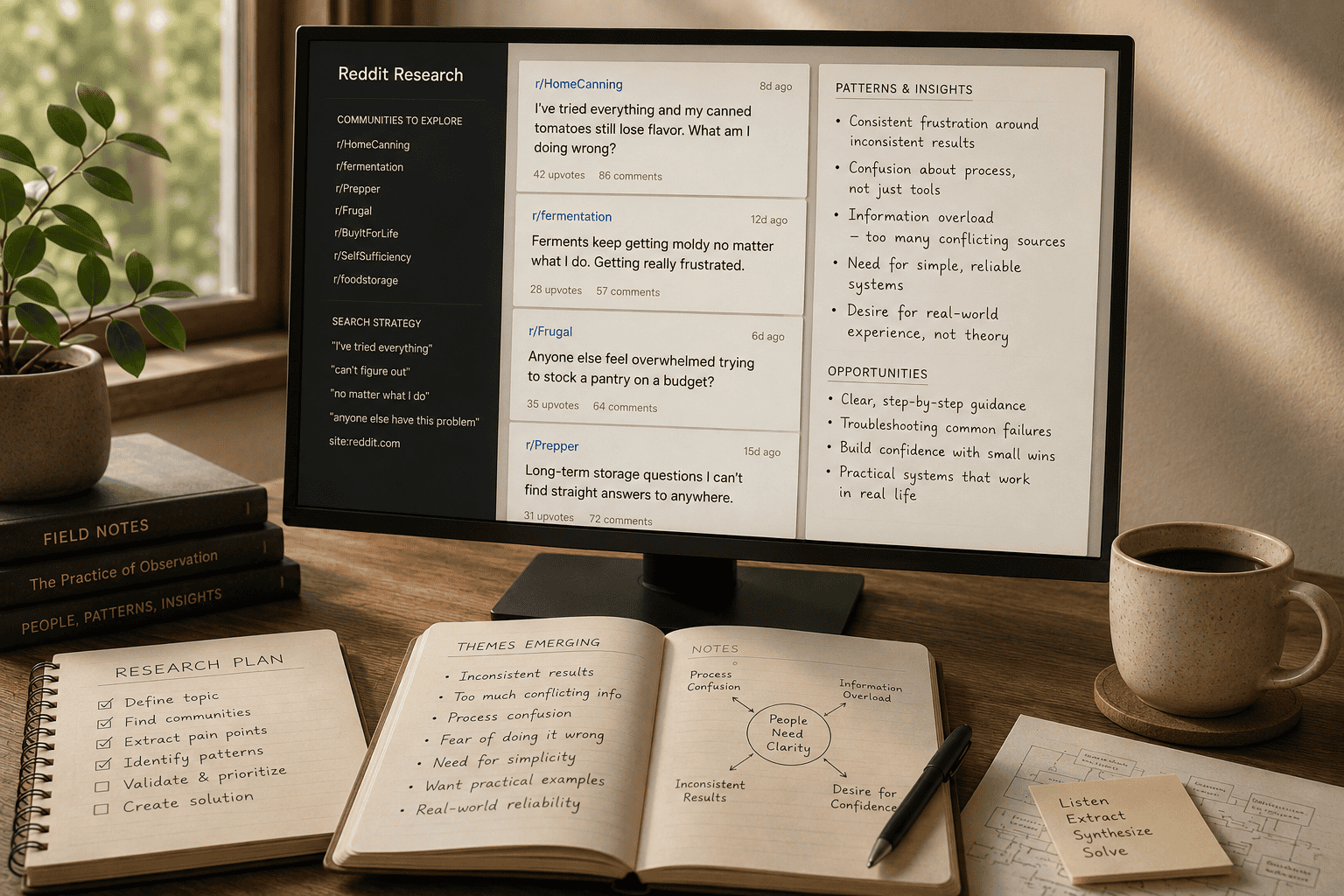
What serious authors actually do with Reddit — and the tools that make it systematic
The Reputation Problem
Reddit marketing has earned its bad reputation — and the advice that created that reputation circulates openly, in courses and guides aimed at people who want traffic without the work of genuinely earning it.
There are actually two distinct schools of thought here. The first is legitimate: spend weeks or months genuinely participating in relevant communities, build real karma, follow each subreddit’s rules, disclose your affiliations, and only share links where they’re permitted and contextually appropriate. Some subreddits — r/Deals, r/Frugal, r/BuyItForLife — actually have designated threads for exactly this. It works. It also requires months of consistent community participation before it produces meaningful results, and that’s not what most people selling “Reddit marketing” courses are actually teaching.
The second school is what gives the first one a bad name. Post helpful-sounding comments, build just enough credibility to avoid suspicion, then slip in a link to your product or affiliate offer — casually enough that it doesn’t read as marketing. Some of this advice goes further: link cloakers to disguise affiliate URLs, Medium articles as a pass-through to fool moderators, and in the more candid corners of the internet, purchased aged accounts with established karma specifically built for this purpose. The goal throughout is to avoid triggering Reddit’s well-documented hostility toward anything that looks promotional. Reddit users will tolerate a paid advertisement in their feed before they’ll forgive someone trying to look like a regular member while quietly monetizing the community’s trust.
Both approaches — the patient long game and the evasion playbook — are not what this page is about.
What follows is something different: a methodology for using Reddit as a research instrument rather than a distribution channel. No links dropped into threads. No performing authenticity. No months of karma farming before you’re allowed to mention what you sell. Just a systematic way to understand what people are actually struggling with, in their own words, before you write a single page.
This article is written for authors who want to make a serious, systematic effort — not for those looking for a shortcut. Along the way it covers some important matters you may not encounter in more casual, rah-rah venues. That’s intentional. The goal is to give you a complete picture, not an exciting one.
What Reddit Actually Is (for a Serious Author)
Reddit is not a marketing channel. It is something considerably more useful: an unfiltered, self-organizing emotional record of human frustration, confusion, and unmet need.
People go to Reddit when they’ve run out of better options. They’ve searched, they’ve tried the top results, and nothing has quite solved their problem — or solved it in a way that works for their specific situation. So they post. And in that post, they describe what’s wrong in the plainest language they have, without PR polish, without the vocabulary of someone who already knows the answer, and without the self-consciousness of talking to an expert.
That’s the opportunity. Not “find unsolved problems and write ebooks about them” — that framing is too crude and has already produced an enormous amount of forgettable content. The more precise version: Reddit surfaces problems that haven’t been solved in a way that satisfies the people experiencing them specifically. Their problems may be addressed in existing books, courses, and guides. Those resources might even be decent. But something about how they’re framed, at what level they pitch their explanation, or what they assume the reader already knows — something is leaving people still frustrated enough to post on Reddit asking for help. That gap — between what’s already published and what readers still need — is where well-researched books find their readers.
A Word About Ebooks Before We Go Further
If you’ve spent any time in self-publishing circles, you’ve probably encountered some version of this advice: pick a popular topic, write an ebook, publish it to Gumroad or Amazon, and let the passive income roll in. The self-help market is huge, the thinking goes. There’s room for everyone.
There isn’t.
A creator who tracked over 200,000 digital products on Gumroad recently published what he found. Of 12,000+ self-help products on the platform, only 12% have ever generated any revenue. DIY printables: 11%. Writing and publishing: 13%. Parenting — one of the most frequently recommended niches — sits at 8%. These aren’t niches that don’t work because the topics are bad. They’re graveyards because the products are indistinguishable from each other. There’s nothing to separate your mindset ebook from the thousands of others competing for the same search terms.
The niches that actually work tell a consistent story: 3D design (43% of products making money), gaming (32%), software and tech (26%), productivity systems like Notion templates (25%). The pattern, as the researcher put it plainly: people buy tools, not advice. You can Google “how to be more productive” and get ten million free results. You can’t Google a Blender asset pack or a custom trading indicator.
What does this mean for ebooks? They remain viable — but only when they function more like tools than essays. A book that addresses a specific, documented pain point, priced in the $30–$49 range where Gumroad data shows the highest success rates, structured around real solutions rather than general wisdom, competes in a different category than the commodity ebook. It’s closer to a toolkit than a meditation. And if it includes a practical component — a template, a Claude skill file, a prompt pack, a checklist — it moves further into tool territory and further away from the graveyard.
One more thing worth noting: if the pain point your research surfaces is frustration with a specific tool, you’re looking at a premium opportunity. People stuck inside a workflow they can’t fix are pre-qualified, motivated buyers. They’re not casually curious. They’re already invested in the ecosystem and actively looking for a fix. A $39 guide that solves a specific, documented problem with a tool they’re already using competes with almost nothing.
This is what Reddit research, done systematically, makes possible. Not “find a popular topic.” Find the specific frustration, confirm that people are spending money to solve it, and build something that actually solves it.
Finding the Right Pain Points: A Marketer-First Approach
The home canning example you’ll encounter later in this page illustrates the mechanics of the Claude subreddit prompt. But it doesn’t illustrate the intent of the methodology — and the intent matters.
The model we’re describing isn’t “write about something you love and hope someone wants it.” It’s closer to this: you’re a marketing technician first and an author second. Given any topic, you can research it deeply enough to produce a focused, useful guide for someone in genuine distress. The topic follows the pain, not the other way around. And the pain worth following is urgent — the kind that sends people searching at midnight rather than asking a friend.
Here’s how to start that process with Claude:
Prompt 1 — Identifying Urgent Markets:
I’m a marketer and independent author looking to identify pain points urgent enough that people will pay for a solution rather than wait to find one for free. I’m looking for problems that are embarrassing, physically uncomfortable, financially threatening, or emotionally distressing — the kind where someone searches at midnight rather than asking a friend. Give me 10–15 niches or specific problems across health, money, relationships, and practical life situations. For each one, tell me briefly why it qualifies as urgent.
A prompt like this surfaces niches with genuine buyer motivation: chronic physical conditions people are too embarrassed to discuss openly — nail fungus, excessive sweating, adult acne — alongside financial emergencies like car repossession, wage garnishment, and eviction, and relationship situations carrying real emotional weight such as recovering from infidelity or recognizing a narcissistic partner. What these have in common is that the person experiencing them isn’t casually curious. They’re motivated, they’re searching privately, and if a credible solution lands in front of them at the right moment, they’ll pay.
Prompt 2 — Drilling Into a Specific Community:
I want to research [specific problem] on Reddit. Find me the subreddits where people are actively expressing frustration, shame, fear, or desperation about this issue — not just asking informational questions, but showing real emotional distress. Which communities would have the highest concentration of that kind of raw, unfiltered language, and why?
This is where the methodology gets specific. Rather than browsing broadly, you arrive at Reddit already knowing which communities are worth your time — and why. That focused entry is what makes PainOnSocial, described in the tool stack section below, significantly more effective than casting wide.
Important Note: Platform Rules, Disclaimers, and the Responsibility That Comes With Urgency
The urgency that makes a topic commercially promising is the same urgency that demands care in how you handle it. A few things every author using this methodology needs to understand before publishing:
Platform rules are worth reading carefully — and the reality is more nuanced than it first appears. Gumroad’s written policy prohibits medical products and credit repair content, but that’s narrower than it sounds. Health and wellness content exists openly on the platform — practitioner guides, trackers, workbooks, self-help frameworks — because the prohibition targets clinical medical claims and treatment products, not information products framed appropriately. The practical line is this: content that educates, informs, or organizes is generally fine; content that claims to diagnose, treat, or cure is where trouble starts.
Even if you see content already listed that’s similar to what you’d like to publish, if you’re in a sensitive niche, it’s wise to read Gumroad’s current prohibited content list — and check it again before you launch, because it can change. Their full Terms of Service are worth a read as well.
Disclaimers are not optional formalities. The FTC takes health and financial content seriously, and the standard practice — and the right one — is to include a clear disclaimer prominently at the front of any guide touching health, finances, or legal matters: this content is for informational purposes only, is not a substitute for professional medical, financial, or legal advice, and the author is a researcher and writer, not a credentialed provider of care. Frame as information. Avoid clinical language. Lead with the disclaimer rather than burying it. That’s not a hedge — it’s the honest description of what you’re offering, and it’s what separates a legitimate information product from something that misleads a vulnerable reader about what they’re getting.
You don’t simply drop a topic into an AI, publish the output, and call it a book. AI-assisted research and drafting is a starting point. The author’s job is to review the content critically, verify claims that matter, add genuine perspective, and ensure that what they’re publishing would actually help the person who buys it. A book that finds its buyer through good research but fails to help them is a refund and a bad review at best. At worst, it’s harm delivered efficiently.
Gumroad may look like a carnival from the outside. It isn’t — or at least, it doesn’t have to be. The same marketplace that hosts a lot of throwaway content also hosts serious creators building real businesses on quality and specificity. The methodology described on this page is designed to put you in the second category.
The Methodology Distinction: From Browsing to Research Instrument
There’s a difference between scrolling Reddit for ideas and using Reddit as a systematic research tool. The difference is extraction at scale — and it starts before you open any specialized tool.
The manual path exists, and it works.
Google’s site operator lets you search Reddit directly. A query like:
site:reddit.com “I’ve tried everything” “can’t figure out” home canning
…will surface threads where people are expressing genuine frustration in a specific domain. You can refine it: add subreddit names, swap in different emotional language, narrow by time. It’s free, it requires no accounts, and a disciplined researcher can pull useful signal from it.
It’s also slow, fragmented, and cumulative in the worst way. You’re doing this one query, one thread, one browser tab at a time. Each result requires judgment: Is this person representative of a real pattern, or are they an outlier? You’re building a mosaic by hand, piece by piece, without any way to know how complete the picture is. And you haven’t written anything yet.
For a project or two, if you have the time and tolerance for that kind of work, the manual path is legitimate. Most people working seriously on publishing projects don’t have either.
The systematic path starts with Claude.
Before any specialized tool enters the picture, the first question is: where is this conversation happening? Reddit has thousands of active communities. The frustration you’re researching might be concentrated in one obvious subreddit — or it might be scattered across several you’d never think to check, embedded in communities organized around adjacent topics.
Claude can accelerate that discovery significantly. Here’s what a prompt and response might look like:
Prompt: I’m researching frustration and confusion around home food preservation — specifically canning, fermenting, and long-term food storage. I want to find Reddit communities where people are actively discussing problems, failures, and unanswered questions in this area. Which subreddits would be worth examining, and why?
Claude’s response: The most concentrated signal is likely in r/Canning and r/fermentation, where questions about safety, process failures, and equipment are common. But you’ll find equally useful frustration in less obvious places: r/preppers and r/homesteading both have active food preservation threads where people are working through real problems without formal training. r/AskCulinary surfaces process questions from people who’ve already tried the standard advice and found it incomplete. r/foodsafety tends toward anxiety-driven posts — useful for understanding what people fear getting wrong, which is distinct from what they’re actually getting wrong. I’d start with r/Canning and r/homesteading for volume, then r/foodsafety for the emotional register of the concern.
That output — a short list of communities with brief reasoning for each — takes about thirty seconds to generate. It would take considerably longer to arrive at the same list through browsing, and you might still miss r/AskCulinary.
Now you know where to look. That’s when the specialized tools earn their place.
The Tool Stack
Most of the material I encountered about mining Reddit for topics to sell ebooks about on Gumroad advised the manual method above (or sometimes the advice wasn’t even that complete. To be honest, I’m not sure I’d have the patience to go Reddit mining and then go poke around Gumroad to confirm demand and sales.
While investigating a ran across tools that make the process easier; a couple are mentioned below. The PainOnSocial link is an affiliate link, by the way; if you sign up for PainOnSocial from this page, I may earn a small commission at no additional cost to you.
A note on the investment question before we go further. Tools cost money. If that’s an obstacle right now, the manual path described above is a legitimate starting point — it will tell you whether a pain point is real, even if it can’t tell you whether people are spending money to solve it. But if you’re serious about building a publishing business rather than taking a fling at it, the tools described below pay for themselves quickly when they prevent you from spending weeks writing something nobody will buy. That’s the honest case for them.
Emotional Intelligence Layer: PainOnSocial
PainOnSocial was built specifically for the kind of extraction this methodology requires. Once you’ve identified the relevant subreddits using Claude, you bring that list here. The tool surfaces how people are actually expressing their frustration — the specific phrases, the emotional register, the vocabulary of someone who doesn’t yet have the answer.
This matters more than it might sound. The language people use when they’re stuck is not the language experts use when they explain solutions. If your book opens with the reader’s own words — not a paraphrased version of their problem, but the actual phrasing they’d use to describe it — you’ve already established that you understand what they’re going through. That’s a different kind of connection than most books make on page one.
PainOnSocial offers a free trial, then moves to monthly plans — as of this writing, $19/mo. for a solopreneur starter plan or $49/mo. for an agency plan. The $49 plan includes what they call a “Pain Universe” — a browsable archive of scans other users have run in the preceding month. That’s an interesting feature, though the vast majority of topics covered will likely be outside your area of focus. What works better is going in with a clear idea of the pain points you’re researching and the specific subreddits Claude identified as worth examining. That targeted approach is where PainOnSocial earns its place — and it’s exactly why starting with Claude matters.
Market Validation Layer: InfoProdSpy
Research tells you what people need. Validation tells you what they’re already buying. These are different questions, and both matter.
InfoProdSpy surfaces what’s actually selling in information product markets — revenue estimates, 30-day sales velocity, category trends. Before you invest serious time in writing anything, it’s worth knowing whether the audience you’ve identified through Reddit research is an audience that buys, and whether that category is growing or fading. My research indicates that authors who treat this step as optional tend to discover they skipped it at an inconvenient moment — usually after the manuscript is finished.
One thing worth knowing before you sign up: they free access, and you can work with enough info to decide whether the tool’s a good fit. Just be aware that it’s not a full-power test drive. Check their site for current pricing and plan options.
What You Do With What You Find
At the end of this research process, you have several things that most authors don’t have before they start writing:
Emotional language — the exact phrases your future readers use when they’re stuck. These belong in your introduction, your chapter openings, and your marketing copy. Not paraphrased. Quoted (in spirit, if not literally). The reader who sees their own frustration reflected back at them in familiar language knows immediately that this book was written for them.
A question map — an organized picture of what people in this subject area are trying to understand, at what level of knowledge they’re starting from, and what the common points of confusion are. This becomes your chapter structure, your subheading architecture, and your answer to the question every author should ask before writing: what does my reader need to know, and in what order?
Validated demand — evidence that people in this space are spending money on information products. You’re not guessing. You’re writing to a market that has already demonstrated it will buy.
This isn’t a guarantee. Books still fail for reasons that research can’t fully anticipate. But the gap between authors who do this work and authors who don’t shows up consistently in the numbers. My research indicates that the most successful indie authors approach their market the way a scientist approaches data — systematically, before conclusions are drawn. The 75% of self-published authors who earn under $1,000 a year are not, as a group, less talented than the ones doing well. They’re less methodical.
The Research Doesn’t Care What You Build With It
Reddit research is format-agnostic. A book is one answer to what you find. A checklist, a workbook, a course, a prompt pack, a custom GPT, a membership community — these are other answers. Some of the most useful things you could build from solid Reddit research aren’t books at all.
Etsy buyers shop actively for printables and workbooks. Whop communities pay for tools and systems. Gumroad and Payhip make it straightforward to sell a single well-researched guide without building an entire publishing infrastructure around it. Google Play Books puts your content in front of Android users worldwide. The format that best serves your audience may not be the one that standard publishing advice points you toward — and you’re no longer limited to the formats that traditional publishing infrastructure was built to handle.
The advantage you have now is the ability to put your research into whatever form best serves the people who need it, and offer it wherever they happen to be. The methodology is the asset. What you build with it is a separate creative decision.
Where to Go From Here
Option 1: The manual path.
Use the Google site operator approach described above. It’s free, it works, and if you have the time and patience for it, there’s no reason not to start there. Go in knowing that it’s slow by nature and that you will miss things a tool would catch — but it will tell you whether the pain is real, which is a legitimate first step.
Option 2: The tool-assisted path.
Use Claude to identify your subreddits, PainOnSocial to extract emotional language from those communities, and InfoProdSpy to validate that the audience you’ve found is one that buys. This is the methodology described on this page, assembled into a working sequence. Everything you need to research intelligently before you build anything.
The research is the work that most people skip. It’s also the work that separates the authors still publishing three years from now from the ones who put out one book, wondered why it didn’t find readers, and quietly moved on.
If this is the kind of thinking you’re looking for, there’s more of it here. I publish when I have something worth saying — and some of it stays list-only.
Some links on this page are affiliate links. If you purchase a product via those links, I may earn a small commission at no additional cost to you.