

The self‑publishing revolution has made it possible for almost anyone to become an author.
Through Amazon’s Kindle Direct Publishing (KDP) platform, writers can upload a book and make it available to millions of readers around the world. In theory, the barriers to entry have never been lower.
But many new authors hit a reality bump: they publish a book… and it barely sells.
When that happens, they often assume the problem must be the writing, the cover design, or the topic.
In many cases, the real issue is something else altogether.
Discoverability.
Amazon’s not just a bookstore. It functions as a massive search engine. If your book doesn’t show up in the search results readers see, it effectively becomes invisible—no matter how good it is.
Why Discoverability Matters on Amazon
Studies of online shopping behavior consistently show that most buyers rarely move beyond the first page of search results.
On Amazon, a large portion of purchases come from the very first listings displayed.
For self‑published authors, this creates a simple but powerful truth:
If readers can’t find your book, they can’t buy it.
And whether your book appears in search results depends heavily on one thing:
Keywords.
Understanding the Amazon A10 Algorithm
Amazon’s ranking system—often called the A10 algorithm—determines which books appear when shoppers search the platform.
For KDP authors, the algorithm evaluates several aspects of a book listing, including:
• Keywords used in the title
• Keywords in the book description
• Backend keyword fields in KDP
• Category placement
• Sales performance
• Relevance to the shopper’s search query
When your metadata closely matches what readers are searching for, Amazon is way more likely to show your book to potential buyers.
In simple terms, keywords act as the bridge between a reader’s search and your book.
Example:
Reader searches: “mindfulness coloring book for anxiety”
If your listing contains those terms, Amazon has a clear signal that your book is relevant to the search.
The Biggest Keyword Mistake New KDP Authors Make
Many authors treat keywords as an afterthought.
After spending weeks (even months!) writing a book, they quickly fill in the keyword fields with broad terms such as:
• journal
• self‑help
• fiction
• notebook
The problem is that these terms are extremely competitive.
Trying to rank for a word like “journal” on Amazon is similar to opening a small shop in the middle of a big metropolis and hoping customers find it among thousands of competitors.
A much smarter strategy is to target buyer‑intent keywords.
These are phrases that signal someone is actively searching for a specific type of book.
Examples of Buyer‑Intent Keywords
Examples include:
• gratitude journal for teens
• keto cookbook for beginners
• yoga for seniors with limited mobility
These longer phrases are known as long‑tail keywords.
They often convert better because they match exactly what the buyer is looking for.
A Simple Free Keyword Research Method
Before investing in any paid tools or courses, you can start with a surprisingly powerful technique called the Alphabet Soup Method.
Here’s how it works:
1. Go to Amazon.com
2. Select Books or Kindle Store
3. Type a topic into the search bar
4. Add letters of the alphabet after the phrase
For example:
weight loss for a
weight loss for b
weight loss for c
Amazon’s autocomplete suggestions reveal real searches that customers frequently perform.
By working through the alphabet, you can quickly build a list of keyword ideas based directly on Amazon’s own search data.
Another Hidden Keyword Goldmine
Experienced publishers often analyze the negative reviews of competing books.
Specifically, they focus on two‑star and three‑star reviews.
Readers frequently reveal what they were hoping to find but didn’t.
You might see comments like:
“I was looking for X, but this book mostly covered Y.”
That missing element—“X”—can reveal a gap in the market.
If multiple readers mention the same missing feature, it could represent an excellent keyword opportunity for a new book.
How to Leverage a Structured Keyword System
Manual keyword research can work well, but it can also be time‑consuming and inconsistent.
For that reason, many KDP publishers eventually look for structured systems that guide the research process step by step.
Amy Harrop, a well‑known instructor in the self‑publishing space, created a training program designed to help authors identify buyer‑intent keywords, uncover niche opportunities, and validate book ideas before writing.
Introducing: KDP Keyword Gold Rush.
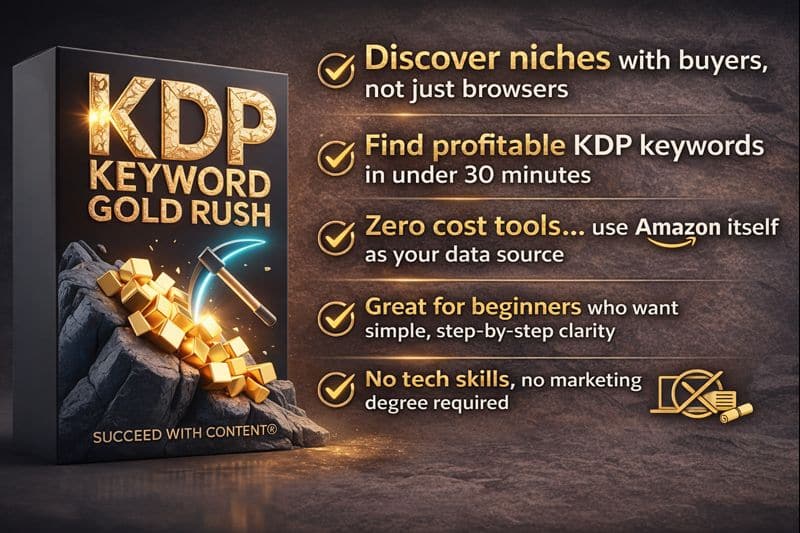
With so many “easy publish” tools flooding the market these days, it’s refreshing to have a course like this one teaching authors foundational book marketing savvy.
Every product I’ve bought from Amy has been worth way more than I paid, and this one’s no exception. Same with the companion products.
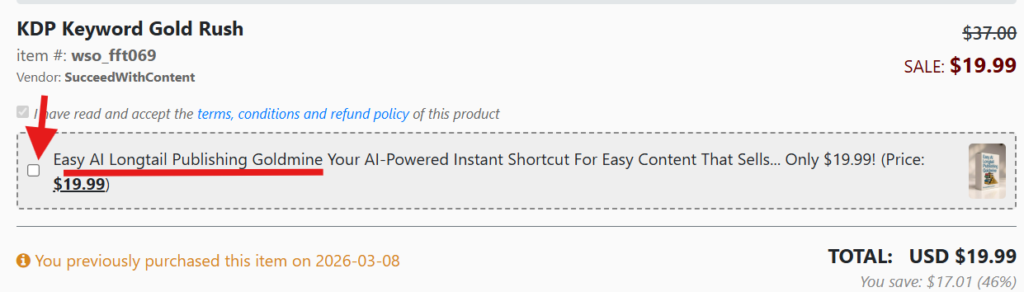
You’ll notice an “order bump” when you go to check out. This is a chance to include Amy course + custom GPT’s, called Easy AI Longtail Publishing Goldmine. Where KDP Gold Rush guides you on keywords to use for ensuring your books visibility, Easy AI Longtail Publishing Goldmine lets you use longtail keyword research to identify topics to write about and how to produce related books in a series. You’ll see it offered right below the terms and conditions line, and it’s the perfect complementary product.
On the next page, you’ll see and upgrade to KDP Keyword Goldmine. It’s KDP Gold Rush QuickStart. In it, Amy teaches category mastery to ensure we know how to get our books on the right “shelf.” Buyers often know exactly what they’re after, and from their previous purchases, Amazon knows, too. And those previous purchases, in specific categories–that’s what the algorithm will highlight for them.
KDP Genre Mastery is the second upgrade, and there we learn that keywords and categories can get our books in front of readers’ eyeballs, but the cover’s got to be right for the genre! Here’s an image Amy used to illustrate the point (worth a thousand of my words):

Yep, you got it. If you fail to join the visual crowd appropriate for your audience, you’ll leave picky readers unsure whether your story is what they expected from your carefully chosen keywords and categories! And you can inert the word “guide” instead of “story,” because this is important for nonfiction authors, too.
Get Amy’s training here, and give yourself and edge!
Key Takeaways for KDP Authors
If you remember only a few principles about Amazon publishing, make them these:
1. Discoverability matters just as much as writing quality.
2. Buyer‑intent keywords outperform broad keywords.
3. Validate your niche before writing the book.
4. Use Amazon’s own search data whenever possible.
Publishing Mindset Matters
Successful self‑publishing rarely happens by accident.
Behind many high‑performing KDP titles is a deliberate strategy involving keyword research, niche validation, and optimized metadata.
When you understand how Amazon’s search system works—and how readers actually discover books—you dramatically increase the chances that your book appears where it matters most:
on the first page of search results.