
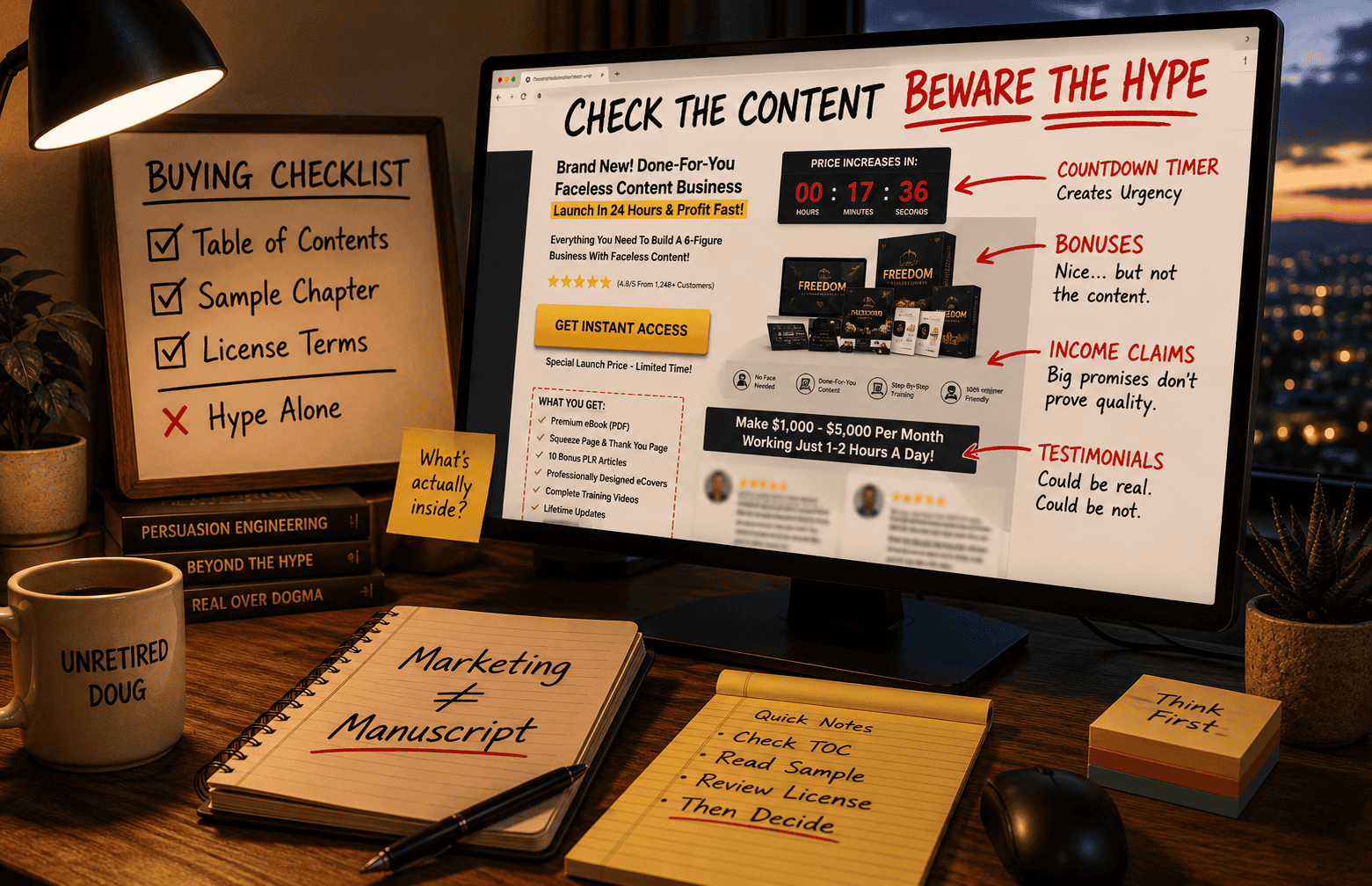
The short version: A PLR sales page that spends nearly all of its space on the time and money you’ll avoid, and almost none on the content itself, is telling you something true about that content.
- A sales page built almost entirely around what you’ll avoid doing is often designed to keep you from evaluating what you’re actually buying.
- A real table of contents and an actual sample are the two fastest ways to tell PLR worth buying from PLR worth skipping.
- Some Warrior Plus sellers do show a genuine table of contents and a real sample before you buy, and that willingness is itself a quality signal worth trusting.
- Even well-researched PLR on health, legal, financial, or safety topics carries two separate risks that have nothing to do with how good the writing is.
I came across a sales page not long ago for a PLR package built around “faceless content” creation. The vendor’s selling through WarriorPlus, but it could just as easily have been sold in any other marketplace. It was the usual big-scroll layout: a countdown timer, income screenshots, a full checklist of what you’d receive, an eBook, a squeeze page, ecovers, bonus PLR articles, more bonus training. What the page never got around to was the thing I actually wanted to know before spending a dollar. What does the eBook actually say?
That’s worth pausing on, because it isn’t accidental and it isn’t rare. Anyone who buys PLR with any regularity, and a fair number of people building content or affiliate businesses eventually do, runs into this exact pattern often enough that it deserves a name and a habit for spotting it before the checkout page loads.
What the Page Actually Sells
Run the numbers on a page like that and the split is almost always lopsided. The overwhelming majority of the copy is about the business opportunity: what you’ll save, what you’ll avoid, how fast you can launch, how much profit you keep. Only a sliver, sometimes nothing at all, describes what’s actually inside the eBook. No chapter list. No sample paragraph. No hint of the argument the content is supposed to make.
This isn’t sloppy copywriting. It’s a specific choice, and it works because a reader who can’t evaluate the content can’t object to it either. A thin, generic, AI-assisted eBook sells just as well as a carefully researched one when nobody gets to look inside before buying. The packaging carries the entire sale.
Sometimes DFY means Done TO You. You paid for something done for you, and what actually got done was skipping past your own judgment before you ever had the chance to use it.
Not Every Seller Plays This Game
None of this means PLR is a dead end, or that everyone selling it is running the same trick. There are sellers on Warrior Plus, and elsewhere, whose product pages show a full table of contents and let you read a real sample before you buy. Their writing tends to hold up once you’re inside the product too, which isn’t a coincidence.
I’m not going to name names here. That’s not really the point, and turning this into a list of who’s good and who isn’t makes the piece about specific sellers instead of a skill you can use on any sales page you land on next month, long after any list I could write goes stale. What matters is the behavior. A seller willing to show you the actual chapter list and let you read a page before you pay is telling you something true about how they feel about their own work.
How to Read a Page Before You Spend Anything
The check itself doesn’t take long once you know what you’re looking for.
- Look for a real table of contents. Actual chapter titles, not a list of vague benefit bullets standing in for one.
- Look for a sample. A page, an excerpt, a preview chapter, anything that lets you read the actual writing before you commit to it.
- Notice where the page’s words go. Content specifics, or almost entirely the time and money you’ll save.
- Treat production polish as neutral information. Slick graphics, funnels, and income screenshots describe the marketing, not the manuscript.
- Read the license terms before you buy. Know exactly what you’re allowed to do with what you’re getting, not after you’ve already paid for it.
The Two Problems Hiding Inside YMYL Topics
Even a PLR product that passes every check above still carries a separate set of problems when the topic is YMYL: health, legal, financial, or safety content. Two different risks live inside that category, and they’re worth pulling apart rather than treating as one vague warning.
The first is a credibility problem. Most people buying and reselling PLR aren’t credentialed in the subject they’re about to publish under their own name. Good writing isn’t the same thing as accurate writing, and a buyer with no background in the topic has no real way to catch a wrong claim before it goes out with their name attached to it.
The second is a visibility problem, and it’s separate from the first. Search engines apply extra scrutiny to health, finance, legal, and safety content specifically because of the potential for harm if it’s wrong, so a site publishing in this space needs stronger authorship and expertise signals just to be considered for ranking at all. Some social platforms restrict health and safety topics more heavily too, which can throttle reach or trigger flags even on content that’s completely accurate and well-intentioned. You can do everything right on the quality side, verify every claim, vet the content carefully, and still run into a ceiling that has nothing to do with the content itself. That’s a platform problem, not a writing problem, and it’s worth knowing about before you build a site’s foundation on a YMYL PLR pack.
What Skipping This Check Actually Costs You
The real cost of skipping this step usually isn’t the purchase price. It’s the weeks that follow. You publish the content, or start editing it into something usable, and only then discover the material is thinner than it looked, generic in the way a lot of AI-assisted PLR is now, or wrong in a way you’re not equipped to catch. At that point you’re not saving time anymore. You’re doing the research you thought you’d bought your way out of, except now you’re doing it after the fact, under a product you’ve already put your name on.
That’s the quiet tax on this kind of impulse buying. It doesn’t just cost the purchase price. It costs the belief that PLR can work for you at all, which is a much more expensive thing to lose, especially when the actual problem was one sales page, not the model itself.
Where to Start
Next time a PLR page catches your attention, scroll past the countdown timer and look for two things before anything else: a real table of contents and a sample you can actually read. If both are there, everything else on the page is worth your attention. If neither is there, ask the seller for one before you buy, or treat the absence as your answer.
Core
What this comes down to:
- A sales page that hides its content while selling the avoidance of work is telling you something true about that content.
- A real table of contents and a genuine sample are the fastest, most reliable filters available to you.
- Plenty of PLR sellers do this well. The ones who do usually aren’t afraid to show you what you’re buying first.
- YMYL PLR carries risks that quality checks alone can’t solve: a credibility problem and a separate visibility problem.
- The habit costs you thirty seconds per page. Skipping it can cost you weeks.
Q&A
Is it safe to buy PLR without seeing a sample?
No, not really. Treat a seller’s refusal to show a sample or table of contents as information in itself. A seller confident in their product usually has no reason to keep it hidden until after you’ve already paid.
Does a professional sales page mean the PLR content is good?
No, and it shouldn’t be read that way. Production polish, graphics, funnels, income screenshots, tells you about the marketing budget, not the manuscript.
Is PLR worth it for building a business?
Yes, when you vet it the way you’d vet any other purchase, with a real look at what’s inside before you commit your name and your site to it.
Should you avoid YMYL PLR content?
Not necessarily, but go in aware that even accurate, well-written YMYL content faces platform scrutiny that has nothing to do with its quality, and that you likely can’t personally verify every claim without relevant background in the subject.