
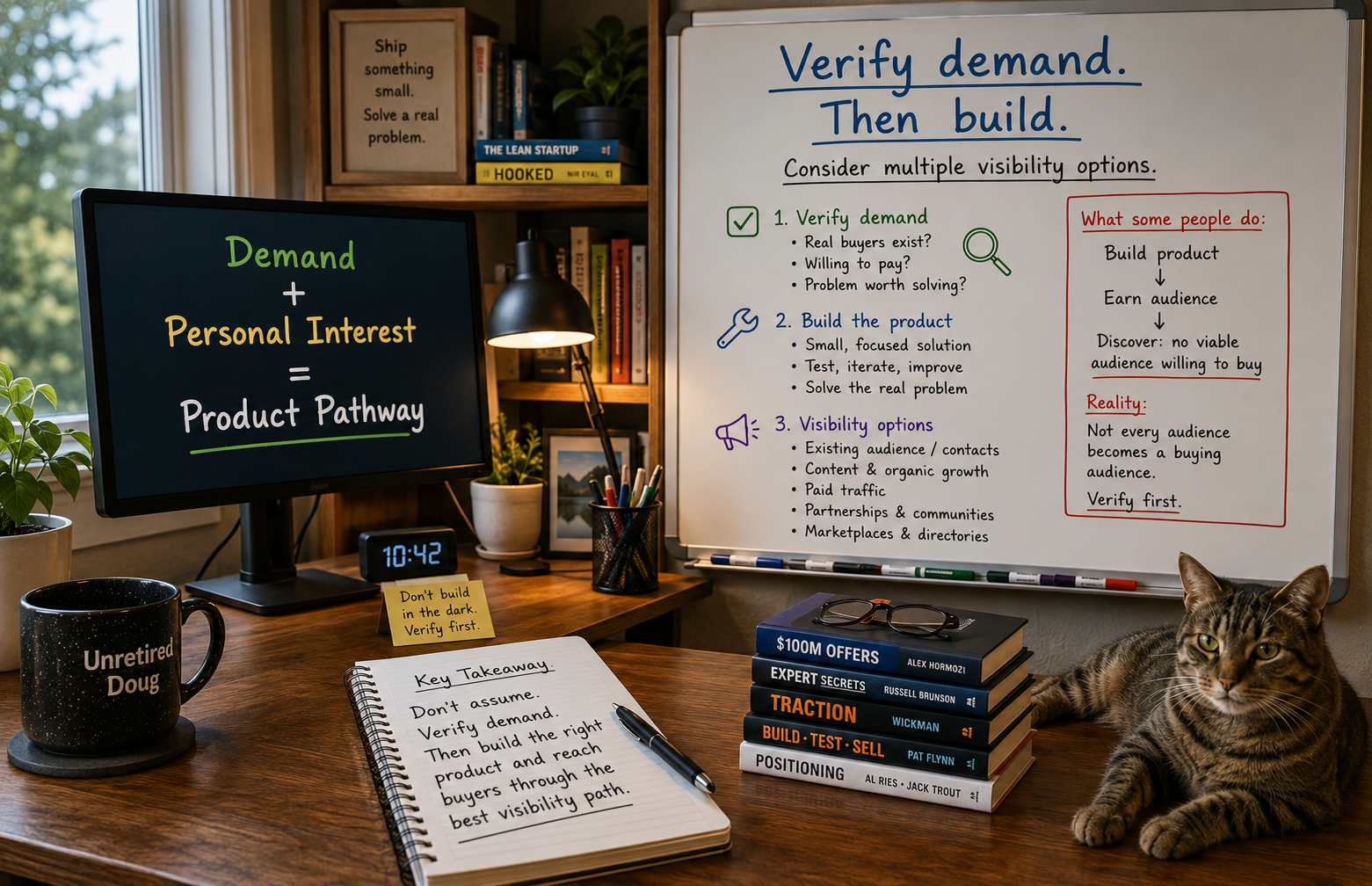
Quick preview: “Build a product from what you already know” and “sell it to the people who already know you” are the two most common pieces of advice for starting an online business, and both are optimized for a specific kind of person who isn’t every reader.
- Audience-first advice assumes you already have, or are willing to build, a following. But income, audience-size, and growth-rate figures suggest organic audience building should be considered with a clear eye, not accepted as the default path to monetization.
- Building from personal expertise sounds efficient, but it substitutes the founder’s assumptions for actual buyer research, and it skips past two separate questions: whether that expertise has real demand behind it, and whether it’s even the topic you want to spend your time on. A new topic, discovered and validated the same way, is just as monetizable.
- Neither piece of advice is wrong for everyone. Both carry real, measurable structural odds against a specific kind of beginner: someone with no career story they want to tell and no existing audience (even personal contacts) to sell to.
- Paid traffic isn’t a risk-free alternative, but it shouldn’t be written off out of hand — it trades one kind of risk (unbounded, slow, hard to measure) for another (bounded, faster, real money out the door before you know if it works).
I got an email recently from an AI-tools newsletter publisher, pitching a $9-a-month community for building and selling small digital products. The pitch was competent and sincere.
The plan presented includes four steps: figure out what you already know how to do, research the people who’d pay for it, build the thing with AI in an afternoon, then sell it to your existing audience or your contacts.
I’ve read numerous versions of this plan. This one was better written than most. But two of its load-bearing assumptions are worth pulling apart, because I think they leave out a reader I care about: someone who doesn’t have a career they’re eager to write about, and who doesn’t have much of an audience to sell to, but does have the patience to learn a topic or skill because the market wants it.
“Build From What You Know” Has a Blind Spot
The first step in almost every version of this advice is some form of self-inventory: what do you already do, what are you already good at, what have people already asked you for help with. It feels efficient. But if you decide your idea’s a great one and plow ahead, you skip the part where you have to go figure out what a market wants, because you’re assuming you already are the market research.
If you do that, there’s a problem: that assumption is exactly what a lot of failed products are built on. You join the creators who mistake a hypothesis for a validated finding. The best advice includes a second step: you’ve got to research the market and make sure there’s a real demand for the product you envision.
I’m glad the email I got includes both steps, because together they get this right. What you land on in step one can be entirely valid in one sense — you do know the subject, and you likely do know, or have known, people who share the interest and ask your advice on it. That’s real signal, not nothing.
Step two exists precisely so you don’t stop there: it keeps you from assuming that because a few people around you want this, a broader market does too. Personal experience gives you a hypothesis worth testing. It doesn’t excuse you from testing it.
None of that means personal expertise is worthless. It means treating it as a starting guess rather than a finished answer (which is a smaller, more honest claim than “build from what you know” usually gets credited with making).
“Sell to People Who Already Know You” Assumes You Have Them
The second piece of advice is closer to gospel in small-business and creator circles: your first customers should come from your existing network, your existing audience, the people already paying attention to you. It’s true, as far as it goes — a warm audience converts better than a cold one. The part that gets skipped is what it costs to build that audience in the first place, and who actually ends up with one worth selling to.
Let’s Preview Social Media Audience Building
It pays to see the landscape, as best the research can lay it out.
First, audience size (note: we’re specifically talking about product sellers here, not social-media influencers whose primary goal is ad income): a survey of 9,500 creators for Linktree’s Creator Report found that two-thirds fall into the “nano” tier, between 1,000 and 10,000 followers, and just over one in ten hadn’t cleared 1,000 followers.
Second, monetization timeline: a Statista survey of creators with under a year of experience found that 59 percent hadn’t started monetizing their content yet, and fewer than one in ten had earned more than $10,000 in that time. Separately, creators take an average of six and a half months to earn their first dollar, and over ten months to become self-supporting.
(While it’s not the main focus here, ad income data helps round out the picture. As of 2025, the top 1% of creators captured 21% of all creator ad-payment volume, up from 15% two years earlier; the top 10% captured 62%. Median campaign earnings were $3,000 in 2025, down from $3,500 the year before, while the average was pulled well above that by the top tier.)
If you look at these numbers and feel good about your odds and likely timeline — or you’re building an audience for reasons beyond this one product — that’s a completely reasonable place to land. The numbers are just useful to have in hand either way, since most pitches for this path don’t include them.
Are There Alternatives?
I don’t think the answer is “ignore your own experience” or “never build an audience.” I think it’s that both are one path among several, not the default every beginner should assume without checking whether it fits them.
Paid Advertising
An alternative I keep coming back to is closer to demand-first: find something a specific group of people already wants and is already willing to pay for, learn enough to build it well, and get in front of that group through a channel you can measure: paid ads. They’re quick. There’s risk, but it’s controllable.
Paid advertising trades the (free, slow, uncertain) cost of building an audience for the (priced, faster, more trackable) cost of buying attention.
A paid ads caveat: paid traffic has its own version of the unbounded-cost problem. Ad accounts get suspended. Costs per impression spike without warning. Platforms change their targeting rules on their own schedule, not yours. The honest comparison isn’t “ads always work, content never does.” It’s bounded and trackable risk versus unbounded and untrackable risk — and which one you can tolerate probably says more about your situation than either piece of advice admits.
Focused Communities
Another alternative is participating in focused communities — think Facebook groups, independent forums, and the like. This gives you access to a narrower group of like-minded people with openly expressed common interests.
Not all focused communities are equally open to marketing, even when it’s subtly practiced. Reddit participants, for example, are notoriously averse to “stealth marketers,” which is how subreddit participants who suddenly reveal a product for sale tend to be perceived.
Facebook groups, on the other hand, are often (not always) open to mentions of, and links to, products that help group members, especially when the post comes from someone who’s been active in the group with genuine goodwill.
What About Other Options?
There are dozens of alternatives, each with its own “best to know going in” considerations. Addressing more of them is beyond the scope of this article.
I’m in the process of building a Traffic Advisor that combines my research into a written guide and an AI system for quickly identifying which methods suit an individual user and pulling up the details. Keep an eye on UnretiredDoug.com — I’ll soon be starting a newsletter where I’ll announce product availability, and I’ll post a notice on the home page too.
What to Do With This
If you’re weighing whether to follow either piece of the advice we started with, the useful question isn’t “is this advice right or wrong.” It’s “does this advice assume something about my starting position that isn’t true yet (or that I may not intend to build at all).” If you don’t have a story you want to tell about your own expertise, or an audience you’re willing to spend months building before you sell anything, that’s not a disqualification. It just means the standard playbook was written with someone else in mind.
Core
What this comes down to: the two most repeated pieces of online-business advice both assume a starting position — expertise worth mining, or an audience you can sell to — that a lot of capable people don’t have yet and don’t need to manufacture before they start. Demand-first thinking, backed by a channel you can measure, is a real alternative, not a shortcut. It comes with its own costs. Knowing which costs you’re actually willing to carry matters more than which piece of advice sounds more confident.
Questions Worth Asking
Does this mean building an audience is a waste of time?
No. It means treating it as a strategy with real, measurable costs and a real timeline, not a default step everyone should take because it’s free to start. If you’re willing to spend six months or more before your first sale, and you enjoy the process, it can still be the right call.
Is paid traffic actually better than building an audience?
Not necessarily better. Paid traffic is faster and more trackable. It costs money up front, but you know roughly what you’re spending and can stop if it doesn’t work. Conversely, audience building costs time you usually can’t get a clean read on until you’re well into it.
What if I genuinely don’t know what to sell?
That’s a research problem, not a personality problem. Go find where the people you’d want to help are already complaining about something, and start there — before you start with your own biography.
Is the “build from what you know” advice always wrong?
No. It’s a reasonable starting hypothesis. The mistake is treating it as validated demand instead of a guess that still needs checking against what buyers actually say.