
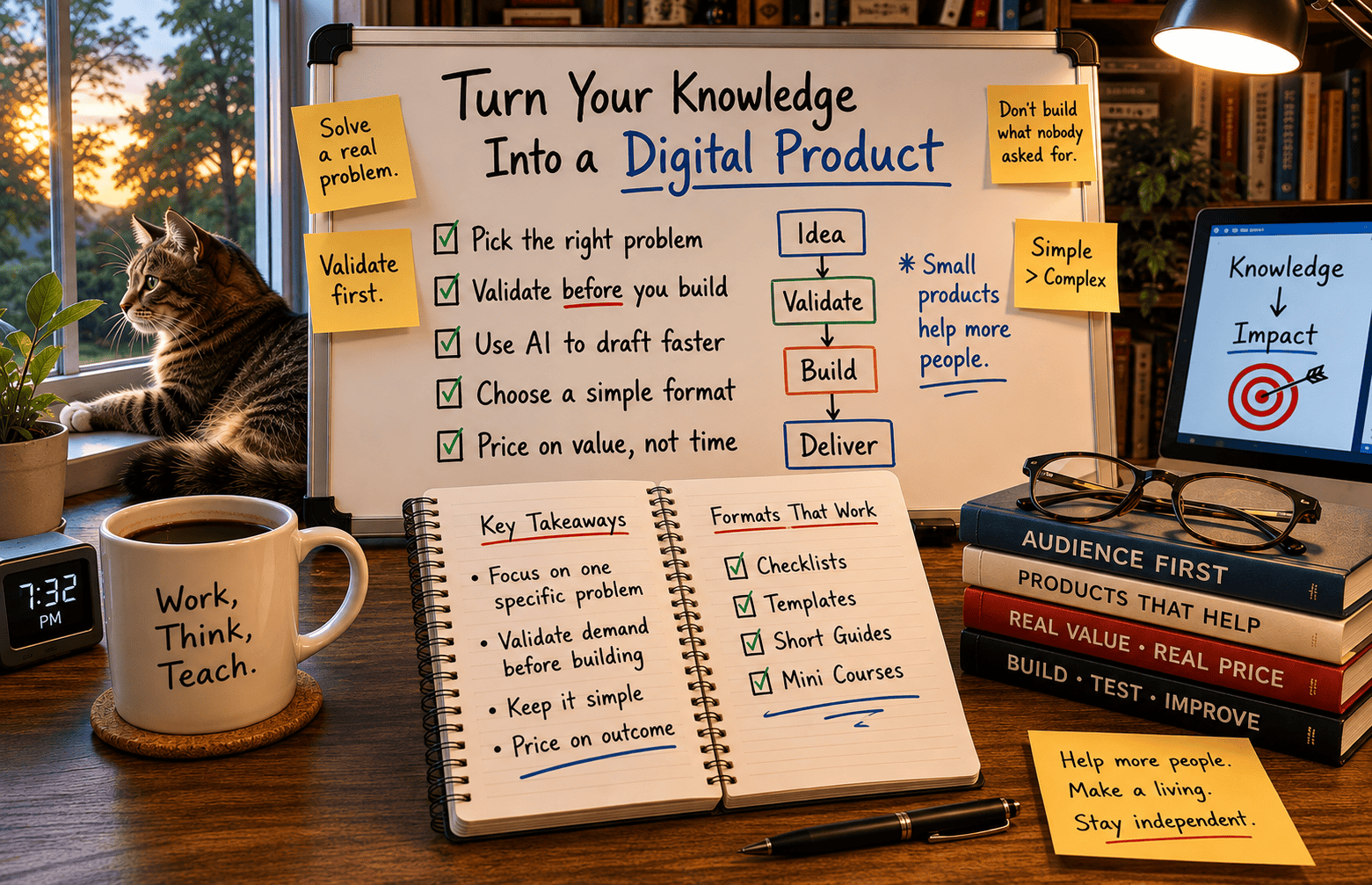
Short version: the block that stops most people isn’t a lack of knowledge. It’s picking the wrong piece of it, and building before anyone’s confirmed they want it.
- Creators who validate demand before building a product finish it about 73% of the time, versus 23% for people who build first and hope, according to ConvertKit’s 2024 Creator Report.
- AI has mostly closed the gap between having an idea and having a full draft, which means the old advice about “just start writing” is less useful than it used to be.
- The actual differentiator now is what you do to that draft afterward, not how you produced it.
- Templates, checklists, and short guides ship faster than courses and make a better first product for most people.
- Price on what the outcome is worth to the buyer, not on how long the product took you to make.
Most people who stall out here don’t stall because they don’t know enough. They stall because two decisions feel bigger than they are: which piece of what they know is actually worth selling, and whether anyone will pay for it before they’ve spent weeks building it. Everything past those two decisions moves fast now. Those two don’t.
A lot of the advice circulating on this topic skips straight past that part. It assumes the hard part is production, so it spends most of its word count on formats, platforms, and launch checklists. That’s backwards. The production step got easy. The judgment step didn’t.
Pick the Problem, Not the Whole Subject
Your knowledge is broad. Your product shouldn’t be.
A product built around “what I know about retirement planning” won’t sell. A product built around “what to do with an old 401(k) from a job you left a decade ago” will, because it names a specific person’s specific stuck point.
The fastest way to find that stuck point is to notice what you’ve already been asked more than once. If two or three people have brought you the same question this month, or if it shows up repeatedly online, that’s not a coincidence. It’s a sample size. Whatever they asked is worth more, as a product, than the impressive stuff you’d rather teach.
It’s also usually not your most advanced material. Beginners outnumber experts by a wide margin in almost every field, and a beginner doesn’t need your hardest-won insight. They need to get two steps further than they are right now. Meet them there.
Validate It Before You Build It
This is the step most people skip, and it’s the one the data is clearest about. ConvertKit’s (now Kit) numbers on presold versus built-first products aren’t close: 73% versus 23%. That’s not a marginal edge. That’s the difference between a product that exists and one that dies in a folder, unfinished and unmissed.
Validating doesn’t require a launch. It requires asking, out loud or online, before you build anything. Describe the product in a sentence or two to five or ten people who actually have the problem. Ask if they’d pay for it, and if the honest answer is a shrug, that’s real information. It’s cheaper to hear that now than after two weeks of building.
A simple version works fine: a short landing page describing the product, an early-bird price, and a small amount of traffic. If people put money down, or genuinely say they would, you build. If nobody bites, you’ve lost an afternoon instead of a month.
Online Research and Validation
Asking real people directly is the best version of this, but it carries an unstated assumption: that you have people to ask. Most guides on this topic skip past that assumption entirely, which is a problem if the career you’re drawing on didn’t leave you with an active professional circle to poll. Not having one isn’t a reason to skip validation. It just means the validation has to come from strangers instead, and strangers are easier to find than most people expect.
One layer of that is question-mining: tools that show you what people are actually typing into Google. AnswerThePublic is the name most people know, though it has tightened its free tier over the years. AnswerSocrates does the same job, pulling from Google Suggest, People Also Asked, and Google Trends, and currently gives away more for free. AlsoAsked is a third option worth comparing if neither fits.
A layer past that is finding where people are already venting about the problem in public, with real numbers attached to it. PainOnSocial is built specifically for scanning Reddit this way. A post asking why there’s no good solution for a problem, sitting at five hundred upvotes and two hundred comments, is a bigger and more honest sample than anything a personal network would hand over lunch. The same search works by hand in the right subreddits and Facebook groups. A tool just saves the scrolling.
The cheapest option costs nothing but time. Browse Amazon’s Kindle bestsellers, or Etsy and Gumroad search results, in a category next to yours. Then read the actual reviews on the closest products. “I wish this also covered…” shows up constantly in reviews, and it’s about as validated as demand gets, since someone already paid for something close and is telling you exactly what they still wanted.
A prompt to start the search: hand this to any AI tool with live web search turned on, filled in for your own topic.
I’m considering creating a [format: guide, template, checklist, short course] about [specific problem] for [specific audience]. Search the web and find the most active subreddits where this audience currently discusses this problem, and the highest-engagement Quora questions on the same topic. For each one, note roughly how large or active it is, and include one or two direct quotes or closely paraphrased complaints that show the problem is real and current. Use current search results, not general knowledge.
Let AI Take the First Draft Off Your Plate
Here’s the part worth saying plainly instead of dancing around: using AI to produce your first draft isn’t a shortcut you should feel sheepish about. It’s just where the work starts now.
Tell it what you know, who the product is for, and the specific problem it solves. Ask for a full rough draft. You’ll have one in minutes instead of the day or two it used to take to get words on a page.
That draft will be generic in places. It’ll state things with more confidence than it’s earned, and it will miss the specific judgment that only comes from having actually done the thing. None of that is a failure of the tool. That’s what a first draft is for, whether a person or a machine produced it: something to react to instead of something you stare down from a blank page.
The Editing Pass Is Where You Actually Get Paid
If the draft came from AI, this is the step that turns it into something worth money, and it’s the one step nobody can do for you.
Go through it and catch what a beginner, human or otherwise, couldn’t. The line that sounds plausible but is subtly wrong. The tip that’s technically true but misses what actually trips people up in practice. The exception nobody mentions because they’ve never hit it themselves.
Add the story only you have. Add the mistake you made so your buyer doesn’t have to make it too. Swap the vague advice for the specific number, the specific tool, the specific sentence to say out loud. If your finished product still reads like the AI draft, you stopped one step early.
There’s a second editing pass worth making, separate from fact and judgment, and it’s easy to skip if you don’t think of yourself as a writer: reading the whole thing out loud, or having someone else do it, and fixing whatever doesn’t sound like you specifically. Voice matters less in nonfiction than it does in fiction. A reader here is after the information, not the prose, and they’ll forgive more on that basis. But it still matters. Stilted, awkward phrasing reads as a lower-value product even when the advice underneath is sound, and a buyer who trips over a clunky sentence on page two starts wondering what else got rushed.
Price and Package With Some Backbone
Price the outcome, not your hours. A checklist that saves someone ten hours of trial and error is worth more than the ten hours it took you to build it, not the same as them.
Most first-time creators price low because asking for real money feels uncomfortable. That instinct is worth ignoring. A price that’s too low doesn’t just cost you revenue. It tells the buyer the product isn’t worth much, which becomes a self-fulfilling read on quality.
Packaging matters more than it should, and less than people think. A clean title that names the buyer’s actual problem, a real cover, and pages that are easy to read turn the same words into something that looks worth paying for. That’s not deception. It’s the difference between a file and a product.
Selling Without an Existing Audience
You don’t need a following. You need access to people who already have the problem.
Those people are already gathered somewhere, in a Reddit thread, a Facebook group, a forum built around exactly the thing you solve. Show up and answer questions honestly. Mention the product only when it’s genuinely the answer, and most of the time it will read as help rather than a pitch, because it is one.
A short, specific message to one person visibly stuck on the exact problem you solve will outperform a broad announcement to nobody in particular. If someone else already has the audience you’d otherwise spend months building, a straightforward revenue split for sending buyers your way is a fair trade. You’re borrowing trust you haven’t earned yet, and that’s fine, as long as the product holds up once they arrive.
None of this is about becoming a different kind of person, or performing expertise you don’t have. It’s the same principle that applies to most of what’s worth building online: get the infrastructure right before you chase traffic, and let the product be genuinely useful before you worry about making it look impressive. Pick the one thing you’ve explained twice this month. Ask five people if they’d pay for it before you write a word. That’s the whole test.