
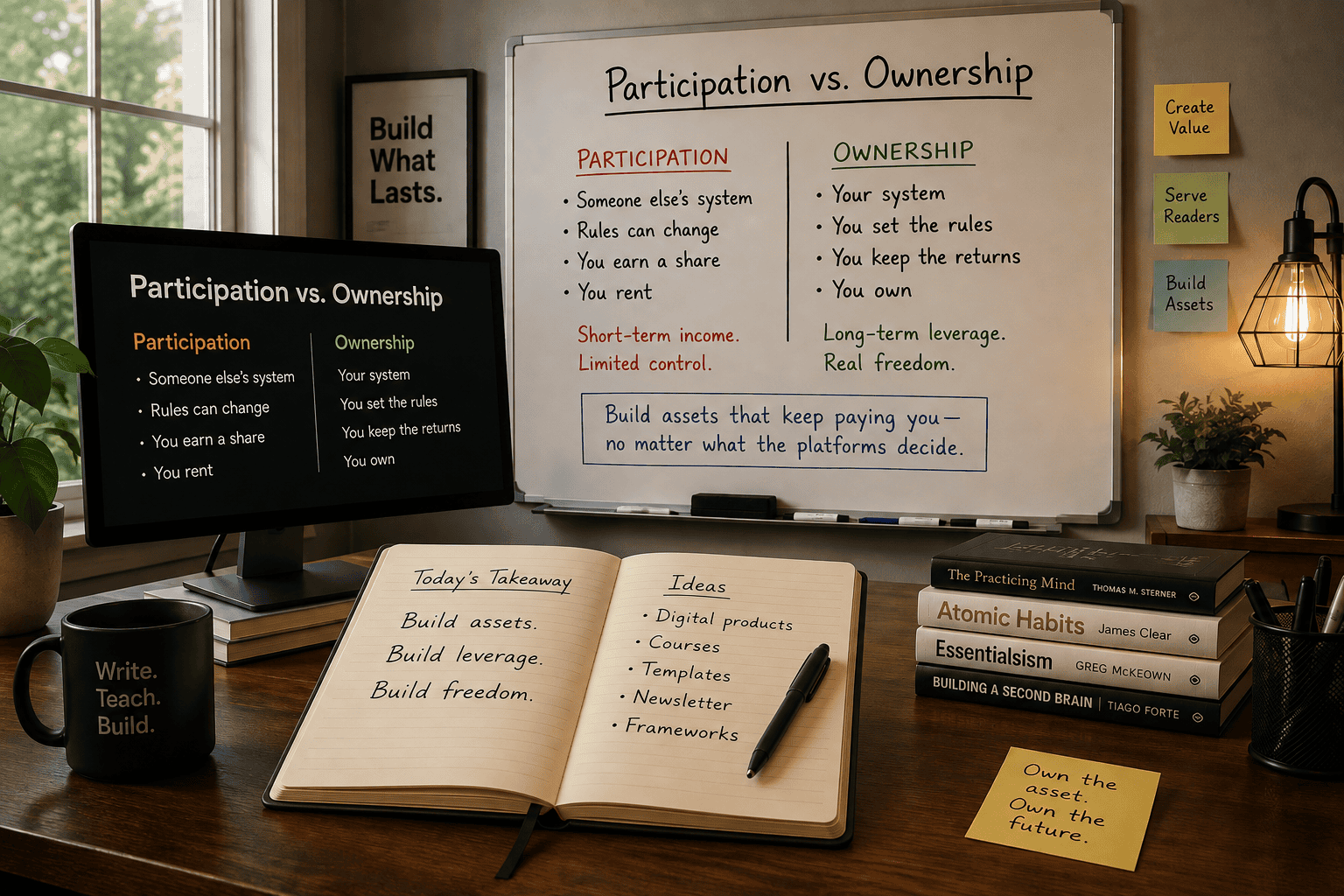
Participation means earning inside a system someone else controls. Ownership means building something that keeps paying you no matter what that system decides.
Two people can run the exact same kind of online business and end up in completely different positions. One holds real leverage. The other is a guest in somebody else’s house, hoping the rules don’t change.
That difference just got very real for YouTube creators. It’s worth understanding before you build anything.
What’s the Real Difference Between Participation and Ownership?
Transactional Participation: Working With Someone Else’s System
In this model, you’re participating in an existing platform, marketplace, or economic structure. You’re contributing effort, attention, coordination, or reach. But the underlying infrastructure, the product, the checkout system, the customer relationship, belongs to someone else.
This isn’t a criticism. Transactional participation can generate income faster than building from scratch. It’s often the most practical entry point, and for many it stays that way by choice.
It also isn’t one single thing. Two of the most common versions work differently enough that they’re worth separating out.
Platform Monetization Programs: YouTube, Facebook, and the Terms They Can Change Anytime
This is YouTube’s Partner Program, Facebook’s Reels and ad-break bonuses, and similar setups. The platform pays you a share of ad revenue once you clear its eligibility bar.
The platform sets that bar. It also gets to move it, and the terms of the share along with it, whenever it decides that’s in its own interest. YouTube’s watch-hour change is the sharpest recent example, but Facebook has quietly reworked its own monetization programs more than once. Your income here is a percentage of somebody else’s revenue, under conditions somebody else revisits on their own schedule.
Affiliate Marketing: A Different Kind of Renting
Affiliate marketing looks different on the surface. You’re not waiting on ad revenue. You’re promoting someone else’s product for a commission.
But the dependency runs just as deep. The vendor sets the commission rate, and can lower it. The vendor can end the program outright, or the network running it can suspend your account. The offer you built content around can disappear entirely, sometimes with no notice beyond an email you may not even open in time.
The one thing affiliate marketing rarely gives you is the buyer relationship at the point of sale. That belongs to the vendor. You get a commission and, if you’re lucky, a name on a list you don’t control.
Both versions of participation are legitimate ways to earn. Both are also, at bottom, someone else’s system that you’re renting space in.
Owned Asset Monetization: Building Things You Control
Here, the asset produces ongoing returns, independent of any single platform’s decisions. Digital products, ebooks, courses, templates, newsletters, specialized websites, and frameworks all fit here.
The work is front-loaded. You build what you sell, and building takes longer than joining an existing system. That’s one honest reason this path appeals to fewer people starting out.
What you build tends to age better. It rarely disappears overnight, and it compounds. Traffic you send today can still be earning next year, without anyone else’s platform-policy email showing up in your inbox.
What Just Happened With YouTube’s Partner Program?
An email landed this week that puts all of this in concrete terms. A YouTube creator laid out the first major change to the Partner Program since 2018.
Starting February 1, 2027, new channels need 8,000 watch hours to start earning ad revenue. That’s double the old 4,000-hour bar. Shorts creators face their own new floor: 10 million Shorts views every 90 days to keep collecting Shorts ad money. Fall short, and the checks pause.
Anyone already inside the program keeps their spot. Their monetized channel arguably got more valuable this week, since the bar behind them just got harder to clear. Everyone else has roughly six months to get in under the old terms.
YouTube changed the price of admission this week, and no creator earning ad revenue there had any say in it. That’s what participation in someone else’s system actually means. There’s a landlord, and the landlord can raise the rent whenever they decide to.
The creator’s own numbers make the case better than any of us could argue it in the abstract. He has 145,000 subscribers. Last month, ads paid him about $900. His own products have paid him roughly $176,000 over the years, on that same channel, with that same audience. The difference isn’t the size of the audience. It’s what he’s actually selling them.
That’s the whole argument for ownership in one comparison. The channel is still rented. What he built and sells through it is his.
This is actually what got this piece written. I’ve had the participation-versus-ownership distinction in my head for a while, and the YouTube news was the prompt to finally lay it out plainly.
Why Are Most Successful Businesses a Hybrid?
Few businesses are purely one or the other. A content creator posting affiliate links is participating in someone else’s system while also building an owned audience and brand.
A course creator often started by participating in an affiliate program to fund the learning that eventually became their own product.
This isn’t a flaw. It’s how most businesses actually grow. Use participation to learn, earn, and build an audience, while gradually shifting weight toward what you own outright.
If You’re Just Starting Out, Which Should You Focus On First?
Most successful builders eventually move some weight toward ownership, even if they start with participation. Timeline, risk tolerance, and existing skills are the most common reasons people stay on one side longer than the other.
Participation gets you earning and learning faster, with far less upfront work. Ownership takes longer to pay off, but nothing you build there can be taken away by someone else’s policy update.
My recommendation for someone starting from scratch: begin with owned assets. You’ll likely find creating and selling your own product less daunting than you imagine, and the skills you develop will transfer to everything you build afterward, including if you choose to add participation later.
Start small. A single useful product for a specific audience, built to teach what actually matters, is a fine place to begin.
What This Comes Down To
In plain terms:
- Participation gets you paid faster. Ownership keeps paying you longer.
- Platform rules are not your rules, no matter how long you’ve been on the platform.
- Most sustainable businesses run on both, weighted increasingly toward what they own.
- If you’re starting from zero, weight your first real moves toward something you control.
Quick Answers
Can I do both participation and ownership at the same time?
Yes, and most people eventually do. The caution is against building exclusively on one side before you understand what the other requires, and getting stuck there.
Is affiliate marketing dead?
No. It’s a genuine business model that still works. The caution is against building your entire income on a platform-controlled arrangement without ever building something you actually own.
What counts as an owned asset?
Anything you create and control, where the value stays with you regardless of a single platform’s decisions. An ebook, a course, a tool, a website, and a mailing list all qualify. The defining trait is that it belongs to you and keeps functioning no matter what any one platform decides to change.