
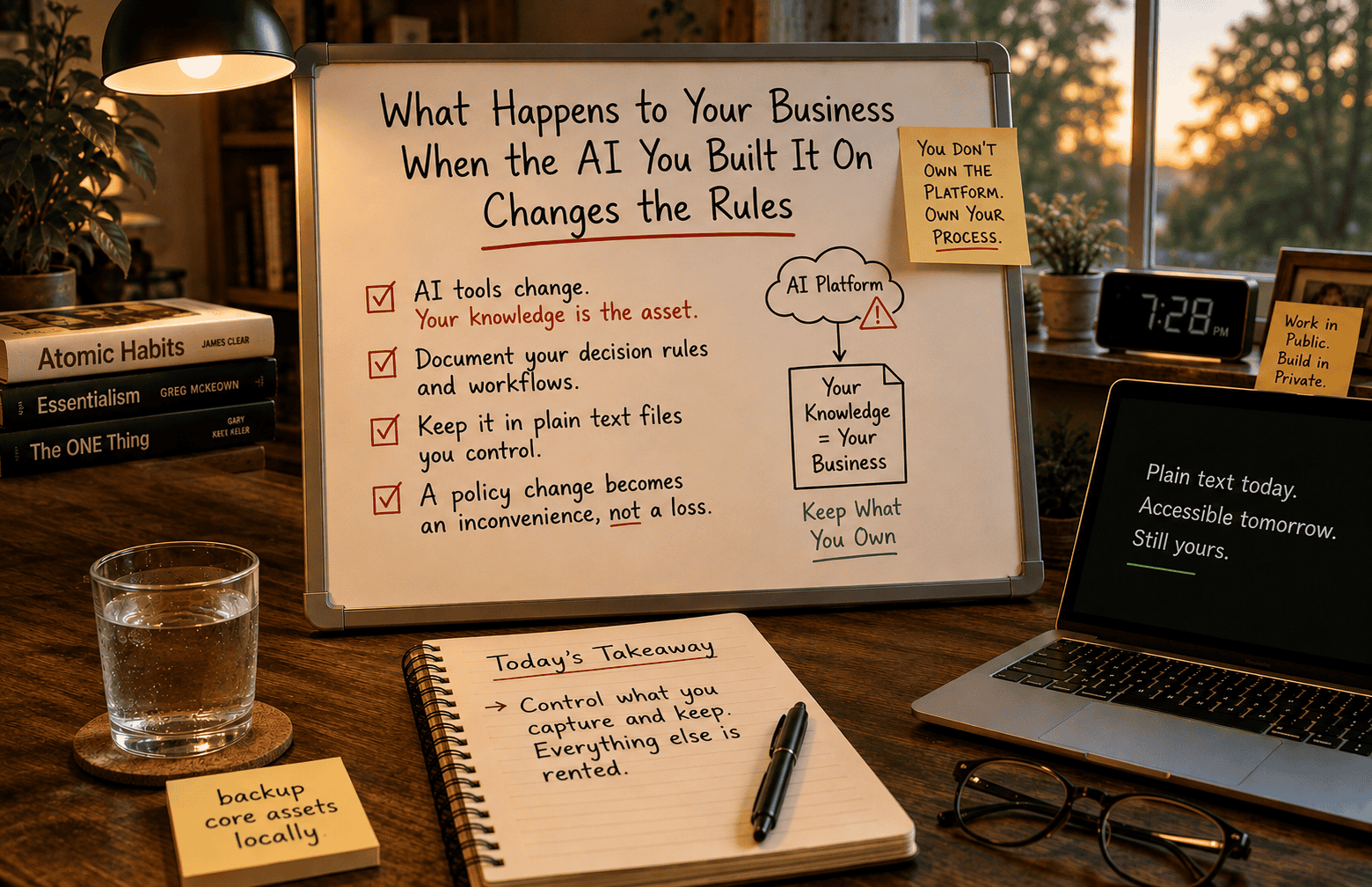
Quick answer: the AI itself is never the asset — your audience knowledge, your workflows, and your decision rules are. Keep those in a plain file you control, not buried in a chat history or a single platform’s custom-bot feature, and a policy change becomes an inconvenience instead of a loss.
In August 2026, OpenAI restricted the ability to publish new Custom GPTs to paid workspace accounts, walking back language it had used just days earlier about the feature staying available. Around the same stretch, Galaxy.ai unwound a lifetime-subscription deal for features customers had already paid for once. Neither company was lying when it made its original promise. Both changed the deal anyway, on their own schedule, with no seat at the table for the people who’d built on top of them.
If you run any part of your business through AI chat, and at this point, who doesn’t, this is worth thinking about for a minute. Not because it means you should distrust these tools. You shouldn’t, and you’d be handicapping yourself if you did. It matters because most people who lose something in a moment like this didn’t lose a tool. They lost work they never wrote down anywhere else.
The tool isn’t what you built
Say you spent real time teaching an AI assistant how to evaluate a business decision: which affiliate offers fit your audience, which content angles convert, which vendor red flags matter to you specifically. You corrected it a dozen times until it finally got it right. That correction process is the actual work. The finished conversation is just where it happened to occur.
The mistake is treating the platform as the place where that knowledge lives, rather than the place where you happened to develop it. A chat thread is a workshop, not a warehouse. When access to a specific feature changes — sharing gets restricted, a bot gets deprecated, a subscription tier gets redefined — what you lose is the workshop. If your actual knowledge only ever existed inside it, you lose the finished pieces too.
This isn’t a reason to avoid building inside these platforms. It’s a reason to make sure the building leaves a trace somewhere you own.
A short list of what actually needs saving
You don’t need to preserve every exchange you’ve ever had with an AI model. Most of it is disposable by nature: quick questions, one-off drafts, dead ends. What’s worth the ten minutes it takes to save is narrower, and it holds up well as a short list.
Write down what you taught it, not what it wrote for you. The output of a good AI session is usually the least valuable part. The valuable part is the corrections that got you there: the moment you said “no, don’t do it that way, do it this way” and it finally clicked. That’s the part that transfers to any model, any platform, any year. Save the corrections, not just the final draft.
Keep it in plain text. A .md or .txt file on your own machine, or in a Drive folder you control, will still open in ten years regardless of which AI company still exists by then. A proprietary memory feature, a platform-specific project format, or a custom bot’s hidden instructions are all real conveniences, but none of them are guaranteed to survive a redesign. Use the fancy version while it’s there. Keep the plain version as the one that has to survive.
Separate your business logic from the platform’s syntax. Some of what accumulates in a long AI relationship is genuinely yours: your audience’s actual objections, the decision rule you finally nailed down after three bad calls, the tone you settled on after rewriting an email nine times. Some of it is just platform housekeeping: formatting instructions, tool syntax, memory settings that only make sense inside that one interface. When you save something, ask which pile it belongs to. Only the first pile needs to survive a platform change.
Capture the why, not just the what. “We focus on YouTube” is a fact any new tool can second-guess the moment a trendier platform comes along. “We focus on YouTube because our audience responds to slower, demonstration-heavy content and we’re optimizing for search discovery, not short-term reach” is a decision with reasoning attached, and reasoning is what actually stops you from re-litigating the same choice every time a new tool makes a confident suggestion.
Update the file when the workflow improves, not just when you first write it. This is the step almost everyone skips. You build the file once, feel good about it, and then spend the next six months improving your actual process inside whatever AI you’re using that week — while the file sits untouched. A few months later, the file is out of date and the platform is your real source of truth again, which is exactly the position you were trying to avoid. Treat updating it as part of finishing the work, not a separate project for later.
Don’t turn it into a junk drawer. The instinct, once you start doing this, is to save everything. Resist it. A file with three years of unsorted notes is nearly as useless as no file at all, because nobody, including you, will read it when it matters. Protect the material that would genuinely hurt to rebuild from scratch: how you understand your audience, the frameworks you’ve developed, the decisions you’ve already made and why. Passwords, API keys, and customer data don’t belong in this file either — that’s a different kind of protection with different rules.
What this actually costs you
Realistically, this is a five-to-ten-minute habit at the end of a productive AI session, not a weekend project. The friction isn’t the writing — it’s remembering to do it before you close the tab and move on to the next task, which is the moment the impulse usually evaporates. The fix that works for most people is boring: keep the file open in a second tab while you work, and treat “did anything just happen that I’d want again” as a question you ask at natural stopping points, not something you try to catch in the moment.
The version of this that fails is the one built around fear — frantically archiving every conversation the day after a platform makes a scary announcement. That produces a pile of notes nobody organizes and nobody trusts. The version that works is closer to routine maintenance: quiet, occasional, and cumulative.
Where to start
Pick one AI conversation from the last month that actually went somewhere — not a random chat, one where you pushed back a few times and the result was noticeably better than the first draft. Ask yourself what you’d want to keep if you could never open that tool again. Write that down in a plain file, in your own words, today. That’s the whole first step, and it’s the one that makes every version after it easier.
Where this leaves you
None of this is an argument against using Claude, ChatGPT, or whatever comes after them. Use the best tool for the job, and use its specific features without hesitation when they genuinely help — that’s what they’re there for. The point is narrower: don’t let the only copy of your actual business knowledge live somewhere you don’t control. Platforms will keep changing their terms, their pricing, and their features, sometimes with plenty of warning and sometimes with none. That’s not a reason to avoid them. It’s a reason to make sure a policy change costs you an afternoon of switching tools, not the knowledge itself.
A few practical questions
Do I need to do this for every AI conversation I have?
No. Most conversations are disposable by nature. Save the ones where you developed something — a framework, a decision rule, a process — not the routine back-and-forth.
I’m not technical. Does “plain text file” mean I need special software?
No. A basic document in Google Docs, Notes, or any text editor works fine, as long as you can get to it without opening the AI platform first. The format matters less than the independence.
Is this the same as just asking the AI to “remember” things for me?
Not quite. Built-in memory features are convenient, but they live inside that platform and follow that platform’s rules about what gets kept and for how long. A file you save yourself follows your rules instead.