
Here’s the thing nobody tells you when you retire: the decades of hard-won knowledge you’re sitting on don’t just disappear because you stopped going to a job every morning. They’re still there. And somewhere out there, people are actively searching for exactly what you know.
They’re not looking for a certified expert with letters after their name. They’re looking for someone who’s actually done the thing, made the mistakes, figured it out, and can explain it like a real person. That’s you.
If you’ve ever explained something to a friend and thought, “someone should have told me this years ago,” you’re already halfway to your first sale.
What a Digital Info Product Actually Is
A digital info product is simply something you write, record, or put together once that helps someone solve a problem, and then you sell it online. No warehouse. No shipping. No inventory to manage. The most common formats are:
- Short eBooks or PDF guides (10 to 30 pages is plenty)
- Simple workbooks or checklists
- Audio recordings where you talk through a topic
- Short video walkthroughs recorded on your phone or computer
You write it or record it once, and it can keep selling for months or years without you doing any extra work. That’s the part worth sitting with for a moment. Every copy that sells after the first one costs you nothing.
Who Actually Buys These Things
Regular people. People who are overwhelmed, short on time, or trying to figure something out that you already know. They’re not looking for a textbook. They want clear, practical help from someone who sounds like a real human being, not a corporate brochure.
The topics that sell well aren’t the flashy ones. They’re the ordinary, useful ones that you might not even think to mention at a dinner party because they feel too familiar. Things like:
- How to stretch a grocery budget without eating boring food
- What to actually say to a doctor when you’re worried about a symptom
- How to set up a comfortable, safe home after a fall or mobility issue
- What to expect when caring for an aging parent nobody prepares you for that
- How to grow vegetables in a small space or a shady yard
- How to talk to your adult kids about money without it turning into an argument
If you’ve lived through any of these and come out the other side with real knowledge, that’s something people will pay for. The knowledge feels ordinary to you because you have it. To someone who doesn’t, it’s worth real money.
The Objection You’re Already Having
“But who’s going to pay me for something I know without even trying?”
Almost everyone thinks this at the start. It’s called the curse of knowledge. When you’ve been doing something for a long time, it stops feeling special. It just feels like common sense. But common sense to you is genuinely hard-won insight to someone who hasn’t been where you’ve been.
You don’t need to be the world’s leading authority on a topic. You just need to be one or two steps ahead of the person who needs help. If you’ve figured out how to manage a fixed income without feeling deprived, you are ahead of every person who hasn’t yet. That gap is your product.
How to Create Your First One
You don’t need special software, a website, or technical skills beyond basic computer use. Here’s how the process actually works:
- Pick one specific problem you know how to solve. Not a broad life topic. A single, concrete problem. “How I learned to manage my blood pressure through small daily habits” beats “Everything I know about health.” Narrow wins.
- Write it out in Google Docs. This is free to use and works exactly like Microsoft Word. Pretend you’re explaining it to a friend who just asked you for help. Use your own voice. You don’t need to sound professional. You need to sound like yourself.
- Save it as a PDF. One click inside Google Docs. That’s your product.
- Design a simple cover if you want one. Canva is free to use and has ready-made eBook cover templates. You drag in your title, change the colors, and you’re done. It takes maybe 20 minutes.
- Set up a free selling page on Payhip or Gumroad. Both are free to join. You upload your PDF, set your price, and they handle the checkout and delivery automatically. Payhip charges a 5% fee on each sale. Gumroad charges 10%. Neither charges you anything upfront.
That’s the whole setup. Most people who sit down and focus can have a finished product ready within a weekend.
What to Charge
Somewhere between $10 and $37 is a reasonable starting range for a short practical guide. A focused 15-page PDF that solves one specific problem is worth at least $17 to most buyers. Around $27 is a common entry price that feels low-risk to a buyer but adds up quickly for the seller.
Twelve sales at $27 is $324. That’s real money, and it’s entirely realistic for a first product once a few people know it exists.
The Part About Building an Email List
An email list sounds more complicated than it is. What it actually means is this: you offer something small and free, maybe a one-page checklist or a short tip sheet related to your topic, and people give you their email address to get it. You then have a way to stay in touch with them and let them know when your paid product is available.
MailerLite handles all of this for free when you’re starting out. Their free plan lets you build a list of up to 500 subscribers and send up to 12,000 emails per month without paying a cent. You don’t need to know what an autoresponder is or how any of the technical stuff works under the hood. You just set it up once and it runs on its own. If you find yourself needing more than 500 subscribers before you’re ready to pay for a plan, that’s a very good problem to have.
Kit (which used to be called ConvertKit) is another option. Their free plan is generous, with room for up to 10,000 subscribers, though it limits you to a single automated email sequence. For someone just starting out, MailerLite’s free plan is probably the simpler place to begin.
You Don’t Need Social Media, a Camera, or a Following
This is the part that trips most people up. They assume that selling anything online requires being on Instagram, making YouTube videos, or having thousands of followers somewhere. It doesn’t.
Your email list is your audience, and you can build one from zero. There are Facebook groups, online forums, and local communities full of people who share your interest or face the problem you’ve solved. Showing up as a helpful, knowledgeable person in those spaces, not selling, just genuinely helping, is enough to get your first handful of subscribers. From there, email does the work.
Nobody needs to see your face. Nobody needs to know how old you are. What they need is the information you have.
What the First Sale Actually Feels Like
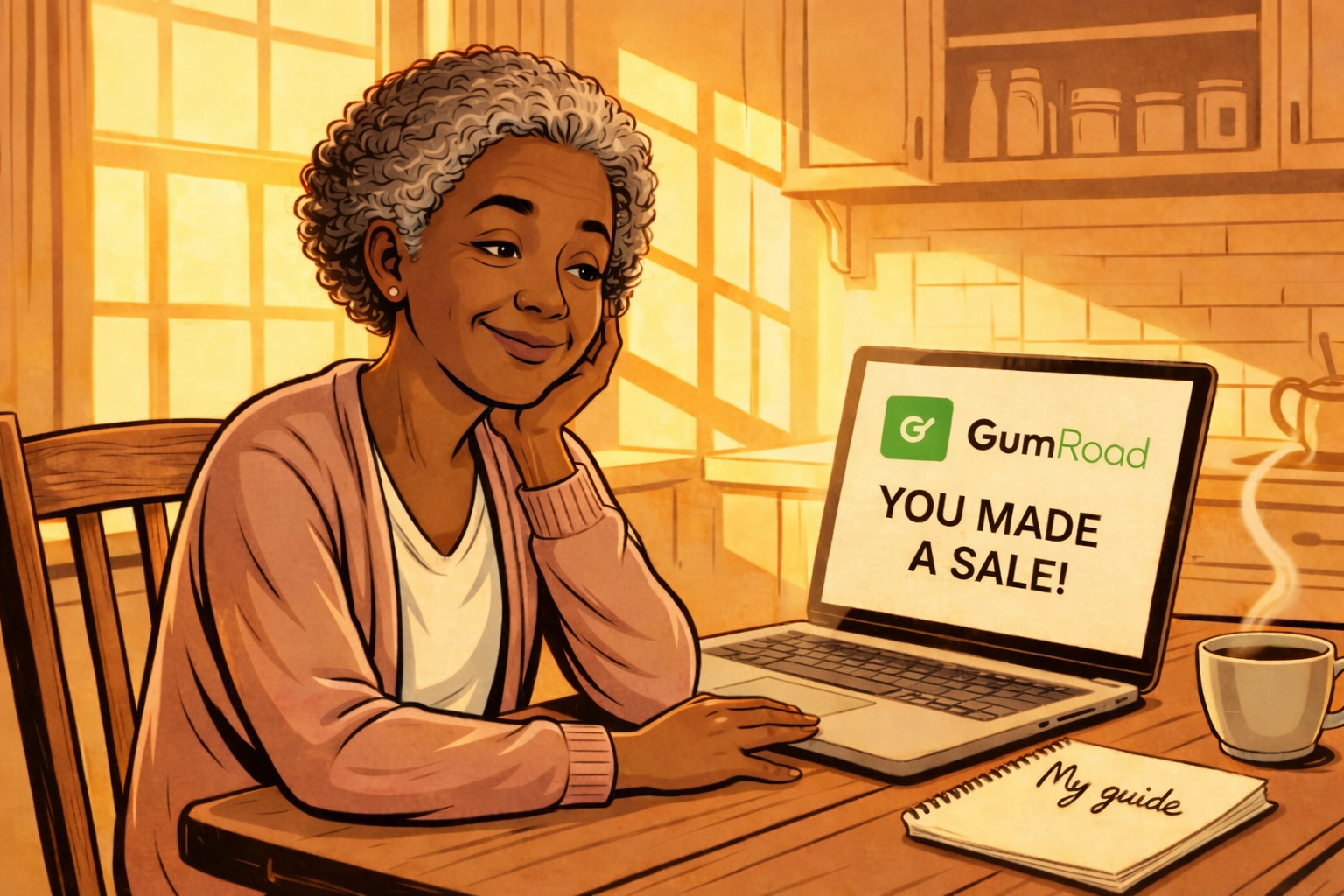
It’s smaller and quieter than people expect, and also somehow more meaningful. You’ll get a notification, probably an email, saying someone paid you for something you wrote. They found it, they wanted it, and they paid for it while you were doing something else entirely.
After that, the mental shift is hard to describe. The question of “would anyone actually pay for this” gets answered permanently. And once it’s answered, the next one gets easier. The one after that, easier still.
Some people make a few hundred extra dollars a month this way and that’s exactly what they wanted. Others grow it slowly into something bigger over a year or two. Either way is fine. The pace is entirely yours to set.
Starting Where You Actually Are
You don’t need to wait until you know more, have more followers, or feel more confident. The first product doesn’t need to be perfect. It needs to be helpful and honest.
If you’ve ever thought “I know a lot about this but I have no idea how to turn it into anything,” this is how you turn it into something. One clear topic. One document. One weekend. Two free tools.
The knowledge you’ve spent a lifetime building isn’t going anywhere. But it could be helping someone right now, and paying you for the privilege.