
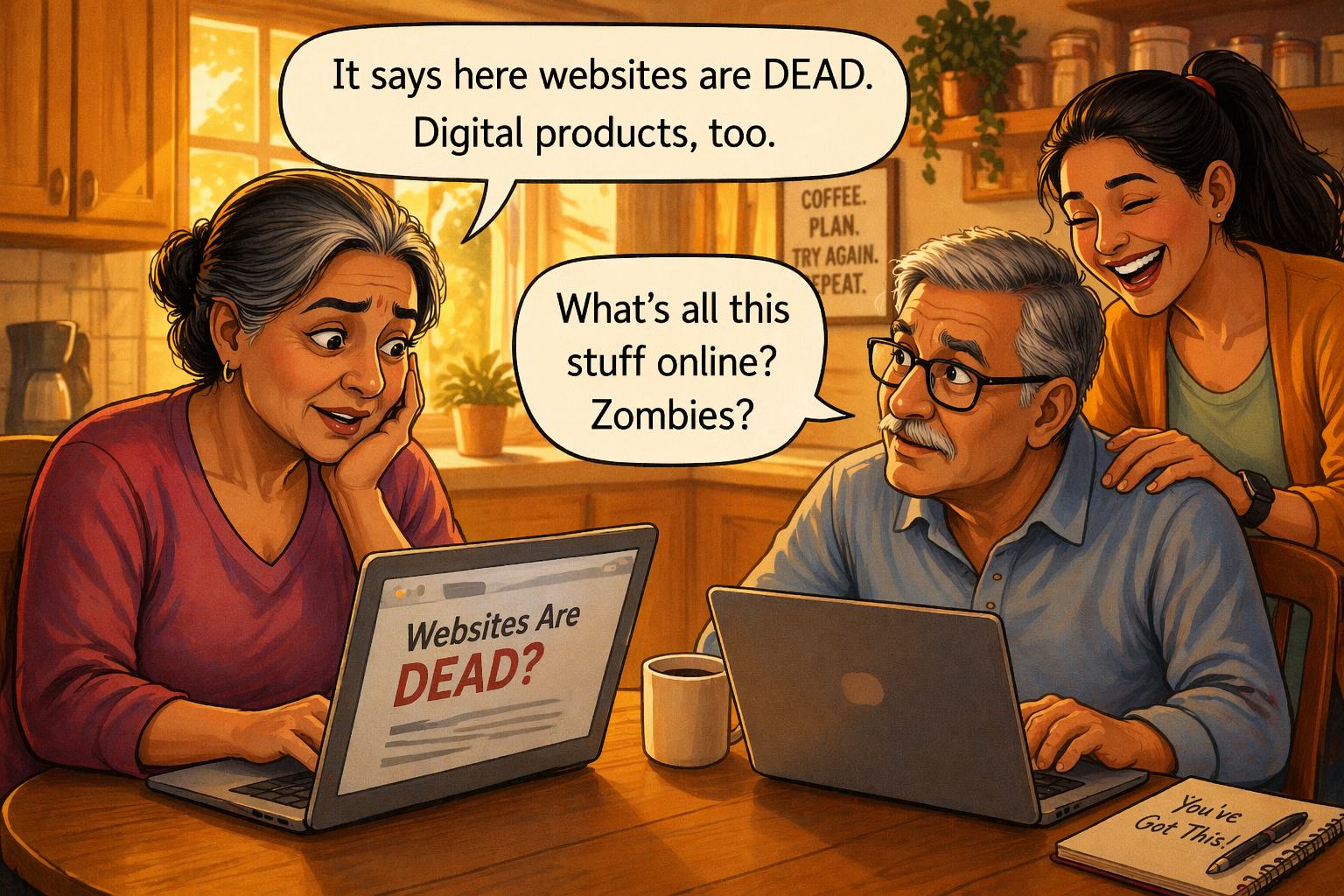
Keep your eye on the news for tech obituaries. We see ’em all the time.
Websites are dead.
Information products are dead.
Email lists are dead.
Give it a week and someone’ll say niches are dead… or maybe the whole internet.
If you’re just getting started, this can be unsettling. You finally pick a direction, then you see a headline telling you it’s already over.
Let’s slow that down a bit.
Because once you look closely, a pattern shows up. And once you see it, it’s hard to miss.
What’s Really Going On Behind Those Headlines
Here’s something worth noticing.
The people declaring these things “dead” are usually still doing them.
The YouTuber saying “digital products are dead” is selling a digital product.
The writer saying “websites are obsolete” is publishing… on a website.
That’s not hypocrisy. It’s a signal.
It tells you something important: these headlines are not neutral observations. They are attention strategies.
And attention matters. A lot.
“Websites are evolving” doesn’t travel very far.
“Websites are DEAD” spreads quickly—because people either agree with it or want to argue with it.
Either way, the algorithm wins.
That doesn’t mean there’s no truth in these claims. There usually is. But it’s narrower than the headline suggests.
That’s where people get tripped up.
What Actually Changed (and What Didn’t)
Let’s take the two big examples.
Websites
When someone says “websites are dead,” they’re usually talking about a very specific kind of site.
A passive, brochure-style site
No traffic plan
No email capture
No reason to return
That kind of site has always struggled. AI didn’t kill it. It was never doing much to begin with.
But a site that builds trust, publishes useful content, and gives visitors a next step? That’s still a solid asset.
You’re using one right now.
Information Products
Same story here.
When people say “info products are dead,” they’re usually pointing at generic content. Think:
- Repackaged basics
- Surface-level “ultimate guides”
- Content that can now be generated in seconds
AI has made that kind of material easy to get for free. So yes, that category is under pressure.
But that’s not the whole picture.
Information based on real experience, judgment, and application is still valuable. In some ways, it stands out more now because there’s so much generic material floating around.
That distinction matters more than it used to.
What Actually Gets “Killed” in These Shifts
There’s a useful way to think about this.
Two things tend to disappear when markets shift:
- Commodity versions of things
- People who don’t recognize the difference
Commodity content is easy to replace. If someone can get the same answer with a quick search or a simple AI prompt, there’s not much reason to pay for it.
But applied knowledge is different.
Someone who has tried something, adjusted it, and can explain what worked and what didn’t… that’s harder to replace.
That kind of insight still gets attention. It still earns trust. And it still sells.
The same applies to websites.
A site built only to chase keywords is increasingly squeezed.
A site built to help a specific person solve a specific problem still has a clear role.
This matters more than it seems.
Why These “Dead” Claims Spread So Fast
There’s usually an incentive behind the message.
The person declaring something dead often has something else to offer.
“Websites are dead… use this platform instead.”
“Info products are dead… switch to this model.”
That alternative might be useful. Sometimes it is.
But the framing creates urgency. And urgency tends to shortcut careful thinking.
For beginners, that’s where the risk shows up.
You start second-guessing a plan you haven’t even tested yet. You shelve ideas that might have worked perfectly well.
That’s where people get stuck.
A simple question helps here:
Is the person saying this still doing the thing they declared dead?
If yes, you’re probably looking at a positioning angle, not a full market analysis.
What This Means If You’re Getting Started
You don’t need to ignore change. Some things really do shift.
But the useful changes are usually quieter and more specific than the headlines.
If you’re building a website, build one with a purpose.
Know who it’s for
Know what problem it helps with
Give people a clear next step
That advice worked years ago. It still works now.
If you’re creating an information product, make sure it offers something that’s not easily duplicated.
That could be:
- Your experience
- Your way of organizing the material
- Your guidance during implementation
It doesn’t have to be complicated. It just has to be genuinely useful.
And if you see another “X is dead” headline?
Pause for a moment. Look at who’s saying it. Look at what they’re doing.
Then decide for yourself.
What You Can Do Next
If you’re in the planning stage, this is a good checkpoint.
Take a look at what you’re building and ask:
- Is this something people can get instantly for free?
- If not, what makes it different?
- Does it help a specific person move forward?
You don’t need perfect answers. But you do want honest ones.
That’s where clarity starts.
Let’s sum it up:
- “X is dead” headlines are usually designed to get attention, not deliver precise analysis
- The real change is narrower: generic, commodity content is getting squeezed
- Experience-based, applied knowledge still holds value
- Websites and info products still work when they serve a clear purpose
- A quick reality check (what is the speaker actually doing?) can cut through a lot of noise
Quick answers
Did AI kill information products?
It made basic information easy to get for free. Products built on real experience and guidance are still valuable.
Are websites still worth building in 2026?
Yes, if they have a purpose. A site that builds trust and guides visitors toward useful next steps is still a strong foundation.
How can I tell if a trend is real or just hype?
Look at behavior, not headlines. If the person warning you is still using the thing they say is dead, that tells you something.
What actually disappears in these shifts?
Mostly generic, easily replaceable content. Specific, experience-based work tends to stand up much better over time.