
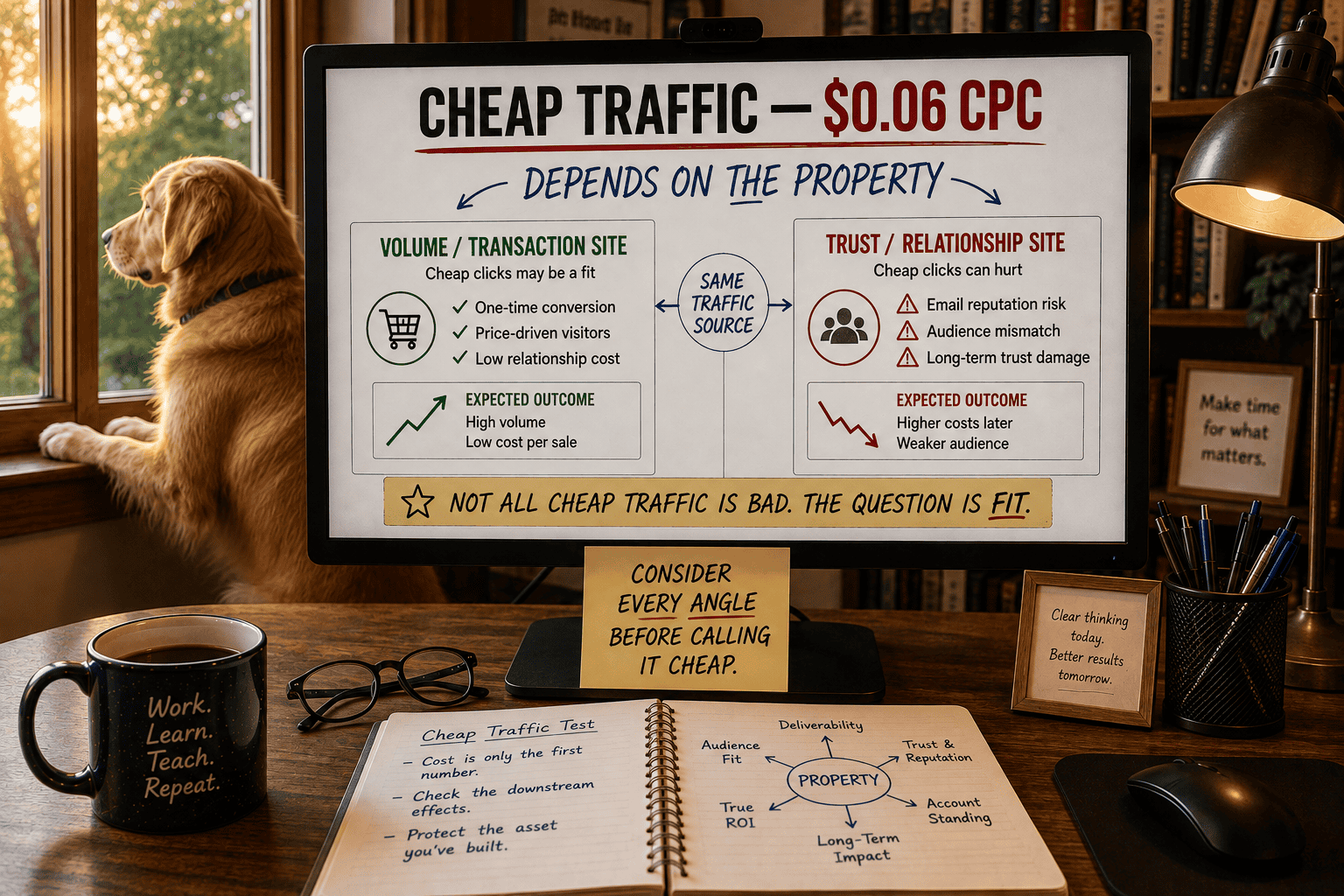
Here’s the gist:
Whether cheap, permissive traffic (push ads and similar networks) helps or hurts depends entirely on what the destination property is built on. A property that runs on trust and relationship can take real damage from traffic that arrives cheap and low-intent. A property built for volume and quick conversion can use that same traffic just fine. The sticker price tells you what you’re paying up front. It doesn’t tell you what you might pay later, somewhere else in the business.
The Part of the Pitch That Doesn’t Get a Bullet Point
Every traffic source gets sold on cost per click and cost per lead. Push ads are one of the cheaper options out there, and the pitch usually stops right there, at the number.
What the pitch leaves out is that traffic doesn’t arrive neutral. It carries habits from wherever it’s been. People who click push notifications tend to click fast and think about it later, if at all. The networks that carry that traffic tend to run a wide mix of advertisers, some of it far from clean. None of that shows up in the CPC.
I went looking into this for a reason. I was weighing a push ad test for one of my own properties, and it occurred to me partway through that the same traffic I was excited about for one project could quietly work against another.
Worth asking outright, since it’s the natural follow-up: even with clean ads running to my clean destination, could my property end up tainted by association? Yes, and for a mechanical reason, not a moral one. Referral logs, ad account reviews, and sender reputation get evaluated at the network level, based on where the traffic came from, regardless of how clean the specific campaign running on top of it happened to be.
Destination Fit, Again
I’ve written before about destination fit, the idea that a traffic source’s landing spot has to keep the promise that got the click in the first place. That post looked at it from the landing page side. This one looks at the same idea from the other direction: what the traffic source itself signals about you, before anyone even reads the page.
A discreet affiliate site built for a narrow, sensitive niche doesn’t lean on relationship. Nobody’s subscribing because they trust the person behind it. They want an answer to a specific question, click, convert or don’t, and move on. Cheap, high-volume, low-intent traffic is a reasonable fit there. The site was never promising a relationship, so it can’t really damage one.
A site like this one runs on the opposite model. People show up expecting a person behind it, a track record, some consistency between one post and the next. That’s the entire value proposition. Feed a site like that a pile of low-intent clicks from a permissive ad network, and the damage doesn’t show up as a bounced sale. It shows up as inflated unsubscribe and spam-complaint rates, which then follow the sending domain into every other email that domain sends, to the actual audience that does care.
Where the Cost Actually Lands
This is the part that doesn’t fit neatly into a spreadsheet, so it’s easy to skip past. A few places where cheap, permissive traffic quietly sends a bill later:
Email deliverability
Email providers track engagement and complaints per sending domain, not per campaign. Low-intent subscribers who never open, or who mark things as spam, drag down the reputation attached to every email that domain sends afterward. The cost isn’t paid by the campaign that caused it. It’s paid by the next one.
Ad account standing
If a site plans to run mainstream display ads down the road, referral logs from adult-adjacent or low-quality networks can get flagged by compliance systems on platforms that are choosier about where their ads show up next to.
Affiliate program standing
Sending traffic straight to an affiliate offer, with no property of your own in between, carries a version of the same risk on the merchant side. Most affiliate networks and individual programs spell out which traffic sources and traffic types are acceptable, and cheap or low-quality traffic sometimes falls outside that list even when nothing else about the promotion is dishonest. Skipping that reading is easy to justify when the terms run long. It can also cost more than a rejected campaign. Violations can mean withheld commissions or an outright account termination, on a program an affiliate may have spent months building a track record with.
Reader trust, slower to notice
This one’s the hardest to measure and probably the most expensive. A site that starts attracting an audience mismatched to what it’s actually offering ends up serving nobody well. The mismatch shows up gradually, in engagement that never quite builds, rather than in any single number you’d catch right away.
The Actual Question to Ask
Not “is this traffic source cheap” and not “is this traffic source shady.” The question that actually matters is narrower: what is the destination promising, and does this traffic arrive already believing that promise, or does it need to be sold on it from zero, cheaply, at volume, with whatever intent that implies?
A property that sells a single, well-understood product to a cold, indifferent audience can often afford traffic that doesn’t care much either way. A property that’s asking someone to trust it over time can’t. Same traffic source, two very different bills.
Core
Cheap traffic is a price. What you get for that price depends on the destination, not the traffic itself. Before testing any low-cost source, name what the property is actually promising its visitors, then ask whether this traffic already believes that promise or needs to be sold on it cold. Match the two and the economics tend to work. Mismatch them and the discount up front shows up later as a bill, usually somewhere you weren’t watching.
Quick Answers
Is push ad traffic always bad? No. It’s a fit question, not a quality question. It works fine for properties that don’t depend on ongoing trust or relationship with the audience.
What’s the biggest hidden cost? Usually email deliverability. Low-intent subscribers drag down sender reputation for the whole domain, not just the campaign that brought them in.
How do I know if a property is a good fit for cheap, permissive traffic? Ask what the property is actually promising the visitor. A one-time transaction can tolerate low-intent traffic. A relationship-based property generally can’t.
This is one article in a series where I’m exploring commonly recommended traffic sources.
Browse the full series →