
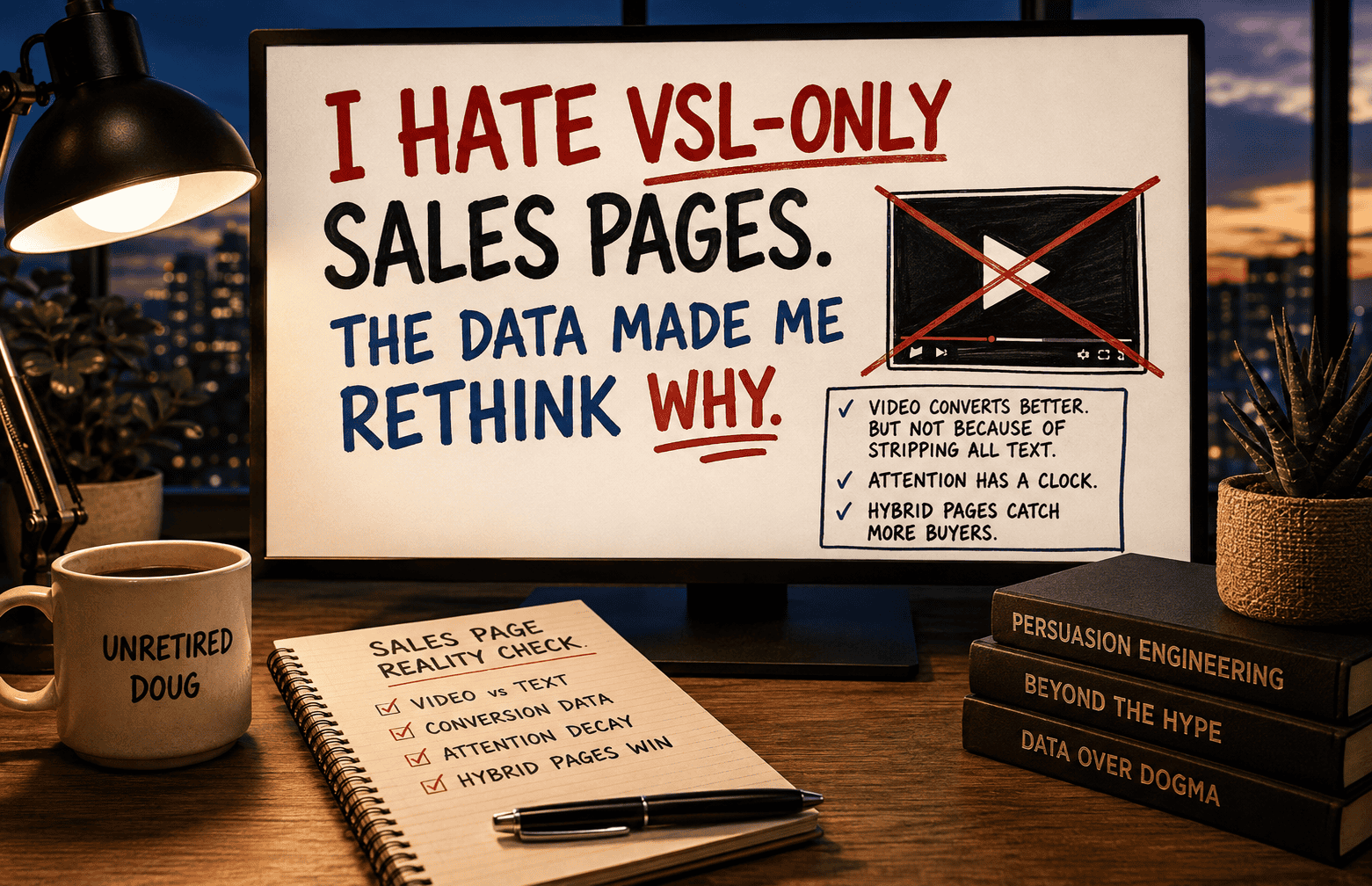
Quick answer: Video genuinely converts better than no video, but the specific claim that stripping all text off a video page is what drives that lift is thinner than it looks once you check where the numbers actually come from.
- Video’s general edge over text is well documented across independent sources, even if the exact percentage shifts depending on who ran the survey.
- The specific, precise-sounding “VSL converts at X% versus Y% for text-only pages” figures floating around marketing blogs mostly trace back to nothing. A commonly repeated citation doesn’t mean a study exists. I address the matter further in another post.
- Attention decays fast on longer video, which is the real mechanism behind why video-only pages can lose visitors that a hybrid page would have caught.
- Consumer preference for watching over reading shows up consistently across separate, real surveys, even though the headline number varies by source.
- None of the legitimate data settles the separate question of whether locking a page down with no transcript and a countdown timer is worth the resentment it can generate.
A recent email pitched me on an “AI SWOT” tool. The premise was solid: run an automated audit on a prospect’s business, surface a couple of sharp, specific weaknesses, and use that specificity to get past the reflexive delete that kills most cold outreach. Worth understanding as a technique, regardless of whether I’d buy it.
The email dropped me on a landing page with a headline, a subheadline, a video, and one button below it. What wasn’t there was a transcript or a written version of the actual pitch. Whatever case the video was building, watching the video was the only way to get it. No skimming ahead to the reasoning, no way to see what I was agreeing to before the button without sitting through the argument first.
I don’t like that setup, and I’ve studied this enough to know it’s not an accident. A headline and a button don’t cost a marketer control over pacing. The persuasive core does, and that’s exactly the part that stayed locked inside the video. It assumes my time is worth less than the marketer’s control over my attention.
It annoyed me enough to try for a work-around. The embedded player turned out to be domain-locked, which blocked the easy workaround, so I gave up and clicked away. The email gave me enough of a hint about the principle, if not the exact method, so I could research it later if I want. I passed on the offer not because the pitch was weak—heck, I didn’t stick around for it. From what the email told me, it involved solid persuasion principle. I passed because the underlying audit strategy carries a real risk of triggering defensiveness in the prospect that I can avoid with a nuanced approach, and I didn’t feel like sitting through a locked video to see if the seller could change my mind.
That left a separate question sitting there, apart from whether I enjoyed the experience. Does the video-only format actually convert better, or is it conventional wisdom nobody bothers to check? I went and checked it. Here’s what actually holds up, and where I landed after reading it.
What the Format Is Actually Doing
A video-only sales page isn’t just a video with the text deleted. It’s a deliberate attention funnel. One headline, one video, one button. No sidebar, no jump-to-pricing link, no way to scroll ahead and read the offer before committing to watch.
That constraint does something a text-heavy page can’t. It forces a binary choice on the visitor: stay engaged, or leave. There’s no middle path where someone skims the bottom third, decides they’ve seen enough, and buys without ever hearing the full pitch. The offer usually lands well into the video, after the presenter builds the case. By the time the button appears, the visitor has either bought into the argument or already left.
That’s the theory, and it’s not wrong. It’s also not the whole story, because a page’s job isn’t to hold attention. It’s to produce a sale, and those two goals only overlap up to a point.
What the Numbers Actually Show
Video’s advantage over no video at all is real and well established. Wyzowl’s annual State of Video Marketing survey, now in its twelfth consecutive year, has businesses using video as a marketing tool at 91 percent adoption in 2026, with 82 percent of marketers reporting a good return. That’s a large, repeated, named survey with a track record, not a single blog post citing itself.
The specific claim that shows up everywhere online, that VSL pages convert at some precise figure like 12.7 percent against 4.8 percent for text-only pages, citing a named benchmark report, does not hold up. I traced that exact citation back to its supposed source and found the real report behind it says something different: an overall median landing page conversion rate around 4 percent, with no VSL-versus-text breakdown at all. The specific numbers being passed around are attached to a real-sounding source that never produced them. That’s worth knowing before you build a page, or a pitch, around it.
A separate, older stat gets repeated almost as often: websites with video convert at 4.8 percent against 2.9 percent without. That one is at least consistent across sources, but the original study behind it is hard to pin down and it’s been circulating since at least 2020 under a few different attributions. Treat it as directionally useful, not as a precise current benchmark.
What’s genuinely well supported is the general preference for watching over reading. Separate surveys from Forbes (2010 to 2015-ish, an elderly survey, I admit), HubSpot, and Wyzowl’s own consumer-side data all land somewhere between 59 and 83 percent of people saying they’d rather watch than read, depending on exactly how the question was asked. The range moves, but the direction doesn’t. People do prefer video. What none of that tells you is whether removing every word of supporting text from a video page is the specific lever responsible for a conversion lift, because nobody publishes that narrower test.
Where the Whole-Video Approach Earns Its Reputation, and Where It Costs You Sales
The real mechanism worth understanding here is attention decay, and this part is well documented. Wistia’s video benchmarking, drawn from over a hundred million uploaded videos, shows viewers watching an average of 82 percent of a how-to video under a minute long, dropping to roughly half the video on average once length stretches out to the 1-to-30-minute range most VSLs live in.
That decay curve is the actual argument for video-only pages, and it cuts both directions. On one hand, a video-only layout gives attention nowhere else to go, which helps hold a viewer through a long pitch better than a page littered with scrollable text. On the other hand, that same decay curve means a meaningful share of visitors are gone before the offer ever appears, and a video-only page has nothing left to offer the visitor who drops off early. A page with two or three lines of proof content underneath gives that same visitor a second way to convert without finishing the video. Nobody I could find publishes a clean industry-wide number for how often that second path saves a sale, because it depends entirely on the offer, but the logic behind it is sound and it’s the reason experienced direct-response copywriters keep split-testing this exact tradeoff on their own campaigns rather than assuming the answer.
The conventional read treats video-only as automatically cleaner and therefore automatically better. Clean doesn’t pay anyone’s bills. Revenue per visitor does, and the only way to know which version wins for a specific offer is to test it, not to borrow someone else’s unverifiable number.
It Depends on Who Actually Shows Up
None of this holds steady across traffic types, which is the part most of the video-only advice skips entirely.
Cold traffic arrives with no context. Someone clicks an ad and lands on a bare video with no headline confirming what they’re about to watch. If the opening seconds don’t hook them, they’re gone, and a lot of that failure traces back to not knowing what they walked into. A single headline above the frame, something concrete like a specific outcome and a specific timeframe, anchors a cold visitor before the video has to do all the work alone.
Supposedly, warm traffic already trusts you. They’re coming from an email list, a webinar, a lead magnet they downloaded on purpose. Ordinarily, a bare page works fine here, because the extra text just slows down someone who already decided to show up. (I’ll admit it: I might be an oddball for not having the patience to watch a video from somebody I’ve purchase from before.)
Retargeting traffic sits in between. They’ve seen the brand before and didn’t buy. A single line reminding them why they clicked can lift both play rate and conversion, even if it costs a small amount of raw watch time.
What This Looks Like If You’re Actually Building the Page
Sub-hundred-dollar impulse offers generally do best video-only. If a video builds a clean story arc and lands every objection inside the narrative, adding bullets and trust badges underneath just introduces friction into a purchase that was always going to be driven by momentum, not deliberation.
High-ticket offers usually need something for the visitor who won’t watch a twenty-minute video start to finish. Three real client results with names and specific numbers, placed below the video, catch the skimmer who would otherwise bounce. That’s not clutter. That’s a second path to the same sale.
Physical products with real specs benefit from a hybrid layout. The video sells the experience. A collapsible spec sheet underneath answers the practical questions a video can gesture at but never fully cover, and it doesn’t cost the video-watcher anything since they never have to open it.
Free registrations, where you’re asking for an email rather than a card number, tend to convert best video-only. There’s less to overthink, so removing the decision paralysis matters more than adding proof.
None of that is a philosophy. It’s a toolkit, and the only way to know which tool your offer needs is to test the video-only version against a version with two or three pieces of genuine proof content, then check conversion specifically among the visitors who didn’t finish the video.
The Part No Split-Test Number Measures
Here’s what none of the legitimate data captures: how the forced-pacing design makes a skeptical visitor feel while they’re stuck inside it.
I’m the exact audience a page like that is built to convert, and I still resented the experience enough to go hunting for a way around it. That reaction isn’t in anyone’s conversion report, because a visitor who resents the page but converts anyway still shows up as a win. But resentment doesn’t stay contained to one transaction. It attaches to the brand, and it shows up later as a refund, a chargeback, or someone who never opens your next email.
A VSL doesn’t have to be hostile to be effective. Forced pacing and persuasive pacing aren’t the same thing, and the offers that hold up long-term tend to use the first only as much as the second requires. The legitimate data says video-only can be the right call for a lot of situations. It doesn’t say withholding the actual pitch behind a locked, transcript-free video is a requirement for that to work. Those are two different decisions wearing the same format.
A Simple Way to Approach This
If you’re building or evaluating a VSL page, run the test most people skip. Build the video-only version and a second version with two or three genuine proof points below the fold, nothing that repeats what the video already says. Send equal traffic to both. Then look specifically at conversion among visitors who dropped off before the halfway point, not just the overall number.
And before you build a page around a statistic someone else is citing, trace it back. A specific number attached to a well-known source name feels solid right up until you go looking for the report it supposedly came from. That habit costs a few minutes and saves you from building strategy on a number nobody actually measured.
The Short Version
Let’s sum it up:
- Video genuinely outperforms no video, backed by large, repeated, named surveys, not by the precise VSL-versus-text figures circulating online.
- The narrow question of whether removing all text specifically is what drives conversion isn’t answered by any public data. Test it yourself.
- Attention decays fast on longer video, which is the real, documented reason video-only pages can lose visitors a hybrid page would have caught.
- Traffic temperature and price point both change the right answer, so there isn’t one universal format.
- A forced, locked, transcript-free page can still convert well and still cost you long-term trust with the exact prospects who are paying closest attention.
Quick Answers
Does removing all text from a VSL page always increase conversions?
There’s no solid public data that isolates that specific variable. What’s well documented is that video beats no video in general, and that attention drops off the longer a video runs. Whether removing all text helps your specific offer is something you have to test, not assume.
My offer is expensive. Should I still go video-only?
Probably not without some backup. High-ticket offers tend to lose skimmers who won’t commit twenty minutes without seeing some proof first. A few real results below the video often recovers sales the video-only version quietly loses.
How do I actually know which format fits my offer?
Run both versions and check conversion specifically among people who dropped off before the halfway mark. That segment tells you whether support content is rescuing sales or just adding friction.
Is it wrong to keep a video’s actual pitch locked behind no transcript and a countdown timer?
It’s a legitimate tactic for some offers and audiences, but it carries a cost the conversion report won’t show you. A visitor forced through a pitch they resent still converts sometimes, and still remembers it later.