
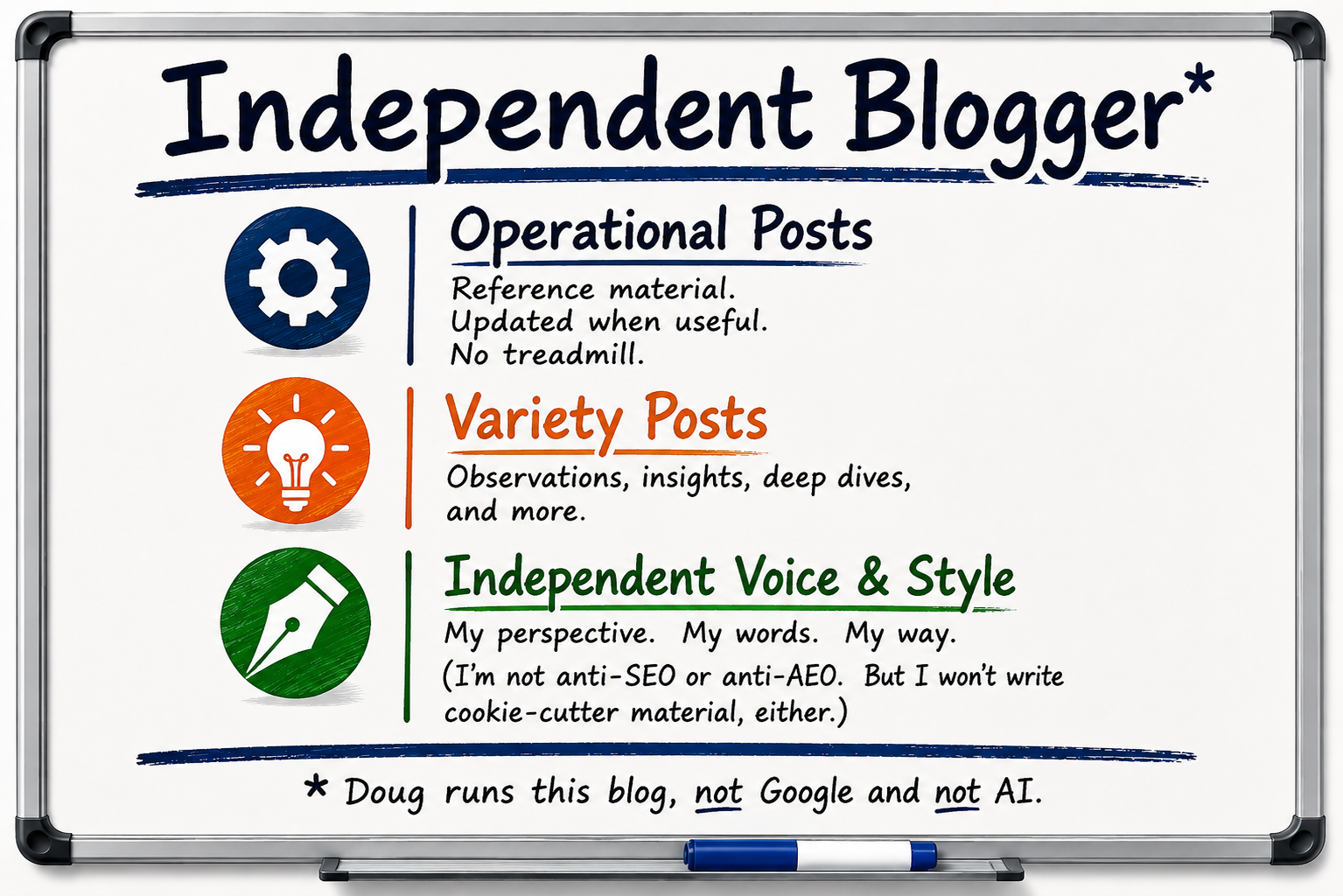
A note on how this section of the site works, and why it probably doesn’t look like what you expected.
If you’ve spent time in the online business world, you know what a “proper” blog is supposed to look like: titles engineered for search, post structures built around keyword clusters, a content calendar ticking in the background like a second job. Every article formatted to satisfy an algorithm before it gets to satisfy a reader.
That’s not what’s happening here, and it’s worth explaining why.
The one thing I’ve ruled out
I have nothing against traditional blog content. You’ll find plenty of it here: articles that explain how things work, observations, commentary, the occasional deep dive. That’s not going away.
What I’ve ruled out is letting SEO and AEO requirements determine my voice or my schedule.
There’s a particular kind of writing those systems quietly demand: a homogenized format, a predictable structure, a cadence driven by publishing pressure rather than genuine readiness. Follow it long enough and the writing starts to feel assembled rather than thought through. The voice gets sanded down to match what crawlers reward, and somewhere in that process the author disappears.
I’m not interested in that trade.
Why that’s not just a preference anymore
Search itself has changed since I first wrote this article. A growing share of searches now end without a click at all. AI Overviews and answer engines increasingly hand someone the answer directly instead of sending them anywhere, this blog included. Being quotable buys a mention. It doesn’t buy a reader.
That matters here. If most of the traffic that actually reaches this blog is going to arrive some other way regardless, changing how I write to please a system that usually won’t send anyone here in return doesn’t make sense.
The two decisions, not one
There are really two separate calls I make on every post, and both are mine.
The first is whether it goes up at all. If I think it will help the person reading it, it goes on the blog. That part hasn’t changed.
The second is whether I format it just for human readers, or whether I try to help the bots too. Where a clear title, a real meta description, or a structure that helps someone scan the article happens to make a piece both easier to find and easier to read, I’ll do that. Where SEO or AEO convention would flatten the piece instead, forcing that same homogenized format, predictable cadence, and sanded-down prose I mentioned above, that loses. Every time. Including on the planned, deliberate series work I write with findability in mind on purpose, not just the one-off posts. Wanting a piece to be found doesn’t hand that goal a veto over whether the piece is actually enjoyable for a human to read.
I’ve written more on how that plays out for the deliberate series work specifically in “Everyone’s Mad About AI Slop. Here’s What to Do Instead” The short version: I’ll play the visibility game reasonably well when I can do it without that trade. I won’t play it at the reader’s expense.
What you’ll actually find here
Posts written when there’s something worth saying, in whatever form fits the material. Some operational and reference-grade. Some traditional blog fare. Some that don’t fit neatly into either category. The schedule is mine, not a content calendar’s. The structure serves the piece, not a template.
The older posts here stay as written, unless I have reason to update them (as with this one). New ones will appear on my terms.
Come back when you feel like it
I won’t promise to hold to a schedule, but I’ve gotten better at managing the site, and that helps me post pretty frequently, at least once a week, and usually more.
Soon, I’ll set up a newsletter, and you’ll see sign-up opportunities on the home page and here and there throughout the site.
In the meantime, I’m happy that you’re here, and you’re welcome back any time.