
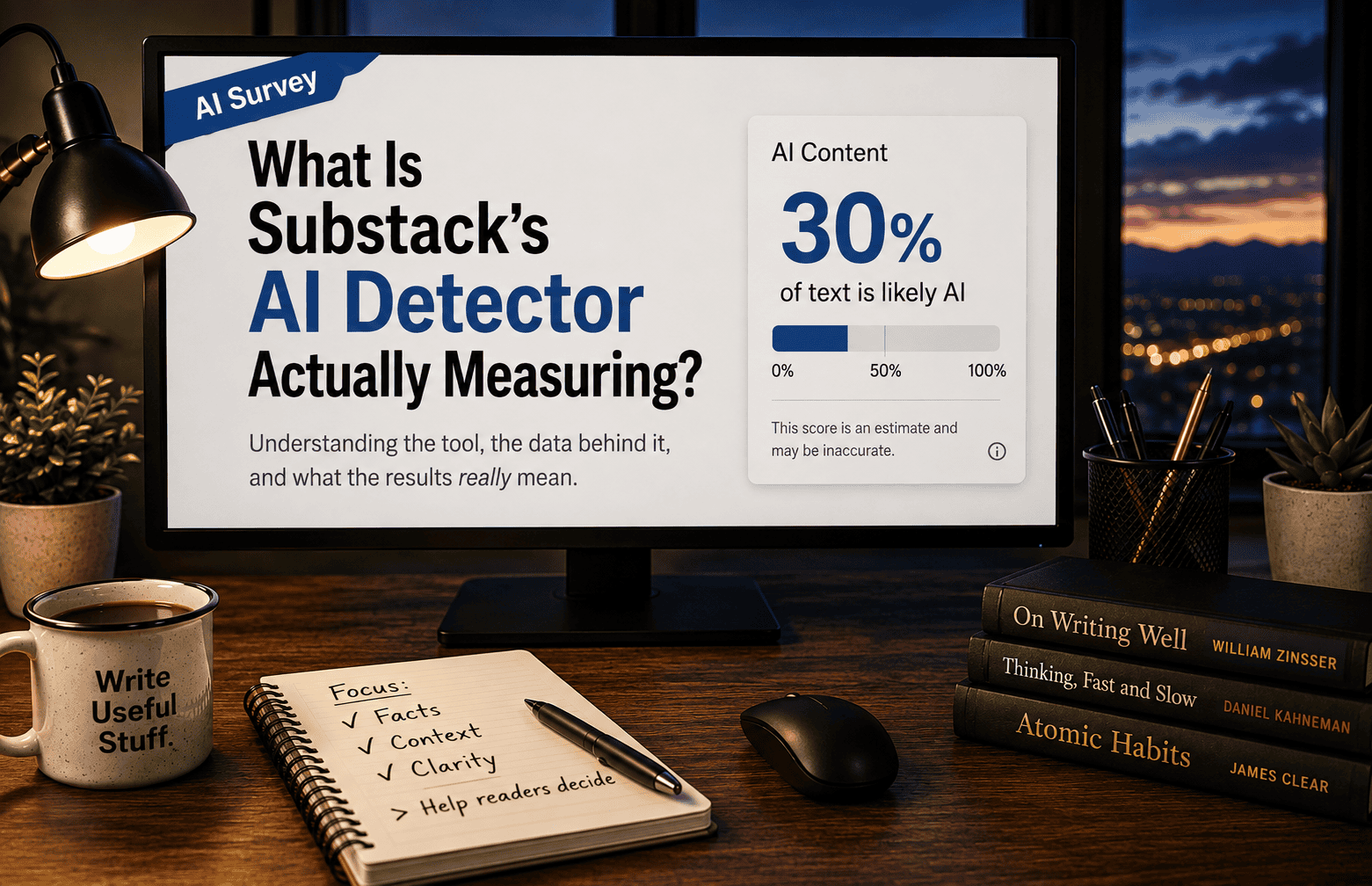
Quick answer: Substack launched an AI detection feature on July 21, 2026, powered by a tool called Pangram. Readers can scan any post, note, or comment and see a percentage breakdown of how “human” or “AI” the text appears. Substack isn’t banning AI writing or requiring disclosure. It’s betting that transparency, not policy, is what protects reader trust. The problem is that the tool measures whether text sounds like AI, not whether a human actually did the thinking behind it. Those turn out to be very different questions.
What Substack Actually Launched
Substack calls the moment a reader realizes a piece they trusted for its human voice was AI-generated “Claudefishing.” That’s the title of CEO Chris Best’s announcement post, and it’s a sharper name for the problem than “AI detection” is.
The mechanics are simple. Tap the three-dot menu on any post, note, reply, or comment published on or after July 21, 2026, and Pangram scans it. You get a percentage: human-written, AI-assisted, or AI-generated. The scan only appears when someone requests it. Nothing gets flagged automatically, and nothing shows up publicly unless the reader chooses to look.
Writers can also disable detection on their own posts, run Pangram on drafts before publishing, and add an optional statement explaining how they use AI in their process. Substack is positioning all of this as a market signal, not a rule. Best has been direct that the company isn’t trying to become the AI police. He’s also been direct that Pangram can’t measure whether care went into a piece, only whether the sentences pattern-match to machine output.
That admission matters more than it sounds like it should. It’s the crack the whole feature is built on top of.
Why the Detector Measures the Wrong Thing
Here’s the gap. Pangram answers one question: does this text look like something an AI produced. It cannot answer the question a reader actually cares about, which is whether a human was behind the thinking, the judgment, the natural flow of the prose, and the decision to publish.
Those things get treated as the same question. They aren’t.
A writer named J.M. Gooding posted a demonstration that made this concrete. He pasted a chapter opening into the scanner. Result: 100 percent human. He fixed a single typo, “latter” instead of “ladder.” Result: 100 percent AI-assisted. He deleted one word to break a sentence on purpose. Result: 100 percent human. He added the word back. Result: 100 percent AI generated.
One word, in a 300-word sample, flipped the verdict from fully human to fully machine and back again. That’s not a tool measuring authorship. That’s a tool measuring surface texture, dressed up to look like it’s measuring something deeper.
The em dash controversy is the same problem from a different angle. The most repeated “tell” for AI writing is supposedly heavy em dash use. But some very great writers have leaned on em dashes as a real prose device, Hemingway, Dickens, Woolf, and Nabokov, to name a few. Each used the dash to do a completely different job: interrupting a thought, adding a dramatic pause, controlling rhythm, tucking in an aside without the formality of parentheses.
If em dash frequency alone were proof of AI authorship, all of that classic prose should trip the same alarm. It doesn’t, because the actual signal was never the punctuation mark itself. It’s how predictably and repetitively it gets used. A writer with real range uses the dash differently depending on what the sentence needs. A tool trained to spot “AI-shaped” prose is really spotting a narrower kind of predictability, and punishing anyone, human or machine, who happens to write in that register.
What Creators Are Actually Saying
I spent some time reading through creator reaction on Substack Notes since the launch. There’s a real range of opinion in there, disability advocates raising accessibility concerns, legal-minded posters flagging defamation exposure, writers annoyed at having to manage a new setting on every single post.
But if I had to compress the dominant sentiment into one line, it’s this: are you joking? It doesn’t work.
I’ll add my own sentiment here too. If the information is accurate and my reading experience is good, fiction or non-fiction, I don’t care if AI was used in producing it.
That’s not one outlier reaction. It shows up again and again, from writers running their own long-worked drafts through the scanner and getting a 100 percent AI-generated result on something that took them ten hours, to writers pointing out that a tool this unreliable shouldn’t get to sit next to their name looking like a verdict.
The skepticism isn’t really about whether AI-assisted writing is acceptable. Most of the people reacting already use AI in some part of their process, openly. The skepticism is about a platform putting a confident-looking number next to their work when that number can be flipped by fixing a typo.
Why Substack Is Doing This Anyway
None of this happened in a vacuum. A GPTZero analysis found that at least 10 of Substack’s top 100 newsletters were using AI in some capacity, with 7 relying on it significantly. That means a meaningful slice of paying subscribers may be reading, and paying for, content they assume is one thing and is actually another.
Substack’s entire business model runs on the promise of a direct relationship between a specific writer and their audience. If that promise quietly stops being true for a chunk of top newsletters, the platform has a trust problem bigger than any single detector’s accuracy rate. Best’s stated logic is that he’d rather get ahead of that erosion now, while it’s still manageable, than wait until Substack starts looking like the more AI-saturated corners of social media.
That’s a defensible business instinct. It just doesn’t fix the fact that the tool they picked to execute it can’t do what it’s being asked to do.
The Real Question for Readers
I don’t give a beautiful, enjoyable campfire extra points because someone rubbed two sticks together to get it going instead of using a match. I care that the fire is warm and it’s burning well.
That’s the whole disagreement in one image. Pangram is trying to grade the fire based on how it got lit. Readers who show up for a newsletter don’t actually want to know the ignition method. They want to know if the piece is worth their time, if it’s accurate, and if the person whose name is on it actually stands behind it.
A percentage score can’t answer any of that. It can only tell you the text has a certain statistical shape, one that a careful human editor and a careless AI generation can both produce, and one that a careless human and a carefully directed AI collaboration can both avoid.
The better question isn’t “how much of this did AI write.” It’s “did the person publishing this do the work of making sure it’s good, true, and worth reading.” No detector, however accurate, answers that. Only the writer’s own track record does.
Quick Answers
Does Substack ban newsletters that use AI writing tools?
No. The detection tool is optional and meant for transparency, not enforcement. Writers can disable detection on individual posts.
Can readers see AI detection results without asking?
No. The scan only appears when a reader clicks the three dots and requests it. Nothing is shown automatically or publicly.
What happens if the detector flags human writing incorrectly?
Writers can report and remove scans they believe are mistakes, and can disable detection entirely on any post.
Does the detector work on older posts?
No. It only scans content published on or after July 21, 2026.
Can writers test their own drafts before publishing?
Yes. Pangram can be run on unpublished drafts from the Publish page, so a writer can see the analysis before any reader does.