
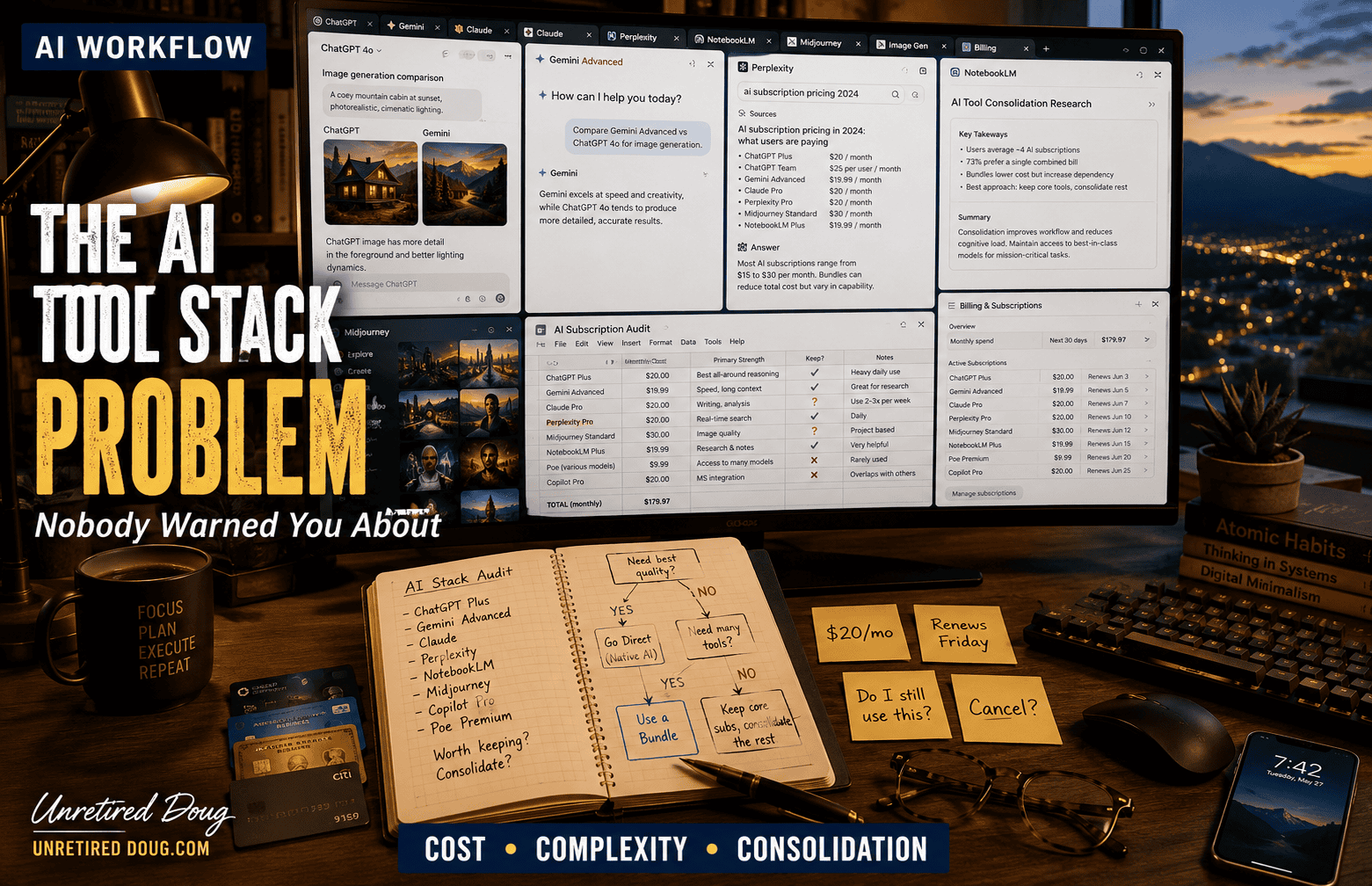
Here’s the scoop:
- The average paying AI user now runs about four subscriptions at roughly sixty-six dollars a month, and most say they want a single combined bill instead.
- All-in-one bundles like Magica cut cost and cognitive load but add a dependency risk: you’re trusting one intermediary to keep pace with every frontier model.
- On a head-to-head test, Gemini generates images faster than ChatGPT, but ChatGPT tends to win on detail and prompt accuracy — bundled tools trade some of both for workflow coordination.
- Magica automatically deletes generated media after thirty days, which makes backup discipline non-negotiable regardless of which AI tools you use.
- The practical fix isn’t picking one camp: keep direct subscriptions for the one or two tools you genuinely exploit, and consolidate everything else.
There’s a moment every independent publisher hits, usually around the third or fourth AI subscription, where you stop and ask what you’re actually paying for. Not in a dramatic way. Just a quiet, mildly annoyed moment while scanning a credit card statement, wondering why you have four different chat assistants and can only remember what two of them are good at.
That moment is becoming universal. Recent survey data puts the average paying AI user at roughly four subscriptions and about sixty-six dollars a month, with a lot of people saying they plan to add more, not fewer. At the same time, more than half admit they can’t really afford everything they want, and pricing across the space is starting to feel less like a marketplace and more like a maze. Reddit threads and creator forums are full of the same complaint: too many tools, too much overlap, too little clarity on what any of it is actually buying you.
If you’re running a publishing or content operation with any real surface area — newsletters, a blog, a storefront, some affiliate work, maybe a book or two — this isn’t background noise. It’s a direct hit on your margins and your attention, two things you don’t have infinite supply of.
Two Camps, One Underlying Tension
Frequent AI users have split into roughly two schools of thought, and neither is wrong.
The first group stays loyal to the flagship tools directly — OpenAI, Anthropic, Perplexity, and so on — on the theory that going straight to the source gets you the best model performance, the fastest access to new capability, and the fewest weird limitations. This is the “pay for what you actually need, from whoever builds it best” position.
The second group is actively trying to shrink the stack. They pick one base model, lean on it hard, and fill gaps with pay-per-use API calls instead of piling on more monthly subscriptions. This is the audit-and-consolidate position, and it’s gaining ground. Roughly three-quarters of frequent users now say they’d prefer a single combined bill for their AI tools rather than a pile of separate ones.
That tension — performance-through-specialization versus simplicity-through-consolidation — is exactly the space a new category of “all-in-one AI super agent” products is trying to occupy. Magica is one of the more visible examples: a single subscription that bundles chat and image generation from multiple underlying models and runs multi-step workflows on your behalf, marketed explicitly as a replacement for the pile of separate subscriptions you’re probably already carrying, often at something close to a quarter of the combined cost.
It’s a reasonable pitch. It’s also worth being honest about what it actually trades away.
What You Gain, What You Give Up
The case for consolidation is straightforward. You cut cost — several twenty-to-thirty-dollar subscriptions collapse into one mid-teens bill. You cut friction — one login, one interface, no more deciding which tool handles which task. And you cut a surprising amount of mental overhead that most people don’t notice until it’s gone: the constant low-grade decision-making about which model to open for which job.
The case against it is just as straightforward, and it’s the part that matters more if you’re building something that needs to last. When you route everything through a single aggregator, you’re trusting one intermediary to keep pace with every frontier model, every policy change, and every feature release across an industry that moves quarterly, sometimes monthly. If that intermediary lags, or changes terms, or has an outage, the bottleneck isn’t the underlying model anymore. It’s them.
There’s also a track record problem. The flagship model providers have been operating long enough to have visible histories on uptime, data handling, and how they treat paying customers when something breaks. A newer orchestration layer sitting on top of those models hasn’t had time to build that same record yet. That’s not a condemnation — every company starts somewhere — but it’s a real variable, and it’s one you’re accepting on faith rather than evidence when you commit to a bundle.
This is the same dependency question that shows up everywhere else in independent publishing, just wearing a different outfit. Convenience is wonderful. Dependency is more dangerous. The tools change. The question of who’s actually holding your workflow together doesn’t.
There’s a concrete version of this worth flagging before it becomes a real problem instead of a hypothetical one. Magica’s own help documentation states that generated media is stored for thirty days and automatically removed after that to maintain server efficiency, which means anything you don’t download in that window is simply gone. That’s not a criticism specific to Magica — it’s a reasonable policy for a company managing storage costs across millions of generated files. But it’s exactly the kind of detail that gets skipped when someone’s evaluating a tool based on the sales page instead of the fine print.
The broader point holds regardless of which tool you’re using: consistent backup discipline matters no matter how good the platform is. If that’s a genuine sore spot for you — if you know yourself well enough to know you won’t reliably download everything within a storage window — that’s a real argument for keeping your heaviest-use tools on a direct subscription, where retention policies tend to be longer and where you’re paying for reliable storage as much as raw generation quality. But even then, don’t let a longer retention window replace an actual backup habit. Platforms change policies, get acquired, or shut down. The only storage you can fully trust is the one you control.
A Concrete Case: Speed Versus Quality in Image Generation
Here’s a small, useful test case, because it’s easier to reason about tradeoffs with a specific example than with abstractions.
Run the same detailed, multi-constraint image prompt — the kind with specific composition rules, text elements, and a lot of small details that all have to land correctly — through Gemini, ChatGPT, and a bundled tool like Magica, and you’ll notice something immediately. Gemini comes back fast. Reviewers and side-by-side testers consistently report Gemini returning complex images in something like ten to twenty seconds, where ChatGPT can take several minutes on the same kind of prompt. Google has apparently optimized deliberately for that snappy first-result feel.
But speed isn’t the whole story. Head-to-head comparisons tend to find that ChatGPT more often wins on detail, realism, and nuanced prompt-following — the things that matter when you’re generating a portrait, a complex lighting setup, or anything with legible text baked into the image. Several in-depth reviews explicitly call Gemini the speed winner and ChatGPT the quality winner on the same prompt.
Where does a bundled tool like Magica land in this comparison? Slower than either, usually, and for a structural reason rather than a quality one. Magica isn’t a single tightly integrated model — it’s an orchestration layer sitting on top of several backend models, chat and image alike, coordinating multi-step workflows. That coordination has value, but it isn’t free, and on a pure “prompt in, image out” task it shows up as latency. The tool isn’t built to win a speed race against a native single-model generator. It’s built to save you from stitching five separate tools together for a task with five separate steps.
That’s the pattern worth remembering, not just for image generation but for the whole subscription-stack question: specialized tools tend to win on the specific thing they’re specialized for. Bundled tools win on everything else — the coordination, the handoffs, the parts of a workflow that would otherwise require you personally.
What the Weeks Actually Look Like
If you consolidate hard into a single bundle, the maintenance burden goes down, but it doesn’t go to zero. You’ll still hit moments where the bundle’s version of a task underperforms what a native tool would give you — a portrait that doesn’t quite land, an edit that takes three tries instead of one — and you’ll have to decide each time whether that’s worth solving with a one-off subscription or just living with.
If you stay fully unbundled, the opposite happens. Your monthly cost creeps upward in increments small enough that no single charge feels like the problem, and your actual working time gets fragmented across interfaces that all do roughly the same core thing with slightly different quirks. That fragmentation is the real cost, more than the dollar figure. Every time you have to remember which tool handles which task, you’re spending attention that should be going into the work itself.
Most workflow-heavy operators end up somewhere in the middle, whether they plan it that way or not. A couple of direct, strategic subscriptions to the tools that do something uniquely well for their specific work, and a bundle or lighter tool underneath for the repetitive, lower-stakes tasks that don’t need best-in-class output every time.
A Simple Way to Approach This
Before adding or cutting anything, sort your current AI spend into two lists.
List one: tools you use because they do one specific thing better than anything else you’ve tried — long-form drafting, deep research, a particular image style, whatever it is for your work. These earn a direct subscription. You’re not paying for convenience here. You’re paying for a capability gap.
List two: tools you use interchangeably, where you couldn’t confidently say why you’re using this one instead of that one except habit. This is your consolidation candidate list. A single bundled tool, or a pay-per-use API arrangement, will almost certainly serve this list better than three or four overlapping monthly subscriptions.
Do that sort honestly, and the decision about whether something like Magica belongs in your stack tends to answer itself. It’s not a universal yes or a universal no. It’s a question of which list a given task actually belongs on.
Where This Leaves You
The subscription fatigue showing up in survey data isn’t a temporary complaint — it’s a sign that the AI tool market grew faster than most people’s ability to rationally manage what they were buying. Consolidation tools are a real response to a real problem, not just marketing noise. But consolidation has a cost too, mostly in the form of dependency on a newer intermediary and a modest hit to output quality or speed on the tasks where a specialized native tool would do better.
What matters here: keep direct subscriptions for the handful of tools where you genuinely exploit something unique, and let a bundle or lighter tool absorb the repetitive, lower-stakes work. That’s not a compromise position. It’s the version of this decision that actually holds up over a year of real use, instead of looking good for one enthusiastic sign-up week.
This post is part of the AI Survey series, where I take a hands-on look at different AI tools and how they actually perform for solopreneurs like me. Browse the full series →
Questions Worth Asking Before You Change Anything
Is a bundle like Magica actually cheaper once you account for what it doesn’t do as well?
Usually yes on raw dollars, but run the comparison against your actual usage, not the marketing number. If you rarely need top-tier image quality or the fastest possible turnaround, the savings are real. If your work leans on the specific strengths of one flagship tool, the “savings” can quietly cost you output quality you’d have to make up somewhere else.
Should I cancel a direct subscription the moment I try a bundle?
No. Run them in parallel for a few weeks on real tasks, not test prompts, before cutting anything. The gap between a bundle and a native tool shows up unevenly — sometimes it’s invisible, sometimes it’s the difference between shippable and not.
What’s the actual risk of relying on an aggregator instead of the model providers directly?
Mainly continuity risk. You’re trusting a smaller, newer company to keep integrating new models and features as fast as the underlying providers ship them, and to stay reliable while doing it. That risk is manageable, not disqualifying — but it’s worth naming rather than assuming away.
Is speed or quality the better thing to optimize for in image generation specifically?
Depends on the job. Fast iteration and rough drafts favor speed — that’s Gemini’s lane right now. Anything you’re actually shipping, especially with fine detail or legible text, favors quality — that’s still ChatGPT’s edge in most comparisons. Match the tool to the stakes of the specific image, not to a general preference.
How long do bundled tools actually keep what they generate for me?
Check the specific tool, because this varies and it matters more than most people assume before they get burned once. Magica, for example, states plainly that generated media is stored for thirty days and then automatically removed to manage server load — after that window, it’s gone unless you downloaded it. Treat that as the norm to plan around, not the exception, and build a same-day or same-week download habit rather than trusting any platform’s storage as a long-term archive.