
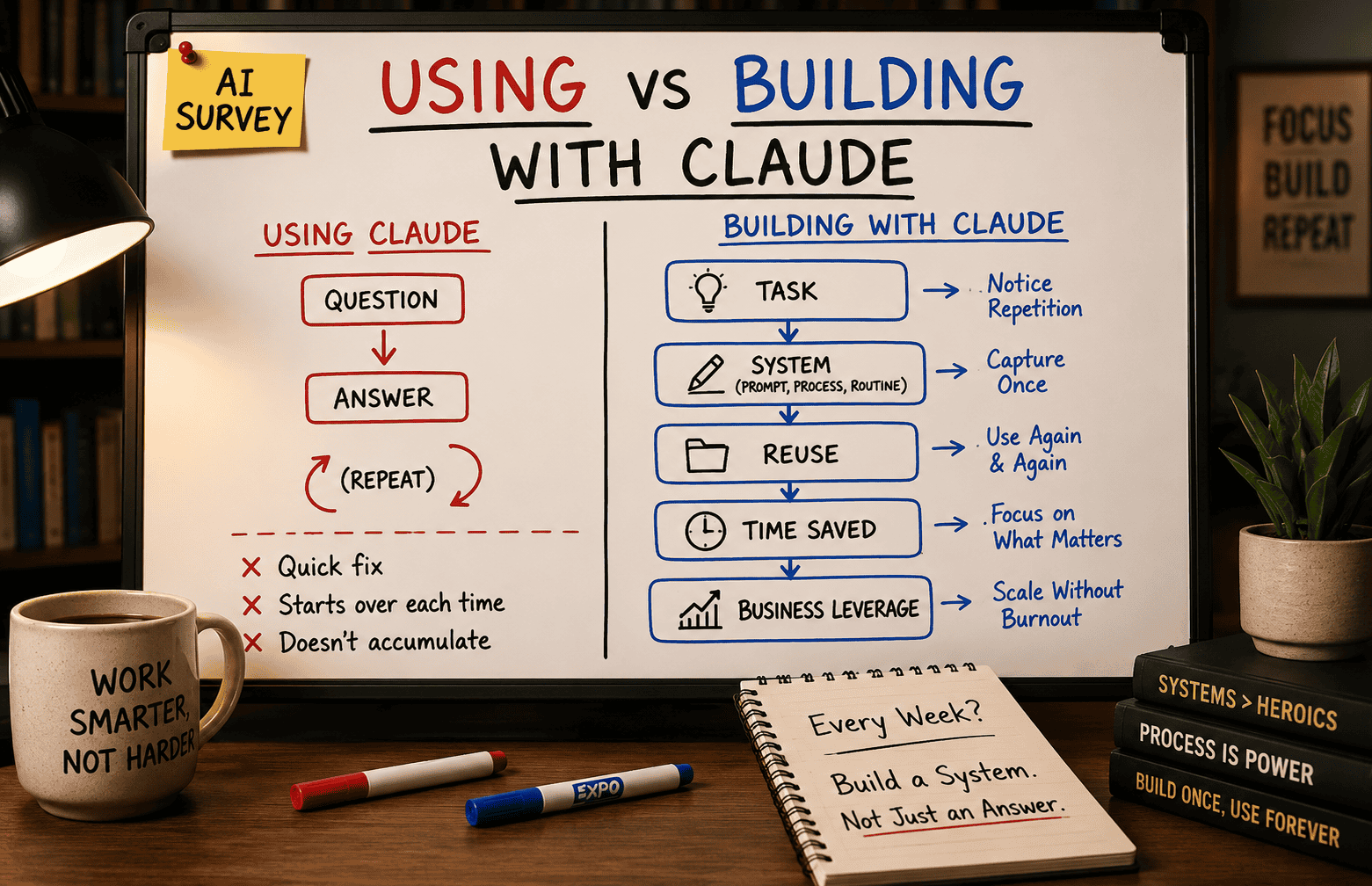
Most people stop at getting good answers. The shift that actually changes how a business runs is smaller than it sounds, and easy to miss entirely.
If you only read one paragraph: the businesses getting real leverage from Claude aren’t the ones asking better questions. They’re the ones who stopped rebuilding the same answer every week and started keeping it.
- Asking Claude a question and getting a good answer doesn’t accumulate into anything. The next time the same task comes up, you’re back to zero.
- A system, in practical terms, is nothing more than a saved prompt, process, or routine you can run again instead of re-explaining the task from memory.
- The tasks worth systematizing are the ones you already know will repeat. Something that only felt urgent once isn’t a candidate, no matter how good the answer was.
- Building a system costs more time up front than a quick question does. That extra time is exactly what turns into hours saved later.
- Systematizing something before you actually know it repeats wastes more time than it saves. Noticing repetition is the skill, not building reflexively.
- The real payoff isn’t sharper answers. It’s a business that keeps functioning on the days you aren’t the one operating it.
There’s a particular relief people feel the first time Claude gives them exactly what they needed. A sharper email, a cleaner outline, an answer to something they’d been putting off looking up. It feels like progress, and it is, mildly. What it isn’t is the thing that actually changes how a business runs. That takes a different habit, and it has almost nothing to do with how well you phrase a question.
Most people never get past the first habit. They ask, they get something useful, they move on. Each exchange is fine on its own and forgotten by the next one. That’s not a criticism, exactly. It’s just a description of where most people’s use of the tool tops out, and it’s worth being honest about which side of that line you’re actually on.
Why the Prompting Advice Only Gets You Partway
Most of what gets written about using Claude well is prompting advice: be specific, give context, show an example, name the format. It’s good advice, and it’s not wrong to start there. It became the standard advice for an honest reason, too, since it’s teachable in a paragraph and the improvement is immediate. Write a clearer prompt, get a visibly better answer, feel like you’ve learned something. You have.
But prompting technique tops out at making each individual exchange better. It doesn’t touch the deeper problem, which is that a business built entirely on individual exchanges never accumulates anything. You can get flawless answers to the same category of question for years and still be doing the same manual work you were doing on day one, just with better phrasing. A good answer is convenient. A system is durable. Confusing the two is where most people stall.
The deeper reality is that the leverage was never in the question. It’s in whatever you build once and don’t have to rebuild. That’s a different skill than prompting, and almost nobody teaches it, because it’s less immediately satisfying to explain and slower to show results.
What a System Actually Is, In Practical Terms
None of this requires software or a technical setup. A system, here, is just anything you’ve captured well enough to reuse: a saved prompt for a report you generate monthly, a written process for onboarding a new client, a routine you run every Monday morning without reconstructing it from scratch. The bar is low. If you can hand it to yourself in six months and it still works, it’s a system. If you’d have to remember how you did it last time, it isn’t yet.
The test that matters is repetition, not importance. A one-off task can be very important and still not be worth systematizing, because you’re only going to do it once. A small, boring, recurring task is often the better candidate, precisely because it comes back. The instinct to systematize the big, exciting thing and ignore the small, tedious, weekly one is backwards, and it’s the most common mistake people make once they’ve heard this idea and want to apply it immediately.
Author’s note: Claude Projects are one specific type of system in Claude. As I write this, I have 18 projects open. They’re an essential business-organization and building feature for me now. In an upcoming article, I’ll go into Projects in detail (and I’ll place a link here). Below on this page, you’ll find links to all the articles in my AI Survey series, where I share what I’m learning about Claude and other AI tools as I go.
What This Looks Like Week to Week
In practice, the shift shows up as a habit of noticing, not a big infrastructure project. You’re doing a task, you have a small moment of recognition, I’ve done this exact thing before, and instead of powering through it again, you take the extra few minutes to capture it as something reusable. Most weeks that’s one or two moments, not a dozen. The system-building itself is usually quick, an afternoon at most for anything short of a genuinely complex process, and Claude can do most of the actual capturing if you describe the task and ask it to turn your rough process into something reusable.
The friction people hit isn’t building the system. It’s the pause before that, the discipline of stopping mid-task to ask whether this is worth keeping. Skip that pause enough times and you end up exactly where you started: competent at getting good answers, with nothing to show for months of them. The maintenance burden afterward is real but modest. Systems drift as your business changes, and a system built for how you worked last year quietly stops fitting how you work now. Revisiting the handful of systems you rely on most every few months is enough to catch that before it costs you anything.
The wasted-effort trap runs the other direction from what people expect. It’s not that people build too few systems. It’s that once the idea clicks, they overcorrect and try to systematize everything, including tasks that turn out to be one-time or that change too much between instances to reuse cleanly. That’s more setup work for less payoff than just doing the occasional odd task by hand. Judgment about what’s actually recurring matters more than enthusiasm for building.
Whether This Fits How You Actually Work
Some of this comes down to temperament, and it’s worth being honest about that instead of pretending the habit suits everyone equally. People who enjoy building infrastructure will find this genuinely satisfying, the kind of work that feels like progress even when nothing urgent got handled that day. People who are energized by the immediate, the next fire, the next question, tend to find system-building tedious and will need to treat it as a discipline rather than something that comes naturally, the way some people need a scheduled time to do the accounting they’d otherwise avoid indefinitely.
Neither temperament is wrong, but only one of them builds something that outlasts the founder’s daily attention. A business that runs entirely on your ongoing effort, however well-prompted that effort is, stays fragile in a specific way: it stops the moment you do, whether that’s a sick week, a vacation, or just a day you’d rather not think about work. A business with even a modest collection of real systems keeps functioning without you in the room, which is a different kind of asset than a stack of good answers you happened to generate.
A Simple Way to Start
You don’t need a plan for this, and you don’t need to sit down and audit your entire operation looking for candidates. The next time you catch yourself doing something that feels familiar, something you’re fairly sure you did last month in almost the same way, stop there. Describe the task to Claude and ask it to help you turn it into something reusable, a prompt, a checklist, a routine, whatever the task actually calls for. Do that once this week. That’s the whole start. The habit builds from repetition of noticing, not from a big initial push.
Core
Let’s sum it up:
- Asking good questions makes each answer better, but it doesn’t accumulate into anything on its own.
- A system is just a task you’ve captured well enough to reuse, not a technical setup.
- The tasks worth systematizing are the ones you already know repeat, not whatever felt urgent today.
- The habit is noticing repetition and pausing long enough to capture it, not building reflexively.
- A business that runs on systems keeps working on the days you’re not the one running it. A business that runs on your effort, however well-prompted, doesn’t.
This post is part of the AI Survey series, where I take a hands-on look at different AI tools and how they actually perform for solopreneurs like me. Browse the full series →
For articles specifically about Claude, browse the Claude tag.
A Few Questions Worth Answering
How do I know if a task is actually worth turning into a system?
Ask whether you’re confident you’ll do it again in something close to the same form. If yes, it’s a candidate. If you’re not sure, wait until the second or third time it comes up before building anything. Systematizing on the first occurrence is the most common way people waste the effort.
Doesn’t building systems take more time than just doing the work?
The first time, yes, noticeably. That’s the trade you’re making: a bit more time now for less time on every future repetition. If a task only ever comes up once, that trade doesn’t pay off, which is exactly why repetition, not importance, is the test.
What happens when my business changes and the system stops fitting?
It will, eventually, and that’s normal rather than a sign the approach failed. Treat your systems as things you revisit occasionally rather than things you build once and forget. A quick check every few months on the ones you actually rely on is usually enough to keep them honest.
Do I need to know how to code or use special tools for this?
No. Most of what qualifies as a system here is a written prompt, a saved process, or a routine you follow in order. Claude can help you turn a task you already know how to do into something reusable just by describing it and asking for that directly.