
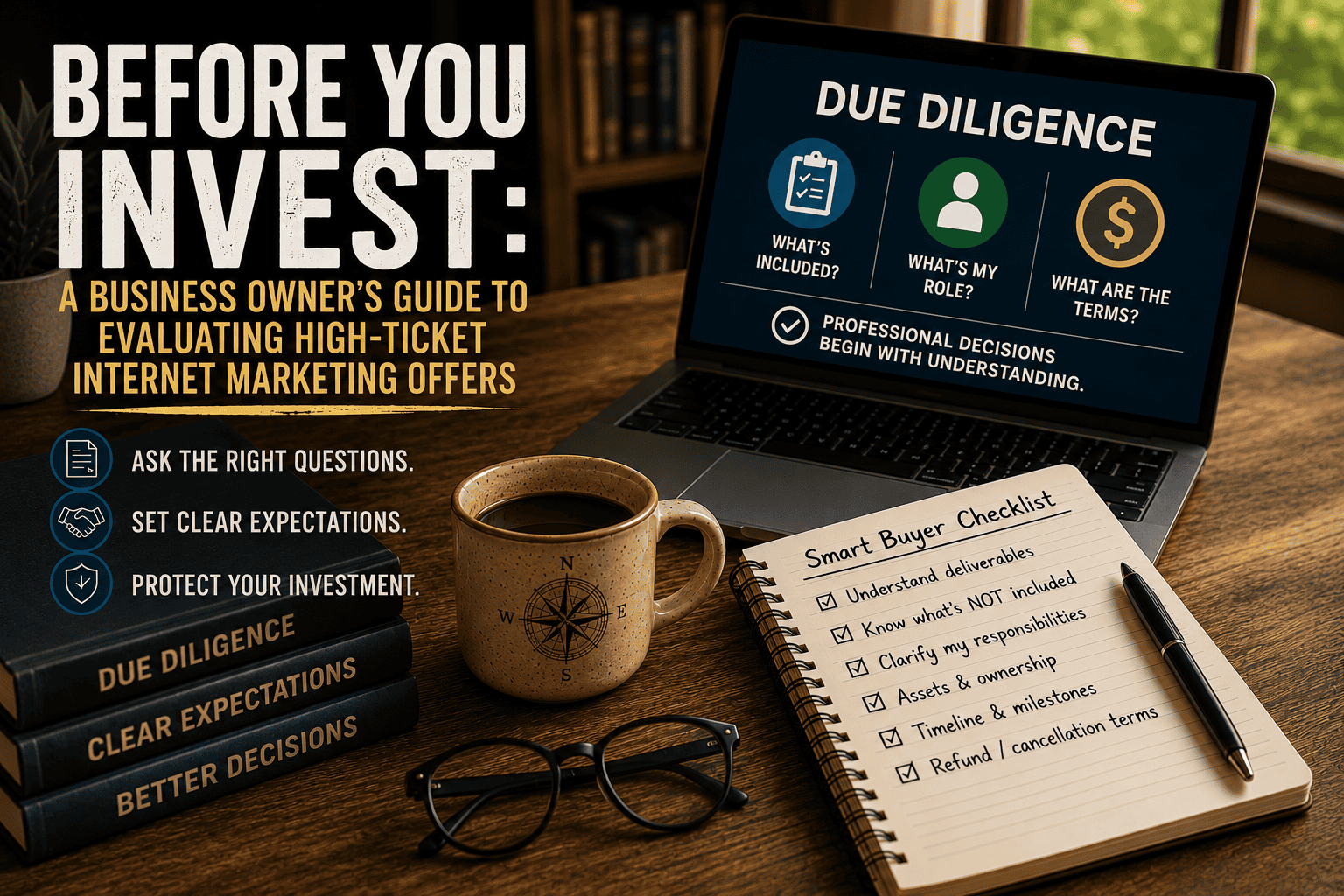
I’ve bought a couple of high-ticket offers this year.
One of them worked out well. The other has taken a lot longer than I expected, and while parts of it have been delivered, it’s not as close to being finished as I’d like. I’ve thought more than once about asking for some of my money back. But when I went looking for the actual terms: the specific point at which fees would or wouldn’t be refunded, spelled out in something more solid than a sales page, I realized I never nailed that down before I paid.
I’m not writing this because I think I got scammed. I don’t think I did. I’m writing it because that absence of a clear, specific agreement about what happens if things slow down or don’t finish as promised is all on me, and I suspect it’s more common than most of us want to admit.
Here’s the comparison that keeps coming back to me.
Someone wants to open a sandwich shop, or a dry cleaner, or a lawn-care business under a recognizable name. Before a dollar changes hands, they expect a disclosure document. They expect financial statements. They expect to know exactly what they’re getting, what they’re responsible for, and what happens if it doesn’t work out. They probably talk to an accountant. They definitely take more than one evening to decide.
Nobody calls that paranoid. It’s just how high-ticket business decisions get made.
Now take a similar transaction, move it online, and call it a “done-for-you” business instead of a franchise, and something curious happens. The disclosure document becomes a webinar. The financial statements become a screenshot of someone else’s income. The evening of consideration becomes a countdown timer or a decreasing number of available spots. And the refund terms become an assumption instead of a written agreement.
In my case, I’m sorry to admit that my familiarity with, and admiration of, an established marketer’s previous work left me a little too comfortable when they expanded into “now let me build one for you” territory.
A Cottage Industry, and Nothing Wrong With That
I was already aware of the DFY business model, but lately I’ve become more sensitized to how often they show up. Someone will populate your Etsy shop. Launch your Amazon storefront. Build your affiliate site. Configure your ad campaigns. Assemble your entire funnel, top to bottom, while you watch from a safe distance.
There’s nothing inherently wrong with any of that. Hiring specialists is what businesses do. I’ve hired people for things I could have learned myself because my time was worth more spent elsewhere. That instinct is sound.
I’m bringing it up because, looking back at my own two purchases, I realize I hadn’t treated either transaction in much of a business fashion. I never insisted on a specific contract spelling out deliverables, timelines, and refund terms before I paid. It’s worked out well enough in one case, and I expect it will work out fine in the other.
But looking back, I would certainly have preferred to have gotten those documents in writing before submitting my payment. If a seller tells you there isn’t time for that, that you’ll lose your spot, or simply doesn’t seem to operate that way, it’s worth remembering there will always be another opportunity. It’s best not to dive in on a sense of urgency alone.
The Asymmetry Nobody Mentions
Here’s a disparity worth thinking about: the person selling you their program has probably done it hundreds of times. They know the objections before you raise them. They know which questions tend to stall a sale and which ones don’t matter. They’ve refined the pitch across dozens, maybe hundreds, of conversations just like the one you’re about to have.
You, on the other hand, may be doing this for the first time in your life.
That’s not a criticism of either side. It’s just an honest description of the room. One person is well versed in the whole process. The other is walking it once, maybe twice, ever.
I’m not saying online business neophytes shouldn’t buy into others’ expertise. But I am recommending that beginners keep their relative inexperience in mind and stick to a firm purchasing protocol. It’s not about suspicion. It’s about slowing down long enough for the difference in experience to matter less.
Two Different Languages
Somewhere in the middle of all this, I think the real distinction lives between two things that sound similar but aren’t: marketing language and business language.
Marketing language exists to help you imagine a future. “We’ll build your Etsy business.” “Passive income.” “We’ll handle everything.” That’s not dishonest by default; it’s just doing the job marketing is supposed to do, which is making a possibility feel real.
Business language exists to define who’s responsible for what, starting when, ending how. “We will deliver one hundred product listings and storefront branding over eight weeks. Ongoing marketing remains the client’s responsibility.” That’s a different kind of sentence entirely, and it’s the one that actually governs what happens after you pay.
Sleeping On It Is Not the Same as Losing It
Part of the willingness to jump into a DFY purchase is the scarcity element woven into many of the offers. Either the deal is only available for a limited time or for a limited number of participants.
There’s a fear underneath a lot of these fast decisions, and it’s worth naming plainly: the fear that if you don’t say yes right now, the opportunity evaporates and takes your future with it.
I understand that fear. I’ve felt something like it. But I’ve also come to think it’s mostly an illusion built by the structure of the offer itself—a countdown clock that only exists because someone coded it to exist, attached to a decision that would still be exactly as good tomorrow morning as it is tonight.
If asking for a night to think genuinely causes a legitimate opportunity to vanish, I’d gently suggest that what disappeared wasn’t the opportunity. It was the pressure that had been standing in for a business case.
Walking away from something you weren’t ready to say yes to isn’t a missed chance. Experienced business owners don’t measure themselves by how many opportunities they said yes to. They measure themselves by how well they chose among the ones in front of them—which, more often than people expect, includes choosing not yet.
What This Actually Comes Down To
I’m not writing this to talk anyone out of hiring help online. I’ll end up getting value from both of my purchases.
But I think it’d be wise for online business newcomers to ensure they don’t approach a high-ticket online purchase like an excited shopper. Instead, approach it the way you’d approach buying a neighborhood franchise: with documentation, with a night’s sleep, and with a specific, written answer to the question, “What happens to my money if this doesn’t go as planned?” before you ever hand it over.
The internet changed where business gets conducted. It never changed what a sound business decision requires.
You’re not simply buying an Etsy shop, an ad campaign, or a funnel. You’re entering a relationship built on three things: shared expectations, clear communication, and mutual accountability. Everything else about the transaction grows out of whether those three things were established before the money moved.
That’s not distrust.
It’s just good business, wherever it happens to be conducted, and it’s what I’ll insist on—from a seller and from myself—before I buy into any DFY business offers in the future.