
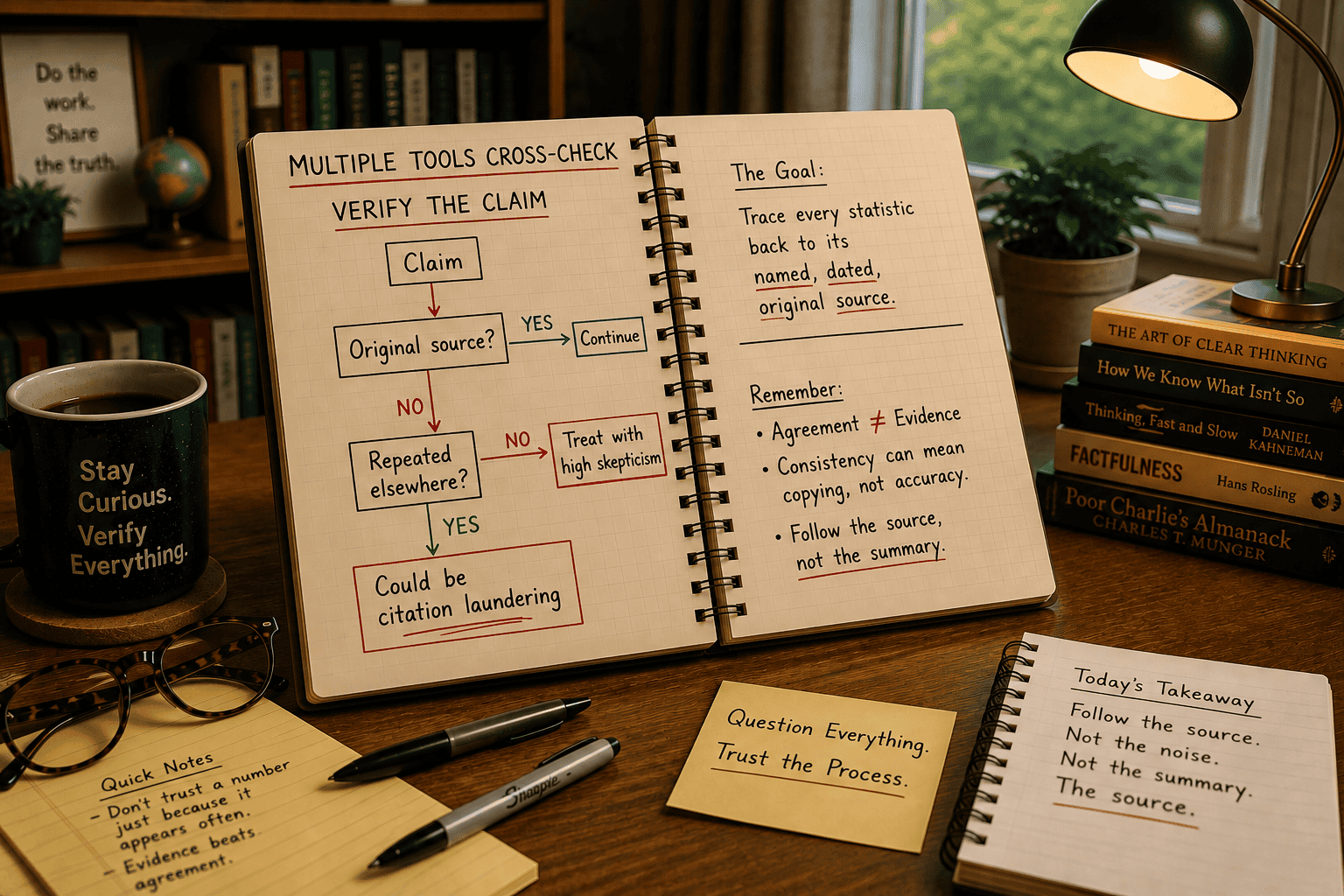
Quick answer: Running a second AI tool against a first one is most useful when it checks different evidence or applies a genuinely independent verification process. If both tools mostly repeat the same widely circulated secondary material, their agreement adds little. The strongest practical check is tracing a specific claim back to its named, dated, original source, not to another summary of it, whether that summary was written by a person or a model.
Picking Up Where the Last Piece Left Off
A little while back I wrote about a specific case: an AI research tool handed me a precise-sounding conversion statistic, complete with a named source and a sample size. A second, dedicated fact-check pass found the number didn’t exist anywhere in that source. It had been copied forward, nearly word for word, across at least three unrelated marketing blogs, none of which had gone back to check it either.
That article was about my dislike of video-only sales pages and my off-the-cuff inquiry about their effectiveness.
The real report is Unbounce’s 2024 Conversion Benchmark Report, built from more than 41,000 landing pages, 464 million visitors, and 57 million conversions, with an overall median conversion rate of 6.6%. Checked the whole thing with two AI’s (yes, I get the irony), and there’s no video-versus text breakdown anywhere in it.
The lesson I drew at the time was straightforward: run a second AI pass, aimed specifically at the statistics, before anything goes out under your name. That’s still good advice. But it’s incomplete, and a piece of research material that landed on my desk since then makes the gap obvious.
The Advice You’ll Find Everywhere: Use Multiple AI Tools to Check Each Other
The idea shows up constantly in AI-and-productivity content: don’t trust one model, ask two or three, and treat agreement as a green light. Different models train on different data, the reasoning goes, so if ChatGPT, Claude, and Gemini all land on the same answer, that convergence itself is evidence.
It’s a reasonable-sounding shortcut, and diverging answers really can flag a weak spot worth a closer look. The trouble is the other half of the advice, the part that treats agreement as confirmation. Models may differ in their training mixtures, retrieval systems, search indexes, ranking methods, and reasoning procedures, but none of that guarantees independent evidence. The advice quietly assumes an independence that often isn’t there.
Why That Assumption Breaks in Practice
Go back to the VSL conversion statistic that turned out to be falsely attributed. It wasn’t hiding in some obscure corner of the internet. It was sitting in plain text, attached to a credible-sounding named source, repeated across multiple public blog posts.
If I’d asked three different AI research tools to look into VSL conversion rates instead of one, there’s a real chance more than one of them would have surfaced that same number. Not because they independently verified it, but because it was one of the more visible, most-repeated answers sitting in the material each tool draws on. Three tools “agreeing” on a laundered number isn’t three independent confirmations. It can just as easily be three tools drinking from the same contaminated well.
Consistency across sources feels like a signal of accuracy. Sometimes it is. But once a specific, wrong number gets repeated enough times, consistency stops meaning anything at all. It just means the copying was thorough.
A Live Example Showed Up in the Research Material Itself
The piece that prompted this follow-up was itself a generic “how to cross-check AI tools against each other” article, the kind meant as background reading before writing something on the topic. Most of it is reasonable, general advice: document each tool’s answer, look for contradictions, take real conflicts to a primary source.
But a couple of lines describe casual multi-tool comparison as “a technique known as ensemble fact-checking or consensus verification,” phrased as if these are established, named practices any reader should recognize. Those phrases do exist in technical research and product literature. But they aren’t standard names for the informal habit of opening three consumer chatbots and comparing their answers. Formal ensemble or consensus systems generally involve structured aggregation, scoring, debate, retrieval, or validation, not just counting how many chat windows happen to agree.
That’s a small thing on its own. But it’s a near-perfect miniature of the exact problem the article is all about: specific, official-sounding language attached to a claim, delivered with total confidence, that doesn’t actually hold up once you look closer. It happened inside the research material for an article about avoiding that exact failure. The irony is the whole point.
You Often Can’t Tell Whether the Original Mistake Was Human or AI
This is the part worth sitting with. The three blogs that repeated the falsely attributed 12.7 percent VSL statistic were apparently written by people, not generated by an AI tool. Somebody read a competitor’s post, saw a specific, official-sounding number attached to a big-name source, and copied it forward without checking. That’s a purely human failure mode, and it predates any of the current AI tools by years.
An AI research tool doing the same thing today, pulling a laundered stat from the same contaminated pool of blog posts, produces an artifact that looks nearly identical. Same unsupported number, same confident tone, same missing methodology. From the finished claim alone, you usually can’t reliably tell whether the original error was human-made or AI-generated. Makes no different whether it was carbon or silicon goofed. The fix doesn’t care which one started it.
That’s actually good news for how you handle it, because it means you don’t need to solve the harder question of who or what originated a bad number. The fix is the same either way.
What Actually Catches It
Not more tools asking the same question of the same contaminated pool. A specific claim traced back to a specific, named, dated original, read directly rather than trusted from a summary.
- Pull out every precise number, named study, or attributed claim before anything gets published.
- Find the original source directly. A report, a named survey, a dataset you can actually open, not a blog post that cites it secondhand.
- Confirm the source actually contains the specific figure being attributed to it, not just a topic in the same neighborhood.
- Treat identical or near-identical wording across supposedly unrelated articles as a warning sign, especially when none of them link back to original evidence. It can mean copying, syndication, or reliance on the same upstream source rather than independent verification. Official statements and wire copy are a legitimate exception to this; laundered marketing stats usually aren’t.
- When multiple AI tools agree, ask what pool of material they were likely drawing from before treating the agreement as meaningful. Live web access on one tool doesn’t by itself guarantee independence from a tool working off a fixed training set.
Does It Matter Whether Multiple AI Tools Agree?
Sometimes, but agreement is a starting signal, not an ending one. It becomes more meaningful when the tools are independently inspecting different authoritative evidence, one verifying a government dataset while another checks the original study’s methodology, for example. Simply giving one tool live web access doesn’t guarantee independence either, since a web-enabled tool and a tool working from a fixed training set can both have absorbed the same widely repeated claim. When several tools are all likely drawing on the same recycled content, agreement tells you the claim is popular. It doesn’t tell you it’s true.
One Thing Worth Confirming Rather Than Assuming
OpenAI’s own published guidance for using its tools tells people to always double-check critical facts with trusted sources, and to check citations and verify details before relying on a response. That lines up with everything above, and it points toward a question worth its own piece: how do you decide how critical a given claim actually is, and how far back you need to trace it before you trust it? A conversion-rate stat for a sales page and a claim behind a new drug formulation don’t call for the same level of verification. More on that soon.
One More Catch, Caught Only By Checking
While preparing this piece, I went back to the real Unbounce report myself instead of trusting the earlier fact-check’s summary of it. The report is real: more than 41,000 landing pages, 464 million visitors, 57 million conversions, an overall median conversion rate of 6.6%. That doesn’t quite match the 44,000 pages and roughly 4.3% median the original fact-check reported. Small numbers, but wrong ones, sitting inside a pass that had already been billed as verified.
That’s not a knock on the earlier check. It caught the part that actually mattered, the falsely attributed VSL breakdown. But it’s a clean demonstration of something worth remembering: even a genuine verification pass can carry its own small errors forward if nobody goes back to the primary source a second time. Verification isn’t a gate you pass through once. It’s a habit you keep applying, including to your own previous work.
It’s also a decent argument for thinking about verification in tiers rather than as one fixed standard. The overall benchmark number wasn’t load-bearing for this article’s actual argument, so a small mismatch there is a minor embarrassment, not a real problem. If that same-size error had been sitting under a client’s budget decision, or a medical claim, it would matter a great deal more. How much any given number is worth double-checking depends on what’s riding on it, which is exactly the harder question worth working out next.
Quick Answers
Is using multiple AI tools to fact-check each other a bad idea? No. It’s genuinely useful when the tools check different evidence or apply an independent verification process. The mistake is treating agreement alone as proof, since agreement can just mean the tools drew from the same widely repeated, unverified source material.
How can you tell if a statistic has been laundered rather than verified? Look for identical or near-identical phrasing repeated across multiple unrelated sites with no link back to an original dataset or methodology. That kind of match usually means copying or shared upstream sourcing rather than independent confirmation.
Does it matter whether a bad number originally came from a human writer or an AI tool? Not for how you handle it. Both produce the same kind of artifact: a confident, specific-sounding claim with no traceable original source. The verification step is identical either way.
What’s the single most effective habit for catching laundered statistics? Go to the named original source directly and confirm it actually contains the specific figure being attributed to it. Don’t stop at a summary, a citation of a citation, or another tool’s paraphrase.