
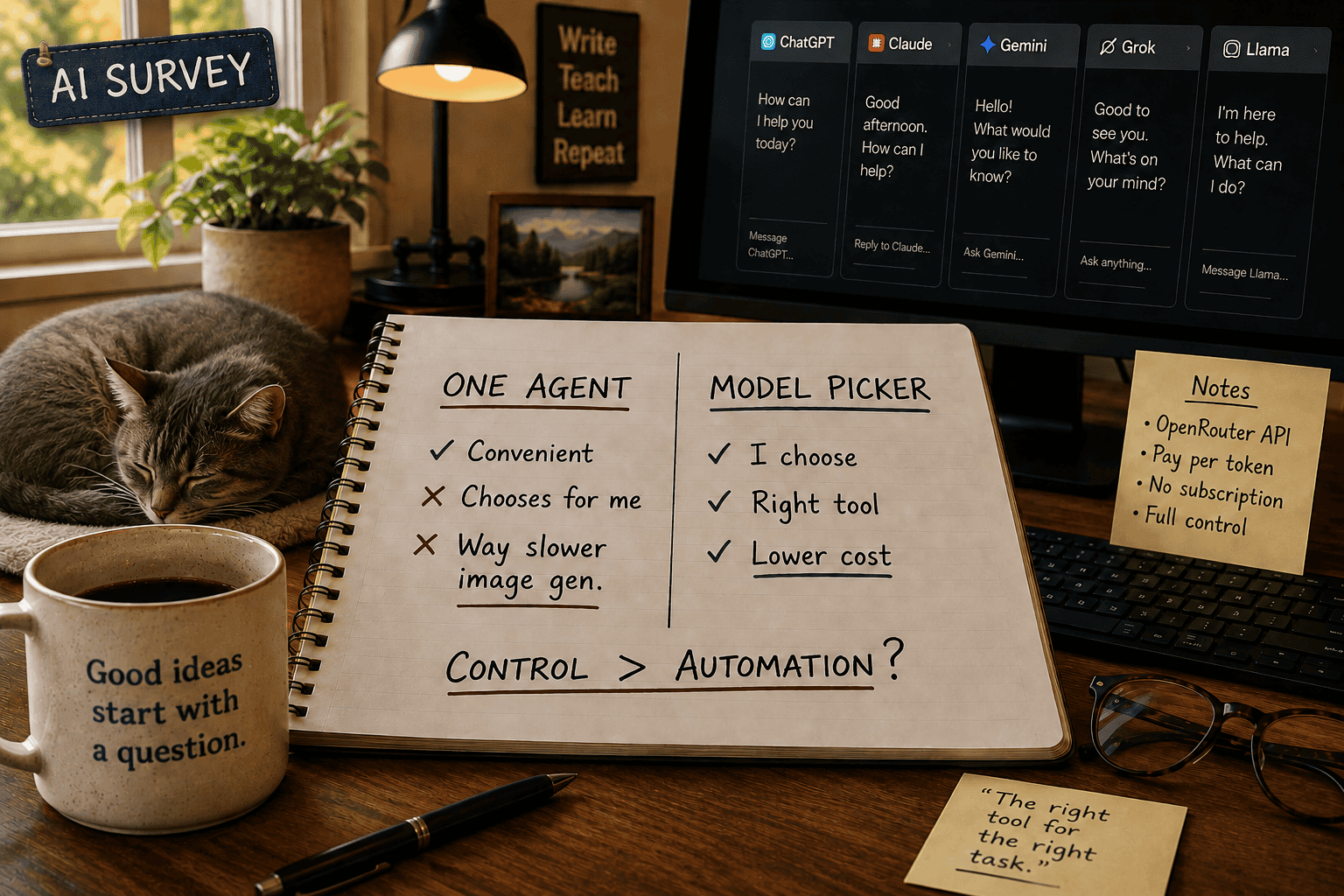
Quick answer: if you left Magica because you wanted to keep choosing your own model per task, an autonomous agent platform won’t fix that. The tools below still let you pick.
- Galaxy.ai became Magica.com in May 2026, and the rebrand traded direct model selection for an autonomous “One Agent” system that burns more credits and runs slower for many tasks.
- OpenRouter paired with TypingMind or Chatbox gets you closest to Galaxy.ai’s old dashboard: pay-per-token pricing and real model choice, with no subscription required.
- 1min.AI, OmniGPT, and MultipleChat all offer genuine multi-model comparison, though each trades away some depth for convenience.
- LibreChat gives you full control if you’re willing to self-host, and Poe remains the steadiest option if you just want a mature product that works.
Magica’s rebrand quietly took something away from people who liked Galaxy.ai for a specific reason: control. If you were happy letting an agent make decisions on your behalf, none of this matters much. But if you left because you wanted to keep choosing your own model, per task, the fix isn’t another autonomous platform wearing a different name. It’s a tool that still lets you decide.
Most “best Galaxy.ai alternatives” roundups miss that distinction. They list other agent platforms, other black boxes, other places where the software decides how your request gets handled. That’s not what a model-picker refugee wants. This piece sticks to tools where you’re still the one choosing.
What Actually Changed When Galaxy.ai Became Magica
Galaxy.ai became Magica.com in May 2026. Same company, not an acquisition. Accounts and credit balances carried over, which is more than a lot of rebrands manage.
The real change was architectural, not cosmetic. Galaxy.ai used to work like a dashboard: you picked a model, you ran a task, you moved on. Magica’s “One Agent” framework runs tasks through chained agent steps instead of a single API call. One request can now trigger several internal steps behind the scenes.
That’s why effective credit consumption went up for a lot of existing users, even in cases where the per-credit price itself didn’t change. It’s also why some tasks that used to finish in seconds are now reportedly taking up to ten minutes. Direct model selection, the thing this whole category exists to solve for, is largely gone.
Why an Agent Isn’t a Substitute for a Model Picker
There’s a reason people build workflows around choosing their own model. Some tasks want a fast, cheap model. Others want a slow, careful one. An autonomous agent collapses that decision into something the system handles for you, and it charges accordingly.
This is a pattern worth recognizing outside of Magica, too. Convenience is wonderful. Dependency can be dangerous, especially when the platform can change the rules of engagement without much warning. If you’re rebuilding your workflow now, it’s worth picking something you’d be comfortable staying on for a while, not just the next thing that happens to fit the immediate gap.
OpenRouter Paired With TypingMind or Chatbox
OpenRouter itself isn’t a chat app. It’s a unified API gateway to more than 300 models from over 60 providers, billed on prepaid credits at pass-through pricing, meaning you pay the same per-token rate the underlying provider charges. The only markup is a 5.5% fee on credit purchases, not on individual calls. No subscription, no per-token markup layered on top.
Because OpenRouter is API-only, you’ll want a frontend. TypingMind is a polished, ChatGPT-style interface that connects to your OpenRouter key in a couple of clicks and pulls in the full model list automatically. It’s sold as a one-time purchase, generally somewhere in the $39 to $59 range depending on the current offer, rather than a subscription. Chatbox does the same job for free, as an open desktop and mobile client across Windows, Mac, Linux, iOS, and Android.
This combination is the closest thing to what Galaxy.ai used to offer. Pick any model, per request, pay only for what you use. The tradeoff is setup: you’re managing an API key and a credit balance instead of one flat login, which is a small amount of friction that pays off if you actually use this daily.
Is 1min.AI’s Credit Estimate as Transparent as It Sounds?
Mostly, yes. 1min.AI is a legitimate multi-model platform covering text, image, audio, and video in one dashboard, with plans starting around $5 to $8 a month and a daily free-credit allowance. It does show the credit cost of a task before you run it, which is the specific claim worth checking, and that claim holds up.
Where it gets murkier is the broader promise of transparency. User reviews are mixed on how easy the credit system is to plan around once tasks get more complex, even with the up-front number in front of you. Image and video generation eat credits fast, one review put a single Flux Schnell image at roughly 9,000 credits, so heavy visual work will drain a plan quickly even on a larger tier.
If your use case is mostly text, this is a reasonable, low-friction option. If you’re leaning on image or video generation regularly, budget carefully before committing to a plan size.
OmniGPT and MultipleChat Aren’t the Same Product
These got bundled together in the original research, but they’re two separate companies, built differently, and worth separating out.
OmniGPT
OmniGPT gives you explicit model selection across GPT, Claude, Gemini, and others, plus the ability to send one prompt to several models and compare the results. Pricing runs free for a basic tier, with a Plus plan generally cited around $16 a month and custom Enterprise pricing above that.
One limitation worth knowing before you commit: OmniGPT doesn’t offer a public API. It’s a hosted app only. Fine if you just want to chat and compare, not a fit if you want to build anything on top of it.
MultipleChat
MultipleChat is a Swiss-hosted web platform, no iOS or Android app as of mid-2026, that runs ChatGPT, Claude, Gemini, and Grok in one workspace, with a dedicated Compare Mode for side-by-side answers. Pricing runs roughly $8.99 to $20 a month depending on tier.
It leans toward workspace features, image studios, document tools, collaboration modes, more than raw pay-per-token access. It suits someone who wants comparison and finished deliverables more than a developer who wants an API to build against.
LibreChat, If You’re Willing to Run Your Own Server
LibreChat is a well-established, MIT-licensed open source project, and one of the most-starred self-hosted AI chat interfaces on GitHub. It connects to OpenAI, Anthropic, Google, Ollama, OpenRouter, and other providers using your own API keys, and it mirrors the ChatGPT interface closely enough that the learning curve is mostly about deployment, not the interface itself.
It’s free in the sense that matters most: no subscription, no vendor markup. You’ll pay for whatever server it runs on, and that’s the whole cost.
One thing worth knowing before recommending this to anyone: LibreChat was acquired by ClickHouse in November 2025. It remains open source and self-hostable, and the move looks aimed at ClickHouse’s broader data and analytics ambitions rather than a change to LibreChat’s core product. Still, it’s a governance change worth naming plainly, particularly in an article built around Magica’s own no-notice pivot. Owning your infrastructure doesn’t mean the project behind it can’t change hands.
This fits a technical reader who wants full control of their data and is comfortable with a Docker deployment. It’s not for someone who wants to sign up and start chatting in five minutes.
Poe, For When You Just Want It to Work
Poe, built by Quora, remains a mature, well-funded aggregator. It gives access to roughly 100 models across text, image, audio, and video, all through a point-based subscription.
Pricing runs a six-tier ladder as of 2026: a free plan, then paid tiers around $5, $20, $50, $100, and $250 a month, each with its own point allowance. Different models cost different amounts of points per message, so a $5 plan stretches a lot further on lighter models than on frontier ones.
Poe has been running since December 2022 and is backed by Quora’s existing business and outside funding. That history buys it more institutional stability than most of the newer entrants here, which matters if you’re tired of platforms that reshape themselves without warning.
What Switching Actually Looks Like the First Week
The friction point almost nobody mentions is the credit-key math. If you’re moving to OpenRouter or LibreChat, you’re leaving flat-fee thinking behind and stepping into pay-per-token thinking, where a careless long conversation can cost more than you expect. Set a small starting balance, watch what a normal week actually costs, then top up. Don’t load a large balance on day one before you know your own usage pattern.
The other trap is trying to replicate your old workflow exactly. Magica’s agent chaining did some of the thinking for you, even if it cost more to do it. A model picker puts that decision back on you. Expect a short adjustment period where you’re consciously choosing a model for each task instead of trusting a system to sort it out. That’s the tradeoff you signed up for by wanting control back, and it’s worth being honest with yourself about whether you actually want that friction or whether you were happier letting Magica decide, expensive as it got.
Comparison at a Glance
| Tool | Model access | Pricing model | Best for |
| OpenRouter + TypingMind/Chatbox | 300+ models, one API key, direct model switching | Pay-per-token pass-through pricing plus a 5.5% credit fee. TypingMind is a one-time purchase (roughly $39-$59); Chatbox is free | Anyone who wants true pay-as-you-go with no subscription |
| 1min.AI | Multiple text, image, audio, and video models in one dashboard | Credit-based, plans from about $5-$8/month, free daily credits | Casual multi-model use where you want a cost estimate before you spend |
| OmniGPT | GPT, Claude, Gemini, and others, with explicit model selection and comparison | Free tier, Plus around $16/month, Enterprise custom | People who want a model picker without touching raw API pricing |
| MultipleChat | ChatGPT, Claude, Gemini, Grok in one workspace with Compare Mode | Subscription, roughly $8.99-$20/month depending on tier | Comparing model answers side by side without managing keys |
| LibreChat | OpenAI, Anthropic, Google, Ollama, OpenRouter, and more via your own keys | Free and open source, self-hosted (server costs only) | Technical users who want full data control |
| Poe | About 100 models across text, image, audio, and video | Point-based subscription, six tiers from about $5-$250/month | Non-technical users who want a mature, single-vendor product |
The Short Version
If you want the closest thing to what Galaxy.ai used to be, OpenRouter with TypingMind or Chatbox is the answer. Everything else on this list is a reasonable option depending on how much control versus convenience you’re after.
- OpenRouter plus TypingMind or Chatbox gives you the most direct model control and the most honest pricing, at the cost of managing your own key and credit balance.
- 1min.AI, OmniGPT, and MultipleChat trade some of that control for a simpler, subscription-style experience.
- LibreChat is the right call only if you’re comfortable self-hosting; otherwise it’s more infrastructure than most people need.
- Poe is the safest bet if institutional stability matters more to you than raw pricing efficiency.
- Whatever you pick, test it on a free tier or a small credit balance before committing real budget to it.
This post is part of the AI Survey series, where I take a hands-on look at different AI tools and how they actually perform for solopreneurs like me. Browse the full series →
A Few Questions Worth Answering
Is OpenRouter cheaper than Magica?
It depends on usage. OpenRouter passes through provider pricing plus a 5.5% fee on credit purchases, so cost tracks whatever the underlying model charges. For light, occasional use, a flat subscription like Poe or 1min.AI might end up cheaper. For heavy or specialized use, pay-per-token usually wins, because you’re not paying for capacity you didn’t use.
Do any of these require coding knowledge?
Just one. OmniGPT, MultipleChat, 1min.AI, and Poe are all point-and-click apps. TypingMind and Chatbox are point-and-click too, once you’ve generated an OpenRouter API key, which takes a couple of minutes. LibreChat is the one option here that expects comfort with Docker and basic server setup.
Which of these is closest to what Galaxy.ai used to be?
OpenRouter paired with TypingMind or Chatbox. Both give you direct, explicit control over which model handles each task, billed per token rather than per subscription, which is exactly what Galaxy.ai’s original dashboard did before the rebrand.