
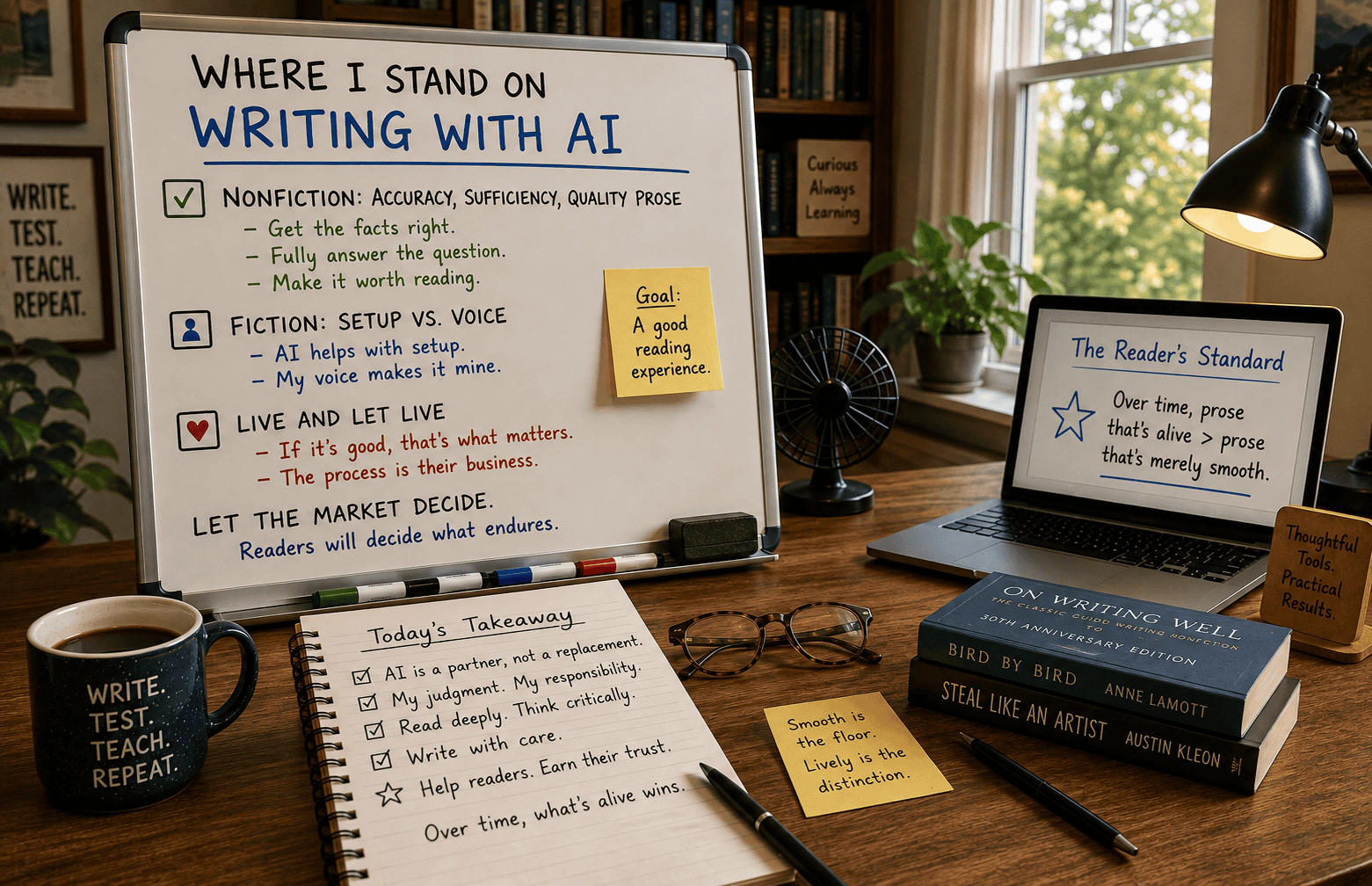
There’s really only one question I care about when it comes to AI and writing: did you get what you came for — or something even better? Not “was this written by a human,” not “how much of this did AI touch.” Just: did the piece do its job, and did you enjoy the experience of reading it?
That question splits differently depending on what I’m writing.
Nonfiction: accuracy, sufficiency, quality prose
For nonfiction, I hold myself to three things. First, accuracy — if I’m telling you something as fact, it needs to be fact, and when AI hands me a first draft, I know when to send it back to double-check its sources. Second, sufficiency — the piece has to actually answer what it set out to answer, not gesture at it and move on. Third, quality prose — which covers a range. Smooth is the floor; I’ll happily read smooth prose all day and it won’t bother me a bit. Enjoyable, lively prose is a mark of distinction above that floor, and it’s the thing I reward over time as a reader, with my attention, my reviews, my willingness to come back for the next piece.
AI drafts are a good starting point on all three, but they need a hand on the wheel. A small example: I use contractions far more than AI does by default, straight out of the box. It’s a tiny thing, but it’s one of a dozen small adjustments that separate “technically fine” from “sounds like me.” And sometimes the adjustment isn’t stylistic — sometimes Claude is the one telling me I should walk something back a notch, and it manages to say so without making me feel accused of anything. That’s a real editorial relationship, not a rubber stamp.
Rereading that last paragraph, I feel compelled to happily and proudly claim my long-standing approval of the much-maligned em dash. I learned to love it, I can’t say for sure, but I’m guessing 1969-ish, while still at Asbury Elementary School. If AI’s fondness for the em dash has made it suspect by association, that’s a shame, because it came naturally to me, and I’m not about to abandon a perfectly good piece of punctuation just because a chatbot also likes it.
Fiction: setup versus voice
As an aspiring fiction publisher, I’m glad to let AI help set up a story: sketch a plot, rough out a scene, get some raw material on the page. Where it stops being useful, at least for me, is the moment the story needs to sound like me. The way I drop a reader into a scene, the rhythm of the dialogue, the instinct to let a character argue a point rather than explain it in a paragraph of exposition — those aren’t things I’ve found AI reaching for on its own. They’re mine, worked out over years of reading writers who did it the way I wanted to learn to do it.
That’s not a claim about what AI can or can’t ever do. It’s a claim about what it hasn’t done yet, for me, in my voice. Give AI the setup work, and keep the parts that only sound right in your own head.
Live and let live
None of this means I think everyone else needs to draw the line where I draw it. If another writer manages to publish something entirely AI-produced and it’s genuinely good, I’m not bothered by that, and I may not even notice. Say I pick up a book by a writer I’ve never met, call him Bob Smith, and I have a great time reading it. I don’t know how much of it Bob wrote himself, how much AI drafted, or where the line fell. It doesn’t matter. Bob delivered the thing I actually care about: a good reading experience. Whatever process got him there is his business, not mine.
By the way, what about images used in written work?
I’ll admit I’ve been too busy with other projects to go check. But I have to imagine that the same writers who hold strong, outspoken positions on AI-written prose have an equally strong position on AI-generated cover art, illustrations, and images used alongside their writing, since visual art is just as legitimate a form of human expression as prose is, and just as capable of being touched or untouched by AI.
I haven’t had time to peruse writers’ opinions on that, but I look forward to it.
Let the market decide
I don’t think this gets settled by writers arguing about what’s right or wrong. It gets settled the slow way, by readers. People like me who are discerning on Amazon, who leave honest reviews, who come back for the next book or skip it based on how the last one felt. A writer with four thousand reviews earned them for reasons that go beyond “the facts were accurate.” Over time, prose that’s merely smooth loses out to prose that’s alive, whether a human wrote every word of it or not. That’s the standard this reader holds to, and it’s the one I trust others will apply, as well.
I recently wrote about how Substack is handling the AI writing issue, and you can read my (skeptical) thoughts on that over here.
Quick update: here’s a related Napkin Note on this issue (doesn’t constitute a full post, but it’s something to think about).
August 2026 update: I’ve just published an article about the intimacy-subscription business model, and why it’s not for me. If I were just starting to navigate the online money frontier, I’d want that article in front of me before I encountered someone trying to sell me on the model, whether it’d be used with or without an AI persona. That’s another layer on top of what I expressed when I first drafted this piece. If there’s information that could be important to my audience, people just exploring the opportunities for online expression and commerce, for me to refuse AI assistance might mean a delay of days or weeks, depending on my workload. That kind of delay, especially when I consider the AI-assisted content–drafted per my instructions and edited by me–to be pretty darned good, would be a pointless disservice to my readers.