
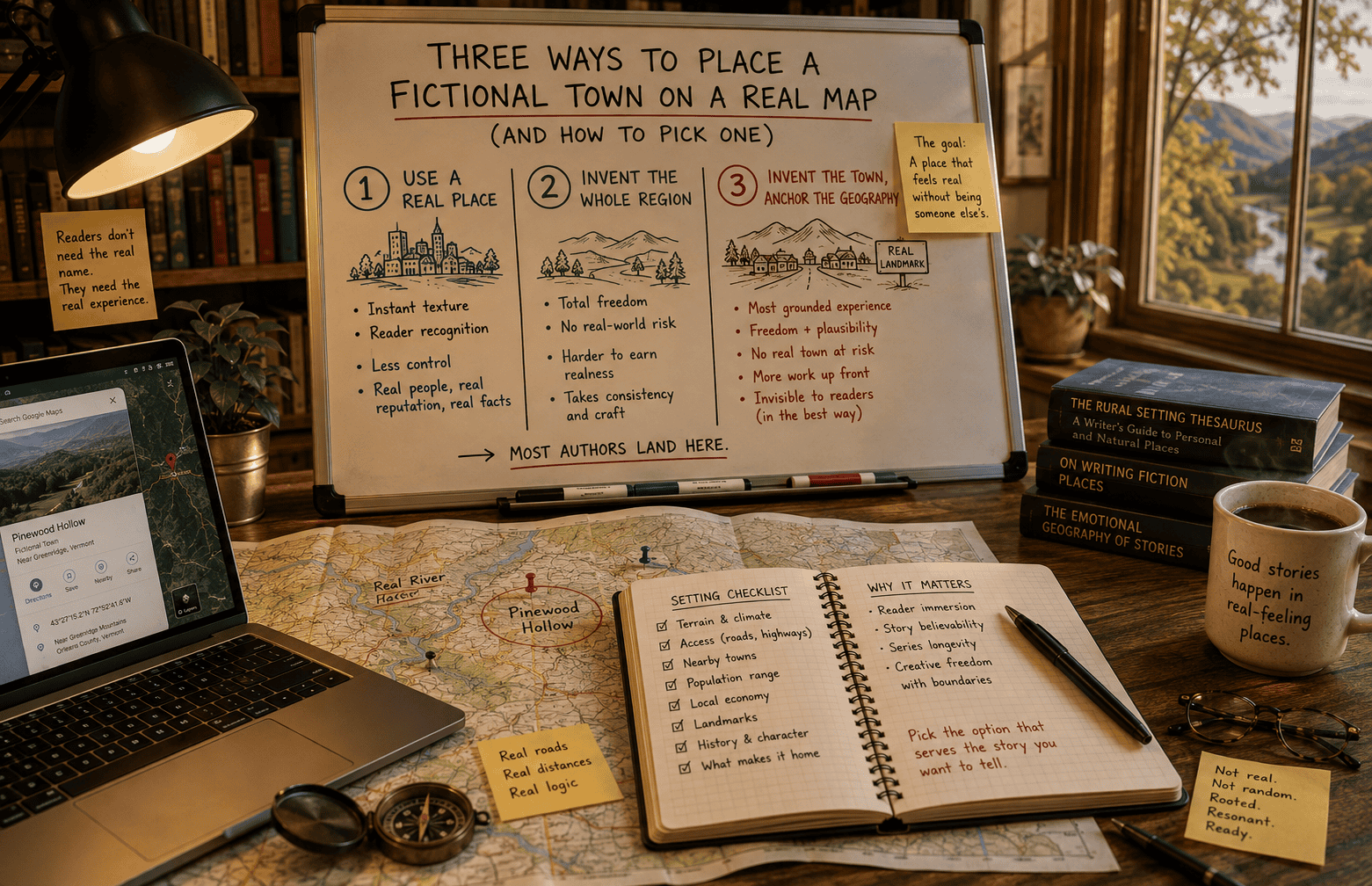
Here’s The Scoop: Every fictional setting sits somewhere on a spectrum between fully real and fully invented. The three working options are: use a real place outright, invent the whole region from scratch, or anchor an invented place to real, verifiable geography. Most experienced authors land on the third. It’s more work up front, but it gives readers the most grounded experience without the risks of the other two.
Every writer setting a story somewhere specific eventually runs into the same quiet decision, usually without realizing it’s a decision at all. Do you use a real town? Make one up entirely? Or do something in between? Most people default to whichever option occurred to them first and never revisit it. That’s a mistake. The choice has real consequences for how the story reads, how much freedom you keep as the series grows, and how much risk you’re carrying without knowing it.
This isn’t really a genre-specific question, though it shows up constantly in cozy mystery and small-town romance. The underlying logic applies just as well to a workplace drama set in a real city, or a thriller that needs a believable regional backdrop.
Option one: use a real place
This is the most obvious choice, and it comes with an obvious appeal. A real city or town arrives pre-loaded with texture, and readers who know the place get an immediate jolt of recognition. Nothing beats “wait, I’ve been there” for reader engagement.
The cost is control. A real place has real residents and real facts that can shift out from under you. Set a series in a real, small, identifiable town and you’re implicitly making claims about it that the actual place never agreed to. Bigger cities absorb this more easily; nobody feels personally implicated when a novel sets a fictional murder in a metropolis of several million people. Smaller places are a different matter. The smaller and more specific the real place, the more that implied claim starts to feel like it’s about someone.
This works best for large, anonymous cities, or for stories where the real setting is doing thematic work a substitute couldn’t replicate.
Option two: invent the whole region
The opposite extreme: build the town, the county, the surrounding landmarks, all of it, from nothing. Total creative freedom. Nobody’s real life gets fictionalized, and the world can bend exactly to what the story needs.
The tradeoff is subtler than it looks. A fully invented setting has to work harder to earn the same sense of realness a real place gets for free. Readers can tell, even if they can’t say how, when a town exists purely to serve the plot rather than because it has its own independent logic. Some of the best-loved series pull this off through sheer craft and consistency, built up over many books. It’s a real skill, and a slower one to develop than the alternative.
Reach for this option when a story wants total tonal control, or is set far enough outside contemporary reality that grounding in real geography wouldn’t add much anyway.
Option three: invent the town, anchor the geography
The middle path, worth taking seriously even though it costs more effort than either extreme: invent your own town, but place it on real, verifiable ground, near real, nameable landmarks, using real regional logic for how someone would actually get there.
This gets you most of the upside of both other options with much less of the downside. The setting can bend to what the story needs, the way a fully invented place can, but it’s tethered to something a reader could look up and find plausible, the way a real place is. Nobody’s actual town gets fictionalized, because you never claim the real name of the small, specific place you’re building near. You borrow its real infrastructure and regional flavor, and let your own invented name carry the story.
Done well, this is close to invisible to the reader. They’re not meant to notice the seams. What they notice instead is that the place feels like it could exist. In every way that matters to the story, it does.
What doing this actually involves
This option asks more of you at the setting stage than the other two. Most of the friction shows up in a handful of predictable places.
Ground truth matters more than it seems like it should. Terrain that looks buildable on a map at a glance can turn out to be marsh, floodplain, or seasonally underwater. That’s the kind of thing that quietly undermines a scene if a reader who knows the area catches it. The reliable check is simple: look for a real, operating business at the spot you’re considering. If something real is functioning there, the ground under it is real too.
Naming is where people either get this right by instinct or get it wrong without noticing. The rule that actually works: keep the small, specific, real place you’re anchoring to unnamed in your text, always. Reference the big, anonymous landmarks around it freely instead: the regional city, the interstate, the well-known bridge or river. Readers get all the grounding they need from those larger references, and nobody’s actual small town ends up quietly hosting your fictional crimes under its own name.
It’s also worth knowing that in a lot of places, truly “empty” land is rarer than it looks. Regions with any real development history tend to have already had most of their buildable, well-connected land subdivided and named by developers, sometimes generations ago, even where nothing visible has actually been built. That’s not a dead end. It just means the goal isn’t finding unclaimed land. It’s finding real land you’re comfortable building your fiction near without naming it.
What this costs you, and what it buys
Be realistic about the time. Confirming ground, checking for overlap with a real community’s identity, and ruling out collisions with other authors already working the same region is genuinely a few hours of work. Not a five-minute decision, and easy to underestimate on the first pass.
What it buys back is durability. A well-anchored setting becomes a resource you keep drawing on for the life of a series, rather than a decision you revisit under pressure once a sharp-eyed reader asks a question you can’t answer. How people actually get from one place to another, what the landscape is really like, what real infrastructure would plausibly be nearby: all of that becomes something you already know, instead of something you invent fresh in every book.
What to do next
Before naming anything, decide which of the three lanes actually fits the story you’re telling. If it’s the third one, invented town with a real anchor, start with the region before the town. Pick real geography with the character you need, confirm solid ground using real, verifiable landmarks, and only then invent your own name for the place itself. Do this once, properly, at the start, and it holds for the whole series.
Core
A fictional setting doesn’t have to be fully real or fully invented. The strongest middle option anchors an invented place to real, confirmable geography, without ever naming the specific small real place it’s built near. It costs more time up front than either extreme, and pays that time back for the life of a series.
Q&A
Isn’t this overthinking a fictional town? For a lot of stories, yes, genuinely. If the setting is mostly backdrop and nobody’s going to scrutinize it, either simpler option is fine. This matters most when the setting itself is part of the appeal, or the story is going to run long enough that inconsistencies eventually surface.
What if I already picked a real place and I’m having second thoughts? Worth checking before you’re deep into a series rather than after. It’s much easier to shift a setting’s specifics one book in than five books in, once readers have a mental picture locked in.
Do I need to pick just one of these three options for an entire series? Generally, yes, for consistency’s sake. Readers build a mental map as they go, and switching approaches partway through tends to create more confusion than freedom.
Is there real risk in getting this wrong, or is this mostly a craft preference? Mostly craft. Fiction has wide latitude here, and this isn’t legal exposure we’re talking about. The real risk is reader trust: a setting that turns out to be someone’s actual, identifiable small town, worn as costume for fictional crimes, tends to land badly even when nothing about it was intended maliciously.
Related reading
Getting Coordinates and Location Info from Google Maps — a step-by-step walkthrough for pulling exact coordinates from any spot on the map and using Google Maps’ Ask Maps feature to gather real, detailed background on it. Useful groundwork once you’ve narrowed in on a candidate location using the approach above.