
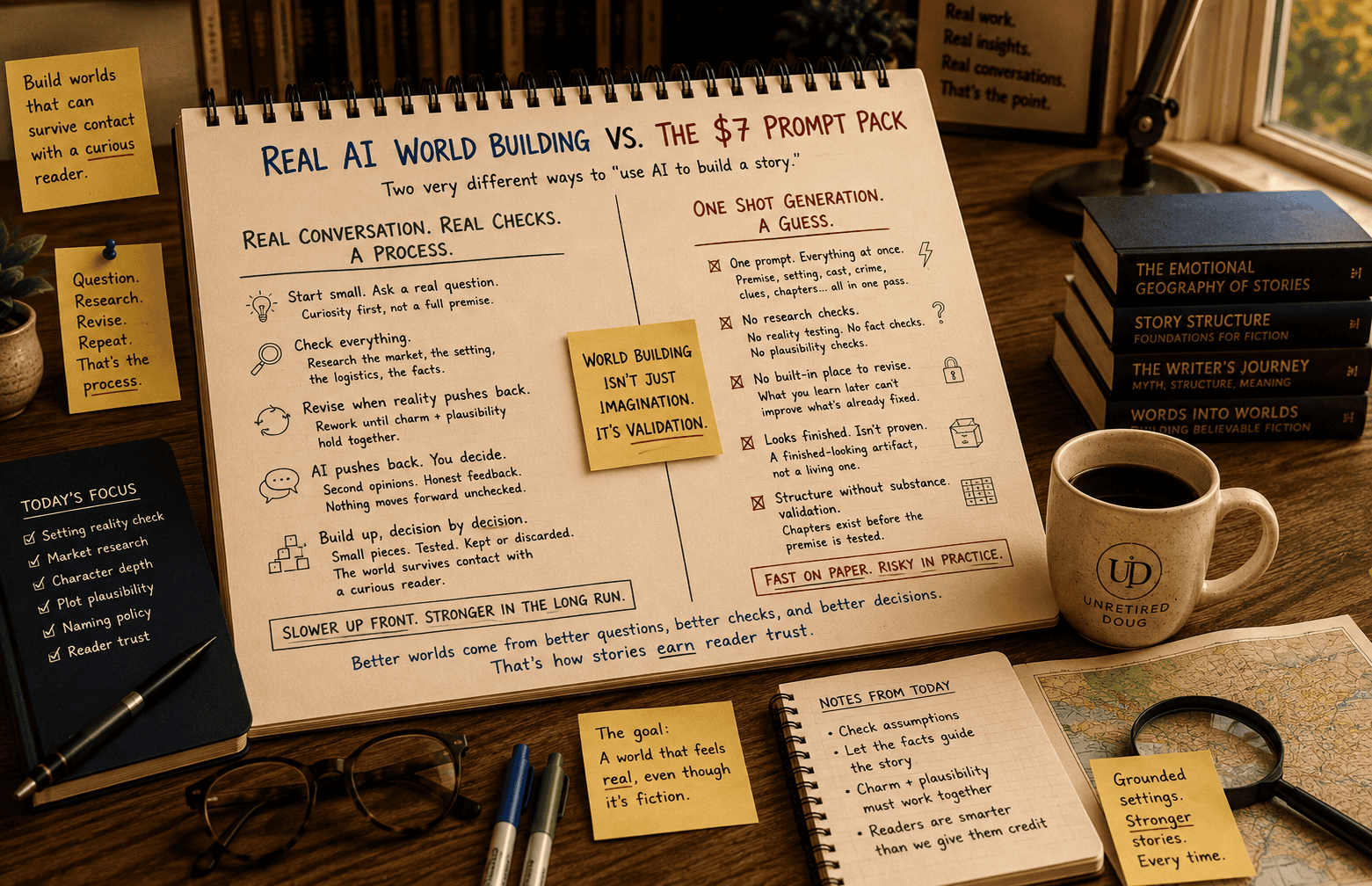
Here’s The Scoop: A prompt pack that generates a full story bible and chapter roadmap in one shot isn’t building a world. It’s guessing at one, confidently, all at once, with nothing checked. Real AI-assisted development looks more like a long conversation: a small idea tested against real research, revised when the research pushes back, and built up decision by decision until the world can survive contact with a curious reader.
I want to walk through the shape of a worldbuilding session I’ve been running lately. Not to show off the specific idea; I’m keeping that part close for now. The process is the actual lesson, and it’s a useful contrast to something I ran across recently: a packet of prompts, sold outright, each one promising to have an AI act as an “elite series architect” and hand back a complete story bible and a full chapter-by-chapter roadmap in a single response.
Both are “using AI to build a story.” They are not the same activity.
How the packaged version works
The prompts are built around a shape that looks rigorous on the surface. They ask for book metadata, a sleuth profile, crime specifics defined up front for logical consistency, a suspect list with real motive and opportunity, a clue chain with red herrings, and a chapter-by-chapter roadmap that hits a four-part structure. That’s a real skeleton. It’s not nothing.
What it doesn’t have is a single moment where anything gets checked against reality before it’s locked in. The premise, the setting, the cast, the crime, the clues: all of it gets generated in one pass, based on nothing but a category label and a one-paragraph pitch. There’s no step where a claim about the setting gets tested against how that kind of place actually works, no step where a plot mechanic gets checked for whether it’s plausible, no step where the AI is asked to push back on the premise itself. The entire fifteen-chapter structure exists before anyone has verified that the premise holds up to five minutes of scrutiny.
And because it’s one shot, it’s also final in a way that’s easy to miss. There’s no built-in place to revise a decision once you’ve learned something that makes it look worse than it did at the start. You get a finished-looking artifact instead of a live one.
How the actual conversation went instead
The session I’ve been running started from a small, specific question: a passing curiosity about whether a particular idea had already been done in a genre I was circling. That’s it. Not a premise. A question.
From there, nothing got locked in without being checked first.
Before I trusted a market angle, I checked it — actually searching for whether the idea was genuinely unclaimed, rather than assuming it. One structural choice that seemed charming on its own turned out to have a real logistical problem once we looked closely at how the underlying reality actually works. Rather than forcing the original idea through, we reworked it, more than once, until the charm and the plausibility both held up together. And a market-positioning angle that looked appealing on paper, a genuinely higher-growth, lower-competition option, got weighed against a real authenticity concern and set aside on purpose. The reasoning got written down. Not just the conclusion.
The protagonist wasn’t handed a personality in the first pass. She got one only after a second opinion pointed out something I’d missed: I’d run the concept past another AI for a read, and it flagged that everything built so far was competence and infrastructure, with no interior life underneath it. That gap got addressed directly. What filled it wasn’t arbitrary. It grew out of a real, personal detail I supplied, then got tested for whether it actually fit the tone of the genre before I kept it.
The setting went through the same treatment. I checked real geography, real terrain, real road access, and real infrastructure before committing to anything, and revised the choice more than once when a better-grounded option turned up. A naming policy for how to handle real places got worked out with real reasoning behind it, rather than defaulting to whatever felt easiest.
At every one of these points, the AI wasn’t handing over a finished piece. It was doing research, offering a craft opinion, sometimes pushing back, then waiting for a decision. That decision came from me, informed by what we’d just found out. Nothing advanced until it had survived that.
The actual difference
It isn’t that one approach uses AI for creative work and the other doesn’t. Both do. The difference is where the checking happens.
The packaged version checks nothing before generating everything. It front-loads a plausible-looking structure and asks you to trust that the content poured into that structure holds up, sight unseen, chapter after chapter.
The other approach checks constantly and generates slowly. Small pieces, tested, kept or discarded, before the next piece goes on top. By the time anything resembling a full bible exists, most of the load-bearing decisions in it have already survived being wrong once and gotten fixed.
That difference matters more than it looks like it should. Fiction readers, cozy readers especially, are unusually good at sensing when something was assembled rather than built. Not because they fact-check settings. A world with nothing checked underneath it tends to feel thin in ways that are hard to name and easy to feel.
What this costs, honestly
The slow version takes real time. A single prompt and a five-minute wait, in the packaged version, turned into dozens of exchanges across more than one sitting in the real one: research, corrections, reconsidered decisions, a periodic outside check-in, a living reference document that got rewritten more than once as understanding deepened rather than treated as finished the moment it was first drafted.
That’s not a knock on prompt packs as a starting point. A good structural skeleton, suspects, motive, clue chains, pacing, is genuinely useful scaffolding. The mistake is treating what comes out of that scaffold as a finished product rather than a rough first pass that still needs the same scrutiny everything else in this process got. Used as a starting skeleton, a prompt pack like that has real value. It just isn’t the whole job, no matter how confidently the prompt was worded.
Core
A cheap prompt front-loads a whole story structure and checks none of it. A slow, iterative process checks constantly, revises freely, and ends up with fewer decisions, but ones that have already survived being wrong once. The second approach costs real time up front. It produces something sturdier for it.
Q&A
Is a purchased prompt pack actually useless, then? No. Treated as a first-draft skeleton to interrogate rather than a finished bible to trust, it can save real time. The problem isn’t the prompt. It’s stopping at the first output.
How do I know when I’ve done “enough” checking on a worldbuilding decision? A reasonable bar: could a reader who actually knows something about this topic, the real place, the real animal, the real profession, read this detail without wincing? If you haven’t checked, you don’t know the answer.
Doesn’t all this back-and-forth slow down getting an actual draft written? It slows down the start. It speeds up everything after, since you’re not discovering plot-breaking problems three chapters in, or after the book is out and a reader finds them for you.
Can this process work for genres that don’t lean on real-world plausibility as much? Yes. The target of the checking shifts. Instead of verifying real-world facts, you’re checking internal consistency, genre convention, and whether an idea that sounds good in isolation actually holds up once it has to interact with everything else in the story.