
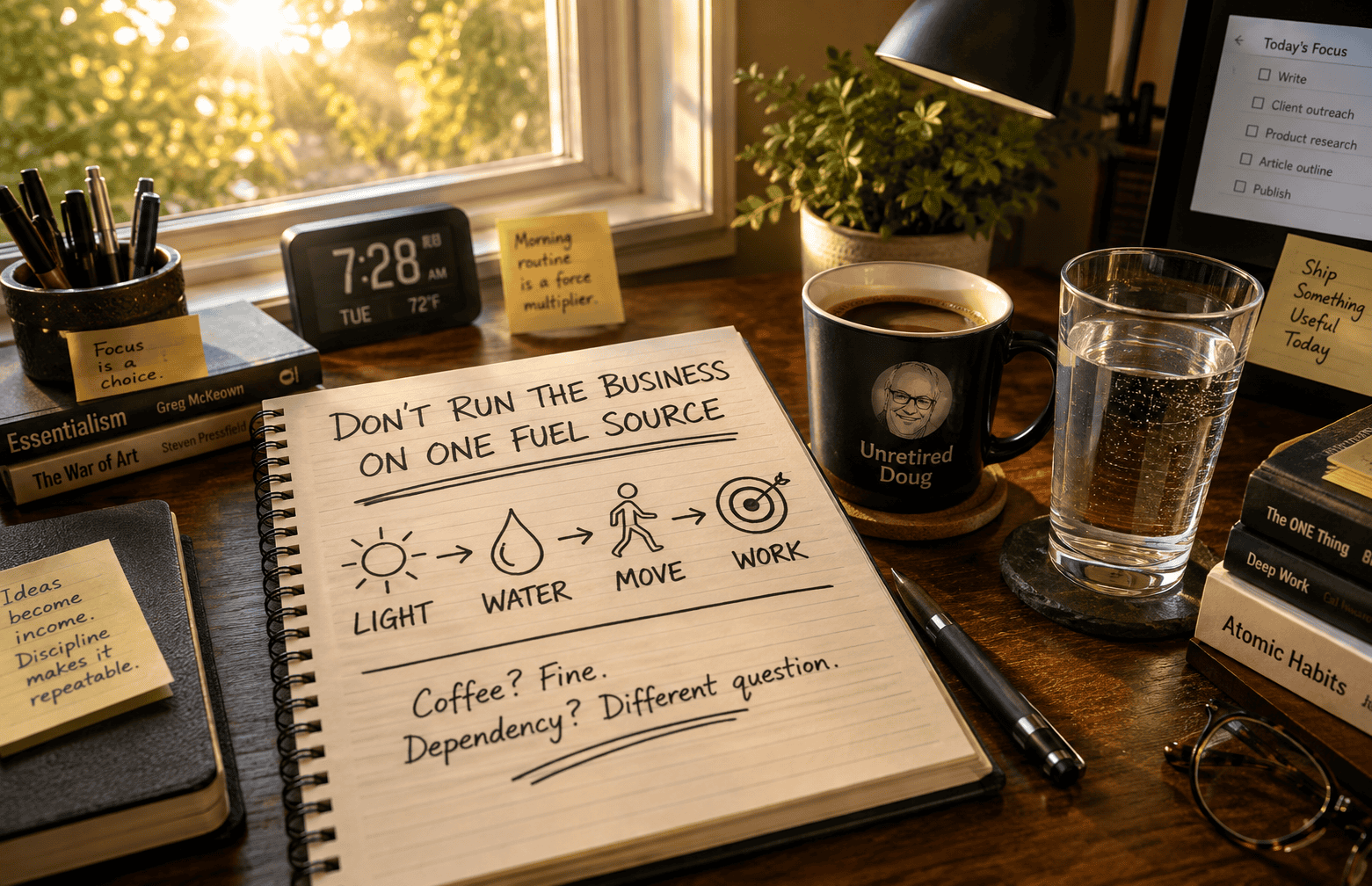
Better morning alertness, without betting your whole operation on one substance
I’m not a doctor or a nutritionist. But I’m a solo business owner with multiple passions and busy days. This article is based on personal experience and research. Read it as a layperson’s advice.
Quick answer: there’s no substance that replicates what caffeine does, but you don’t need one. Real alertness without dependency comes from a combination of non-stimulant fundamentals and a small set of lower-dependency herbal options, used deliberately rather than as a daily requirement.
- Caffeine doesn’t create energy. It blocks the signal that tells your brain you’re tired, which is why tolerance builds and why quitting produces real withdrawal.
- Several popular “caffeine alternatives,” including yerba mate, guarana, and matcha, still contain caffeine or closely related stimulant compounds. They’re lower-dose substitutes, not dependency-free ones.
- The most reliable non-stimulant levers are morning light exposure, hydration, and short movement, not another beverage.
- Ginseng and L-theanine have the better evidence behind them among herbal options; most of the rest of the popular list runs on tradition and marketing more than research.
- If you’re tapering off caffeine, doing it over two to three weeks avoids the worst of the headache-and-fog withdrawal window that makes people quit trying.
If you work for someone else, a rough morning is survivable. You show up underslept, you coast through the first meeting on autopilot, and the day absorbs it. Nobody’s tracking whether you were sharp at 8 a.m.
Running your own business removes that cushion. There’s no one covering for a foggy morning. The invoice still needs sending, the client call still happens, the writing still has to get done, and it has to get done by you, today, whatever state your brain is in when you sit down.
That’s probably why so many solopreneurs quietly build their whole operating system around one input: caffeine. It works, until the day it doesn’t, whether that’s tolerance creeping up so the same cup stops doing the job, a travel day that breaks the routine, or a stretch where the jitters start interfering with the exact focus you needed the coffee for in the first place.
This isn’t an argument for quitting caffeine. It’s an argument for not needing it to function. Those are different goals, and most of what gets written about “caffeine alternatives” doesn’t actually separate them.
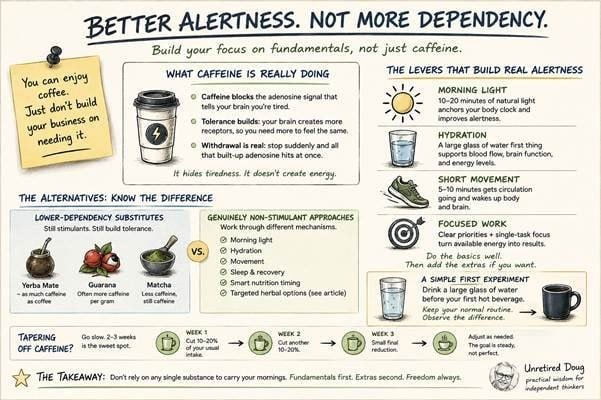
What Caffeine Is Actually Doing
Caffeine doesn’t manufacture energy. Your brain produces a compound called adenosine throughout the day as a byproduct of activity, and rising adenosine is what makes you feel progressively more tired as hours pass. Caffeine works by blocking the receptors that read that signal. The tiredness is still there. You just stop being able to feel it for a while.
That’s the mechanism behind both effects people associate with caffeine. The jitters happen because blocking adenosine also triggers a mild adrenaline response, which is why too much caffeine feels like anxiety with a caffeine flavor. The dependency happens because your brain adapts to constant blocking by growing more adenosine receptors, so the same dose stops working as well over time, and you need more just to get back to baseline. Stop entirely and all that built-up adenosine hits at once, which is the actual source of caffeine withdrawal headaches.
Once you see it this way, the search for a true replacement starts looking different. You’re not looking for something that produces energy the way caffeine appears to. You’re looking for either a gentler version of the same blocking mechanism, or a way to reduce how much adenosine and fatigue you’re generating in the first place.
The Alternatives That Aren’t Really Alternatives
Most “caffeine alternative” lists include yerba mate, guarana, and matcha as though they solve the dependency problem. They don’t. Yerba mate contains roughly as much caffeine as coffee. Guarana is often more concentrated per gram than coffee beans. Matcha contains less caffeine than a cup of drip coffee, but it’s still caffeine, paired with an amino acid called L-theanine that takes the edge off the jitters without touching the underlying dependency mechanism.
That’s a genuinely useful distinction to know before you build a routine around one of these, thinking you’ve solved the problem. Swapping coffee for yerba mate is swapping one caffeine source for a different one with a different flavor and a different antioxidant profile. It might be worth doing for other reasons. It won’t get you off the caffeine cycle.
The honest way to think about the popular list is as two separate categories. One is lower-dependency substitutes: still stimulants, still capable of building tolerance, but often gentler in dose or paired with something that smooths the jitters. The other is genuinely non-stimulant approaches that work through a completely different channel. Most of what gets marketed as an “alternative” is quietly the first category dressed up as the second.
What Actually Reduces the Need for a Stimulant
The non-stimulant levers get the least attention in most of these articles, probably because they don’t sell a product. They’re also the ones with the most consistent evidence behind them.
Morning light exposure is the single biggest lever most people ignore. Your circadian rhythm, the internal clock that governs when you feel alert versus tired, is set primarily by light hitting your eyes early in the day. Ten to fifteen minutes outside, or even near a bright window, shortly after waking does more to anchor genuine daytime alertness than most supplements attempt to.
Hydration matters more than it sounds like it should. Mild dehydration, which is common first thing in the morning after six or eight hours without water, produces fatigue and brain fog that feels a lot like needing caffeine but isn’t. A large glass of water before your first hot beverage is a cheap experiment worth running for a week before assuming you need a stimulant at all.
Short movement, even a five-minute walk or some stretching, raises alertness through a completely different pathway than caffeine does, and it doesn’t come with a comedown. This is the one people resist most, usually because it feels like it should be less effective than a beverage, and it usually isn’t.
Among things you actually consume, ginseng has the better research behind it for cognitive alertness and has been used long enough, and studied enough, that it’s not purely anecdotal. L-theanine, the amino acid found in tea, has decent evidence for reducing anxiety and smoothing focus on its own, separate from whatever caffeine it’s usually paired with. Most of the rest of the popular list, chicory root, rooibos, cacao, peppermint tea, runs more on tradition, taste, and marketing copy than on real data. That doesn’t make them bad choices. It means you should pick them because you like them, not because you expect them to functionally replace caffeine.
What This Actually Looks Like Week to Week
If you decide to try reducing dependency rather than swapping products, the friction shows up faster than people expect. The first three to five days without your normal caffeine dose are the hardest. Mild headache, low mood, difficulty concentrating, and a strong pull back toward the old cup are all typical, and all temporary. Cutting the dose gradually over two to three weeks rather than stopping outright avoids the worst of that window, which is usually where people give up and conclude none of it works.
Once past that window, the honest tradeoff becomes visible. Morning light and hydration and a short walk produce real alertness, but it’s a flatter, steadier version than a caffeine spike. It doesn’t feel like anything is happening the way a coffee kick does. For someone used to that jolt as the signal that the day has started, the absence of the jolt can read as failure even when the underlying alertness is genuinely there.
The other friction point is habit architecture. Coffee is a ritual as much as a chemical, the cup in hand, the walk to the kitchen, the few minutes of quiet before the inbox opens. Removing the substance without replacing the ritual usually fails, not because the alternative didn’t work, but because the morning lost its shape and something else, usually the phone, filled the gap instead.
Why This Matters More When You Work for Yourself
An employee whose alertness depends entirely on one substance has a manager, a team, and a schedule absorbing the bad days. A solopreneur has none of that. If the thing you built your energy system around stops working, whether from tolerance, travel, illness, or simply running out, there’s no backup system and no one covering the gap.
That’s the actual argument for building this out before you need it, not as an emergency fix once the jitters or the crashes get bad enough to force the issue. Dig the well before you’re thirsty applies here as much as it does to any other piece of infrastructure in a one-person operation. A morning that doesn’t depend entirely on a substance holding up is more resilient than one that does, in the same way a business that doesn’t depend entirely on one traffic source or one platform is more resilient than one that does.
There’s also a psychological piece worth naming honestly. Solopreneurs tend to over-rely on caffeine specifically because there’s no external structure imposing breaks. No one calls a meeting you have to sit through while you recover. The instinct is to push through with more caffeine instead of stepping away, and that instinct is exactly what turns a useful tool into a dependency.
What to Do Next
Don’t try to overhaul your whole morning at once. Pick one lever from the non-stimulant list, morning light, water before coffee, or a five-minute walk, and run it for a week alongside your normal caffeine routine, unchanged. Notice whether it moves anything. Most people are surprised by how much one of these does on its own before they’ve touched their actual caffeine intake at all.
Only after that, if you want to reduce dependency itself, taper the dose over two to three weeks rather than stopping outright. Track how you feel, not how much willpower it takes. The goal isn’t zero caffeine. It’s not needing it to function.
Core
Let’s sum it up:
- Caffeine blocks your body’s tiredness signal rather than creating energy, which is why tolerance builds and quitting produces withdrawal.
- Many popular “alternatives” (yerba mate, guarana, matcha) are still caffeine sources, just at different doses.
- Morning light, hydration, and short movement are the most reliably effective non-stimulant levers, and they’re free.
- Ginseng and L-theanine have the more credible evidence among herbal options worth trying deliberately.
- Building this before a crash forces the issue is the same resilience logic that applies to any other part of running a one-person operation.
Quick Answers
Will any of this actually replace what caffeine feels like?
Not the spike, no. Nothing replicates the specific jolt of adenosine-blocking. What these approaches replace is the dependency, the crash, and the need for an ever-increasing dose to feel normal. Some people find that tradeoff worth it. Some don’t, and that’s a legitimate call to make with full information rather than half of it.
Is it fine to keep drinking coffee and just add these on top?
Yes. This isn’t a quit-caffeine article. Adding morning light and hydration on top of your existing coffee routine still produces a real, noticeable difference, and it’s the lowest-friction place to start if a full taper isn’t something you want to take on right now.
Why do I feel worse the first few days if I cut back?
That’s the adenosine backlog clearing, along with a genuine adrenal adjustment. It’s uncomfortable and temporary, typically resolving within three to five days for most people, sooner with a gradual taper than a hard stop.
What about energy drinks or nootropic stacks marketed as “clean energy”?
Most of them are still caffeine, often at a higher dose than a cup of coffee, with additional stimulants layered in. Read the label the same way you would for any of the herbal “alternatives” above: check what’s actually in it before assuming the marketing language means dependency-free.