
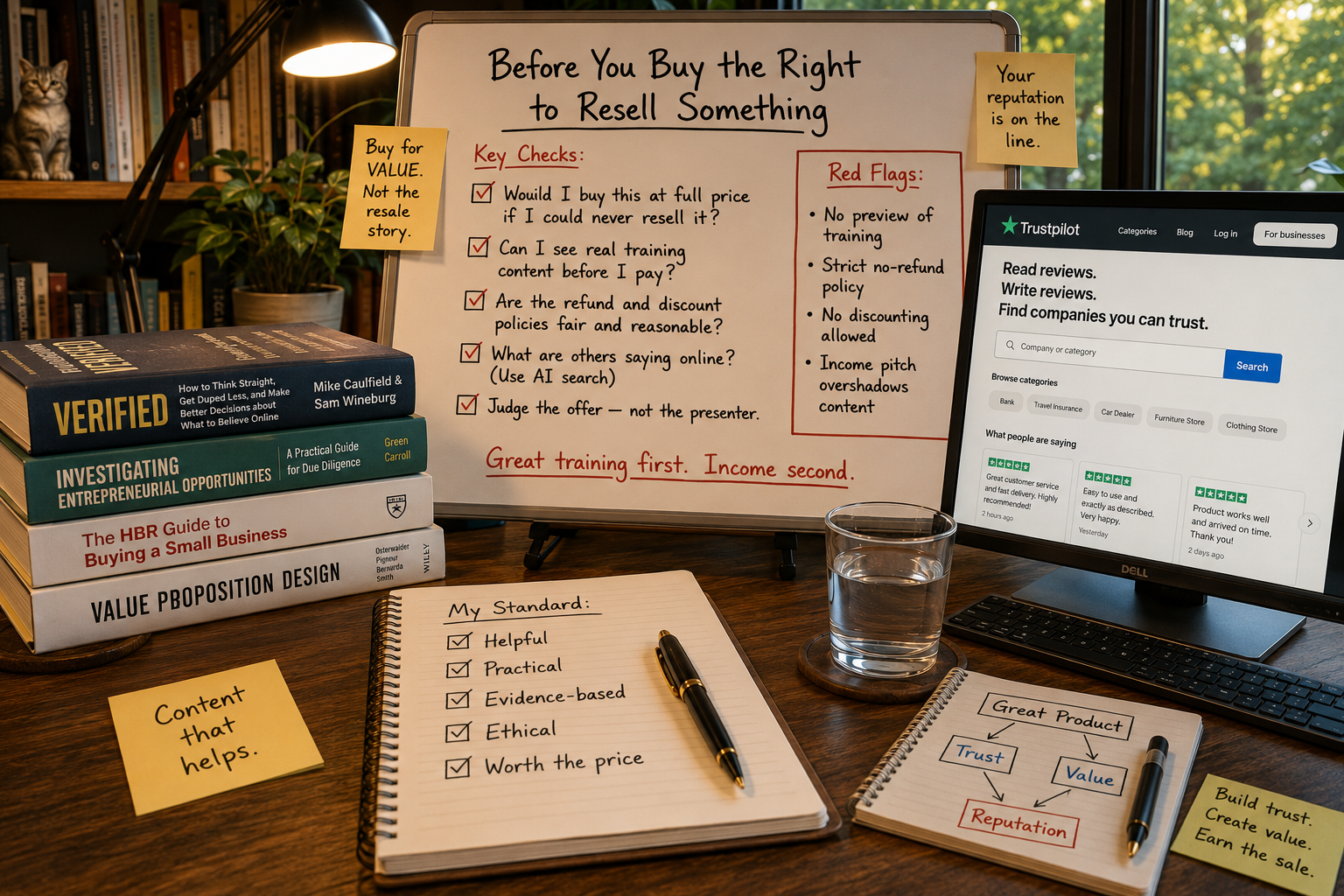
Quick answer: if a high-ticket “buy this system, resell this system” program won’t let you see a real sample of the training before you pay, that’s reason enough to walk. Ask yourself whether you’d want the product at its full price even if you could never resell it. If the answer is no, the resale pitch is covering for something the product can’t do on its own.
A specific kind of digital marketing program has been making the rounds for a few years now: pay a few hundred to a few thousand dollars for a “done for you” training system, and along with the training you get master resell rights, meaning you can turn around and sell that same system to someone else, at the same price, and keep the money yourself.
It had its first real hype spike a while back, took a credibility hit as the market got saturated and buyers started comparing notes, and it never actually went away. It’s a well-established pattern at this point, not a passing fad and not a new discovery, and new entrants keep showing up with fresh branding and a fresh face fronting the pitch.
One scoping note before anything else: this is about the high-ticket end of that world, the programs running $500 to $1,500 or more that bundle training with resale rights and a whole funnel to go with it.
It is not about the low-ticket private label rights content you’ll find on PLR marketplaces or general internet-marketing PLR sites, where you’re buying raw material for a few dollars with the explicit understanding that you’ll rewrite and reshape it before it’s yours to use. That’s a different transaction with a different risk profile. PLR content doesn’t ask you to vouch for someone else’s income claims or resell an unmodified system to people who trust you. The concerns below are specific to the higher-priced “opportunity” category.
If you’re weighing one of these programs, or you already sell one and something’s nagging at you, here’s what’s actually worth checking before money changes hands.
Quick Answer
- Ask whether you’d want the product at full price even if you could never resell it. That question strips the income pitch away and leaves you looking at the actual thing you’re buying.
- If a program won’t let you preview real training content or see a curriculum before purchase, that’s sufficient reason to pass on its own.
- A strict no-refund policy paired with a rule against discounting the resale price can leave you holding something you can’t return and can’t price to actually sell.
- Before you buy, have an AI search for related conversations online, including variant spellings and phrasings of the program’s name. It helps to see the pros and cons others are discussing, especially from people who’ve already bought in, and misspelled or oddly punctuated threads on forums and review sites often hold conversation a plain search misses.
- A warm, trustworthy-seeming presenter tells you nothing about the product underneath. Judge the offer on its own terms.
The Question That Cuts Through the Pitch
Every one of these programs sells two things at once: the training itself, and the right to sell that training to somebody else. The second part is doing most of the persuading. Take it away for a second and ask the plainer question: would you pay this price for this content if resale rights weren’t part of the deal at all?
That question works because it separates what you’re actually being asked to evaluate from what’s being used to distract you. The income opportunity is vivid and easy to picture.
The content itself, sitting there without the resale story attached, is what you’d be judging if you were buying any other course. Most people are decent judges of whether a course is worth its price when there’s no side pitch attached. Add the resale angle and that judgment gets harder to trust, because now you’re weighing two things that pull in opposite directions: how good is this, against how much could I make reselling it.
Here’s where the honest version of this test runs into a wall. You cannot answer it with any confidence if you’ve never been allowed to see what you’re buying.
A program that keeps its curriculum behind the purchase button isn’t being cagey by accident. It’s removing the one piece of information that would let you answer the only question that matters, and it’s doing that before you’ve spent a dollar. That’s not an inconvenience. That’s the test failing before you even get to take it.
A Different Kind of Purchase
Buying an ordinary course is a contained transaction. You pay, you consume it, you judge it for yourself, and if it turns out to be thin, the damage stops with you.
Buying resale rights changes what that transaction actually is. You’re not just a customer anymore. You become the person vouching for this thing to whoever you sell it to next, usually people who already trust you for something else. If the content underneath is weak, that’s not your problem alone anymore. It’s now something you’ve asked someone else to pay for on your recommendation.
This is also where the general saturation problem shows up, and it’s the same mechanism behind the original hype-and-backlash cycle these programs went through. There’s no residual income built into a one-time resale.
Once you’ve made the sale, that transaction is closed, and the person you sold to is now competing with you for the next buyer. There’s no ongoing relationship pushing the creator to keep improving the product, because the sale already happened. And because everyone reselling the same system tends to be fishing in overlapping waters, the pool of people who haven’t already seen the pitch shrinks faster than most people expect going in.
What to Actually Check Before You Pay
The sales page is written to move you toward the button. The terms and conditions page is written to protect the company, and because of that, it tends to say what the sales page leaves out. Read it in full, not skimmed, and look specifically for a handful of things.
Start with the refund policy. Some programs state plainly that all sales are final, no exceptions, regardless of circumstance. That’s worth knowing going in, because it changes how much diligence you owe yourself before purchase.
Look for a clause restricting how you can price the product once you own the resale rights. Some terms explicitly forbid discounting below the stated price, which sounds like brand protection but functions as a floor you can’t lower even if your own market won’t bear the sticker price.
Check what happens if you initiate a chargeback. Some programs treat a chargeback attempt as grounds for immediate, permanent account termination, no reinstatement considered. If a refund request through your bank is the backstop you’re counting on, know in advance what that costs you.
Look for costs that show up in the terms but not the pitch. Domain names, hosting, “enhanced” support tiers, or mandatory upgrades sometimes appear only in the fine print, well after the marketing has already sold you on a specific price.
Check for restrictions on sharing or discussing the training content itself. Sometimes the same clause that prohibits unauthorized redistribution also blocks existing buyers from giving an honest preview to someone deciding whether to buy in. That’s worth noticing, because it closes off the one informal channel that might otherwise let you evaluate the product before committing.
And notice whether there’s an explicit “I agree to these terms” checkbox at checkout. It’s worth understanding exactly what that acceptance does and doesn’t waive before you click it, rather than after.
One more step worth taking before you pay: ask an AI to search for the program by name, and by variant spellings and phrasings of that name. People starting threads on Reddit, TrustPilot, and smaller forums routinely misspell a name, drop a space, or swap out punctuation, and a straightforward search often misses exactly the conversation you’d want to find.
This isn’t foolproof in either direction. Finding nothing doesn’t mean the program is safe. A newer or narrowly marketed offer may simply not have generated public discussion yet. But finding something is worth taking seriously, and it costs almost nothing to check.
On Chargebacks and No-Refund Policies
This isn’t legal advice, and terms vary by card issuer and by circumstance, but it’s worth understanding roughly how this works. Agreeing to a no-refund policy at checkout doesn’t automatically strip you of the right to dispute a charge with your bank or card company later. What it does give the merchant is a documented position to push back with when that dispute happens, which can make the process longer and the outcome less certain than it would be otherwise.
The practical takeaway is not “chargebacks never work.” It’s that you shouldn’t buy on the assumption that a chargeback is a guaranteed undo button. Treat the purchase as final at the moment you decide to make it, and let anything that comes after be a bonus rather than a plan.
The Instinct Worth Naming
There’s a reasonable-sounding thought that shows up here: in any program with a lot of members, some percentage will be unhappy no matter what, so a handful of bad experiences doesn’t tell you much. That instinct isn’t wrong on its own. Large groups of people produce a range of experiences almost by definition.
What it shouldn’t do is talk you out of reading the terms yourself. A no-refund clause, a resale price floor, and a chargeback penalty aren’t matters of individual experience.
They’re written into the contract the same way for everyone who buys in. Whatever spread of satisfaction exists among the people already in the program, the structural terms apply regardless, and they’re worth evaluating on their own merits before you decide whether the “some people are just unhappy” explanation actually covers what you’re looking at.
Worth naming directly, too: the person delivering the pitch tells you nothing about what’s underneath it. A relatable fifty-something with a warm, personal story is exactly as capable of running a weak offer as a slicker twenty-something with a polished script. Neither age nor tone nor sincerity is a quality signal. The paperwork and the public record are. Trust those, not the person on camera.
What to Do Next
If you’re looking at one of these programs, ask directly for a sample module or a real curriculum outline before you pay. A program with nothing to hide has no reason to refuse that request, and how they respond to it is itself useful information.
Have an AI search for existing conversations about the program, including a few variant spellings and phrasings, the kind of dropped spaces and swapped punctuation that hide conversation from a plain search.
Then have it, or read yourself, go through every terms and checkout page looking for the specific clauses above, and check whether there’s more than one version of that page floating around, since what’s linked publicly doesn’t always match what shows up later in the funnel.
Run the resale test in writing, honestly, before you buy: would you want this, at this price, even if reselling it were never part of the deal. And go in already knowing where you stand on chargebacks, rather than finding out after you’ve already paid.
Core
Let’s sum it up. The sample-access question and the resale test are really the same test asked two different ways, and a program that fails one usually fails the other. The terms page and the public record will tell you more than the sales page ever will, if you’re willing to read them before you buy instead of after something’s gone wrong. And the skepticism belongs on the offer itself, not on how likeable or credible the person selling it happens to seem.
Q&A
Isn’t a no-refund policy fairly normal for digital products in general?
It’s common enough on its own. What changes the picture here is stacking it with no preview access and a resale price floor. Any one of those alone is a minor inconvenience. All three together mean you have no way to evaluate the product beforehand, no way to return it if it disappoints, and no way to reprice it if your market won’t pay full freight.
What if the seller offers a partial preview, like one free lesson or a short sneak peek?
It’s better than nothing, but ask whether that sample is genuinely representative of the full curriculum or a highlight reel chosen to sell you. A single polished lesson doesn’t tell you much about modules six through twelve. If they’ll show you a table of contents or a full module list alongside the sample, that’s a stronger signal than the preview alone.
Does agreeing to a no-refund checkbox mean I have no options at all if things go wrong?
Not necessarily, since a chargeback through your card issuer is often still possible depending on the circumstances and your bank’s own policies. But some programs specifically penalize a chargeback attempt with permanent account termination, so understand that tradeoff going in rather than treating the chargeback as a free, risk-free undo option.