
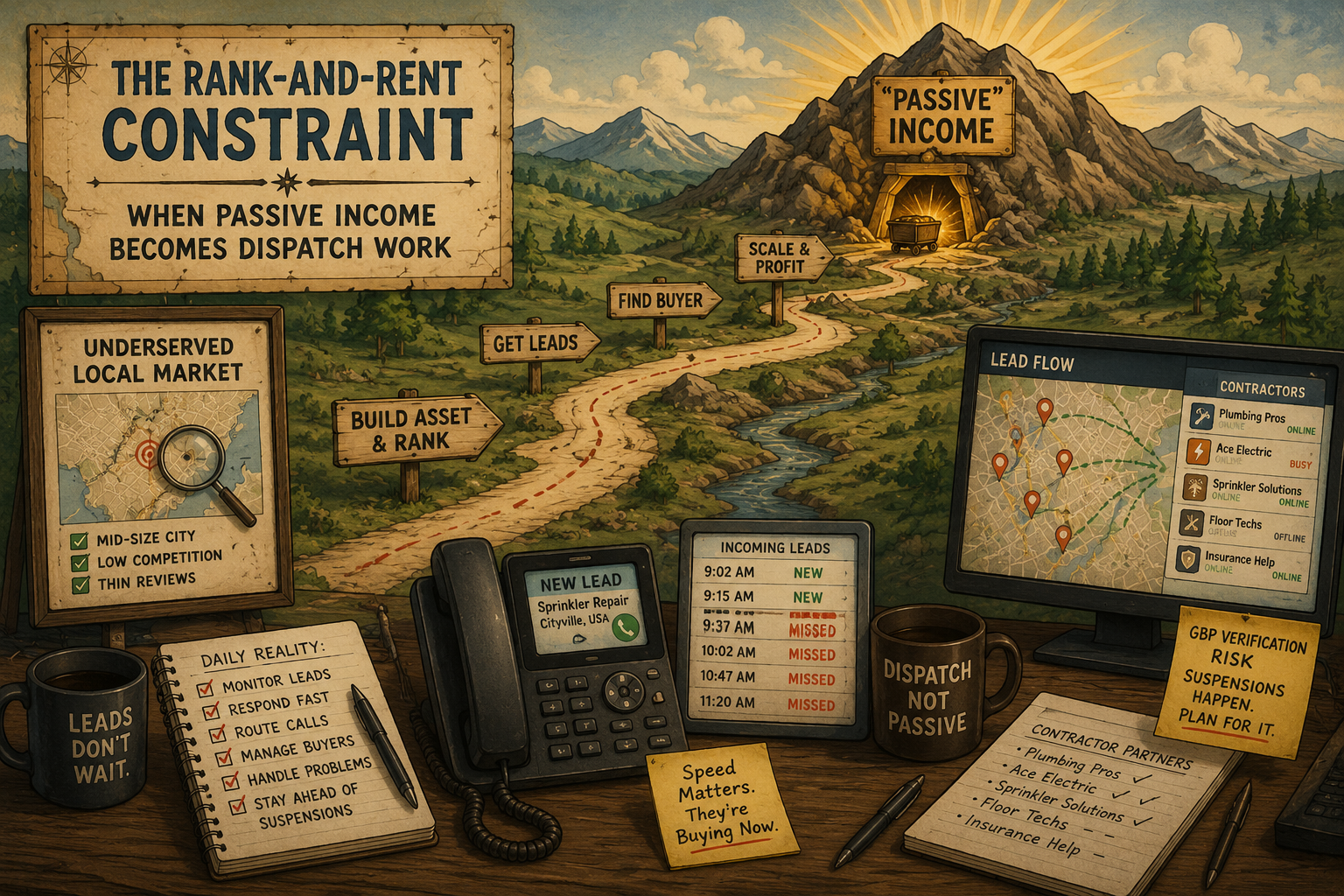
A friend sent me a video recently with a course link attached. The pitch was familiar territory if you’ve spent any time in the local-business-marketing corner of the internet: find a low-competition service niche in a mid-size city, build a ranked asset — a website or a Google Business Profile — collect inbound leads, and sell them to a contractor. Epoxy flooring. Sprinkler repair. SR22 insurance. The presenter walked through a few examples, found niches where the existing competition had surprisingly few reviews, and described the whole thing as close to passive income.
It’s not a bad idea. It’s an incomplete one. And the gap between “not bad” and “actually works the way it’s described” is where most people lose months they didn’t plan to lose.
What the pitch gets right
The niche research method itself is sound. You pick a mid-size city, search for a service category, and look at what the top few listings have for review counts. If the top result has 40 reviews and a website from a different city, you’re probably looking at thin competition. If the top three results have 200+ reviews and have clearly been doing this a while, you’re not.
That’s a useful filter. It works whether you’re trying to rank an asset yourself or, as I’d argue is the better application, trying to find local business owners who could use help with their own listing. Same research method, different target. More on that below.
Where the asset itself runs into trouble
The part the pitch glosses over is what happens after the asset starts working — meaning, after it actually generates an inquiry.
A homeowner searching for sprinkler repair isn’t browsing. They’re buying, usually same-day or next-day. If your asset generates an inquiry at nine in the morning and nobody sees it until three in the afternoon, that homeowner has already called someone else. The asset only earns money if someone is watching it in something close to real time. That’s not passive income. That’s a monitoring job wearing a digital-asset costume.
You could solve this by arranging for leads to auto-forward to a local contractor — take yourself out of the loop entirely. That solves the monitoring problem and creates a sequencing one. The asset has no value until you have a buyer lined up. But you can’t credibly offer leads from something that doesn’t rank yet, and you can’t sell a contractor on a revenue arrangement for a website that doesn’t exist. Somebody has to commit to something uncertain first, and it’s usually you.
And if you build and rank before lining up a buyer — which is what most of these courses actually walk you through — there’s a second problem waiting. An asset that generates leads nobody answers doesn’t just sit there failing to make money. It actively gets worse. A consumer who calls and reaches no one leaves a bad review, or flags the listing as unresponsive, or tells Google the business looks closed. The asset can degrade while you’re still trying to get it off the ground.
The Google Business Profile complication
If your version of this plan leans on a Google Business Profile rather than a website, there’s an additional layer. Google has tightened verification meaningfully over the past few years, particularly around service-area businesses — listings without a verified physical storefront, which is exactly the structure this model depends on. Video verification is increasingly standard, and suspensions for listings that look like exactly what they are — a speculative asset built to capture and resell leads — have become more common, not less.
The presenter in the video I watched acknowledged this directly, and treated it as an acceptable cost of doing business. That’s a defensible posture if your plan is to profit before getting flagged and move on to the next listing. It’s a poor fit if you’re trying to build something that holds up over time.
What the daily reality actually looks like
If you strip away the passive-income framing, what’s left is something closer to a small dispatch operation. You’re either personally monitoring incoming leads across however many assets you’ve built — which doesn’t scale past a handful of sites before it consumes your day — or you’ve built routing infrastructure and signed contractor agreements, which is a small business with operational overhead, not a side project with a ranked website attached to it.
Neither version is wrong, exactly. But neither version is what “build a site, rank it, collect passive leads” implies. The people who make this model work at any real scale are usually running it as their primary business, often with help, and treating account suspensions as a known and budgeted cost rather than an occasional surprise.
What’s actually worth keeping
The one piece of this I’d hold onto is the research method — not the asset-building model that sits on top of it.
Searching a city, finding a service category where the established competition is thin, and treating that as a signal: that’s a legitimate way to identify markets that aren’t locked up. It’s just as useful for finding business owners who’d benefit from help with their own existing listing as it is for trying to build a competing asset and rent it out. The target is different — a business owner who needs assistance, not a consumer shopping for a contractor — but the lens for finding the opportunity is the same.
That distinction matters more than it sounds like it should. One version asks you to build something speculative and hope a buyer materializes before the asset degrades. The other asks you to find someone who already has a real business and a real gap, and offer to close it. The second version doesn’t depend on perfect timing the way the first one does.
If you’re going to look into this
Separate the research method from the business model before you commit to either one. The method is reusable in low-risk ways. The model has real constraints that don’t show up in the pitch, and most of them get more expensive the longer you ignore them.
What this comes down to
- The niche research method — checking review counts on top local listings — is a clean way to spot underserved service categories.
- A ranked asset built to capture and resell consumer leads only earns money if someone is actively monitoring it in near real time.
- Auto-forwarding leads to a partner solves the monitoring problem but creates a sequencing problem: you need a committed buyer before the asset has any value.
- An asset that generates unanswered leads doesn’t sit idle — it accumulates negative signals while you’re still trying to get it running.
- Google Business Profile listings built around this model face real and increasing verification scrutiny, particularly for service-area businesses without a physical location.
A few practical questions
Is the niche research method itself worth using?
Yes. It’s a legitimate way to find underserved local service categories, whether you’re looking to build something or to find business owners who need help with what they already have.
Could this work if I had a contractor lined up before building anything?
It removes the worst of the sequencing problem, but most contractors won’t commit to a real revenue arrangement on an asset that doesn’t exist and isn’t ranking yet. You’re usually still building on faith that a buyer shows up.
Is the Google Business Profile route easier than building a website?
It can rank faster in some cases, but it comes with more verification scrutiny right now, particularly for listings without a real physical address. Neither route avoids the lead-timing problem.
What’s the better use of this skill set?
Using the research method to find local business owners with thin or struggling listings, and offering to help them directly, tends to be a more stable starting point than building a speculative asset and hoping a buyer appears.