
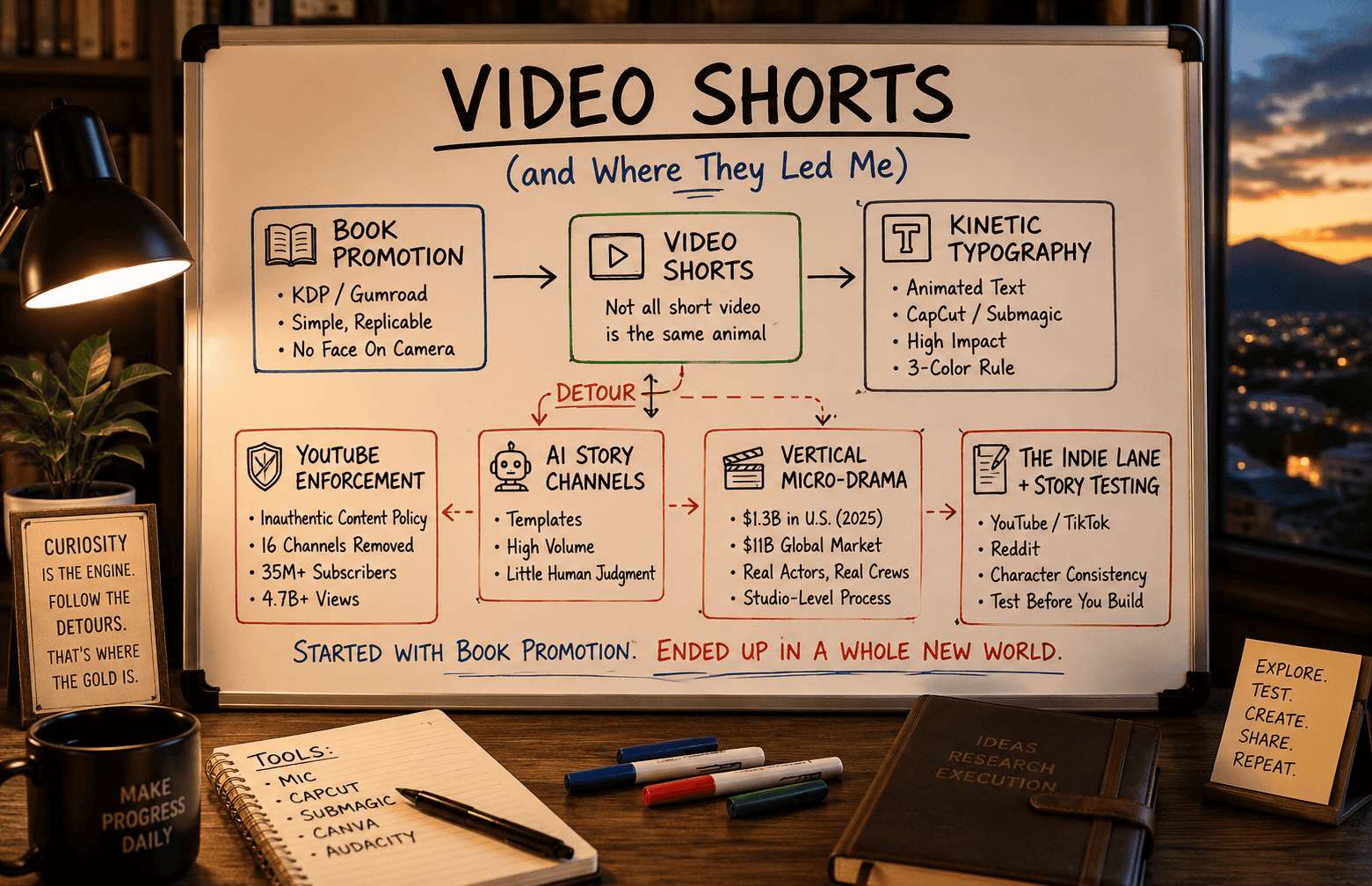
As I explore video shorts as a business model, one thing became clear fast. There’s a real variety of formats and styles under that one label. “Short video” isn’t a single thing. It’s a whole category with its own sub-genres, tools, and audiences.
Here’s what I found, starting with the format I’m actually going to use, and ending with a detour I didn’t expect to take.
Not All Short Video Is the Same Animal
Talking-head clips, AI avatar presenters, B-roll-heavy montages, kinetic typography, dramatized mini-scenes. They all get lumped under “short-form video,” but they solve different problems and fit different content.
For book promotion specifically, I landed on kinetic typography. Here’s why, and how I’m planning to use it.
Kinetic Typography for Book Promos
Kinetic typography is animated text. Words appear on screen timed to spoken audio, often with movement, emphasis, and rhythm built in. Think the high-impact, rapid-fire text style that’s become common on TikTok and Shorts, but styled with intention rather than thrown together.
The stack is simple. A decent microphone, plus CapCut or Submagic to handle the auto-captioning and text animation. Cost runs free to about $20 a month. Record the audio track, drop it in, let the software auto-caption it, then batch-style the text into something bold and centered, using an animation style where words appear exactly as they’re spoken.
The formatting rules I’m borrowing come from direct-response video, not social media trends. The old-school VSL playbook has a few principles that translate well:
- One idea at a time. Keep the screen clean. A high-contrast background, plain white or deep black, with big bold sans-serif text. Never crowd the screen with paragraphs. Animate the words as they’re spoken, not in blocks.
- Strategic visual interjections. You don’t need complex B-roll. A clean, high-resolution mockup of the book’s cover, dropped in whenever the script says “this book” or “your copy,” turns an abstract text video into something that feels like a tangible product.
- A simple three-color palette. One color for standard text, one for emphasis words like System, Free, Trap, or Secret, and one for commands or links. More than three colors and the eye stops trusting the hierarchy.
That’s the plan for post-publishing promotion on KDP, Gumroad, or wherever the book lands. Simple, replicable, and not dependent on my face being on camera.
Where That Exploration Led Me
While I was looking into video shorts generally, I ran into something else entirely: short-form fiction video. Not book promotion, actual dramatized or narrated fiction, built for vertical scrolling. That’s a different world from anything above, and it’s worth a separate look.
YouTube Is Actively Policing This Space
YouTube ran a serious enforcement sweep in January 2026 under what it calls its “inauthentic content” policy. Sixteen channels, with a combined 35 million subscribers and 4.7 billion lifetime views, were permanently terminated in a single wave.
The pattern across those channels was consistent: AI-narrated stories, published multiple times a day, from identical templates, with little to no human editorial input. YouTube has been explicit that the target isn’t AI use itself. A creator who uses AI to draft something, then applies real judgment and their own voice to shape the final product, is treated as using a tool, the same as anyone using a word processor. What gets flagged is volume plus templating plus the absence of anything a person clearly chose.
That’s a useful line to hold onto for any short-form video work, fiction or otherwise: the risk isn’t whether AI touched it. The risk is whether it looks like something a specific person actually made a judgment call about.
Vertical Micro-Drama Is a Real, Large Industry
Somewhere in this same rabbit hole, I ran into vertical micro-drama: 60-to-90-second scripted soap-opera episodes, built for phones. It’s genuinely large. Something in the neighborhood of $1.3 billion in U.S. revenue in 2025 alone, inside a global market industry trackers put at roughly $11 billion for the year.
The part that surprised me is that it’s real actors, real crews, real production. Casting calls, agents, directors, non-union talent building actual income from it. One actor built real income doing dozens of these shoots, describing his range as everything from werewolves to billionaires to a British prince. It’s shot fast and cheap by design, but it’s genuine filmmaking, not synthetic performers.
Getting a series onto one of the major platforms isn’t a solo, single-episode operation. The submission process typically wants a full series bible, a 20-episode breakdown, and 3 to 5 fully produced sample episodes at broadcast quality, before anyone even reviews it. This is a studio-level undertaking, not a sign-up-and-post workflow.
The Indie Lane Does Exist
The one genuinely accessible on-ramp is solo AI-video production. Tools now exist that let one person write a script, lock consistent AI-generated characters across scenes, generate voiceover and captions, and export a finished vertical episode without a crew. The barrier to entry has collapsed in a real way.
But the bottleneck that remains is the same one it’s always been: a hook in the first few seconds, and a cliffhanger that earns the next watch. No tool replaces that judgment. And realistically, a solo channel’s ad revenue at that scale is thin. The actual money in this space still concentrates at the platform level, not the indie creator level.
Where I think this lane is genuinely useful is as a testing ground, not an income stream in its own right. A writer with an actual story could adapt a chapter into a short-drama episode to see whether it has a visual audience, before sinking real time into anything bigger.
Where This Leaves Me
Two very different outcomes from one exploration. Kinetic typography for book promotion is simple, low-cost, and I’m using it. Short-form fiction video is a much bigger, more contested space, interesting to understand, but not something I’m building toward right now.
I wanted to pass both along. One because it’s genuinely useful and I’ll be doing it. The other because it’s a space worth knowing about, even from the sidelines.