
A repeatable way to check before you build, launch, or buy into anything new.
A course landed in my inbox this week: a done-for-you “Faceless YouTube AI Automation” package, thirty lessons. The pitch was persuasive, and the niche is real. There are people who really don’t want to show their face on camera, and that reluctance is stopping them from starting a channel.
But there’s been a lot of buzz about YouTube’s crackdown on, and demonetization of, low-effort, repetitive, low-differentiation AI content. YouTube’s not on my immediate agenda, so I’d have passed on the course anyway.
The pattern shows up more than once
However, the YouTube example isn’t the only place I’ve run into this. Not long ago I built a niche health site aimed at readers 55 and up, my own generation. The plan seemed obvious: who better to create Pinterest content pointing back to health articles than someone who identifies closely with that exact audience? Pinterest has a real audience for health topics, and organic reach there felt like a natural fit.
What I found instead is that I had to get a lot more careful than I expected. Health content sits in the YMYL category (your money or your life), and that classification follows the content everywhere it goes. Some niche health topics risk a shadow ban on Pinterest or might be denied outright if I try to buy ads there. The same YMYL flag would create friction buying Facebook ads and real trouble buying Google ads pointing to that content.
I worked with AI tools while creating the site, and again when mapping out a Pinterest profile and boards strategy. I might have expected a cautionary nudge during that process. But I’m reminded now that AI entities work to help with the task at hand, not, as a rule, to autonomously scope out every peripheral aspect of a project.
Two different platforms, two different content types, same underlying problem: something can be perfectly fine to build today and risky by the time it’s finished, or fine in one channel and strongly unwelcome in another right next to it.
What I actually want
Both experiences revealed a gap in my own process: I didn’t have a reliable way to check where a platform’s policies and enforcement actually stand right now, before I build or invest. Rules change frequently and differ from platform to platform.
Speaking of rules: the rules for picking a niche have changed! Picking a niche used to mean answering a shorter, almost innocent set of questions. Is there real demand? Can I make money in it? Is the competition too thick to break into, or too thin to prove anyone wants it? Do I know or care about the topic enough to stick with it? Is it evergreen or a passing fad? Answer those well and you had a viable business. Nobody I knew was asking whether the niche itself might become unwelcome on the very platform you built it for. That wasn’t really a question five years ago. Now it might need to be the first one.
So, I need a repeatable process I can run every time I’m scoping a new niche, platform, or business model, a method that gives me answers in real time, that tells me: what’s the current policy landscape here, what’s changed recently, and what’s the specific thing that trips people up in this exact combination of content type and platform?
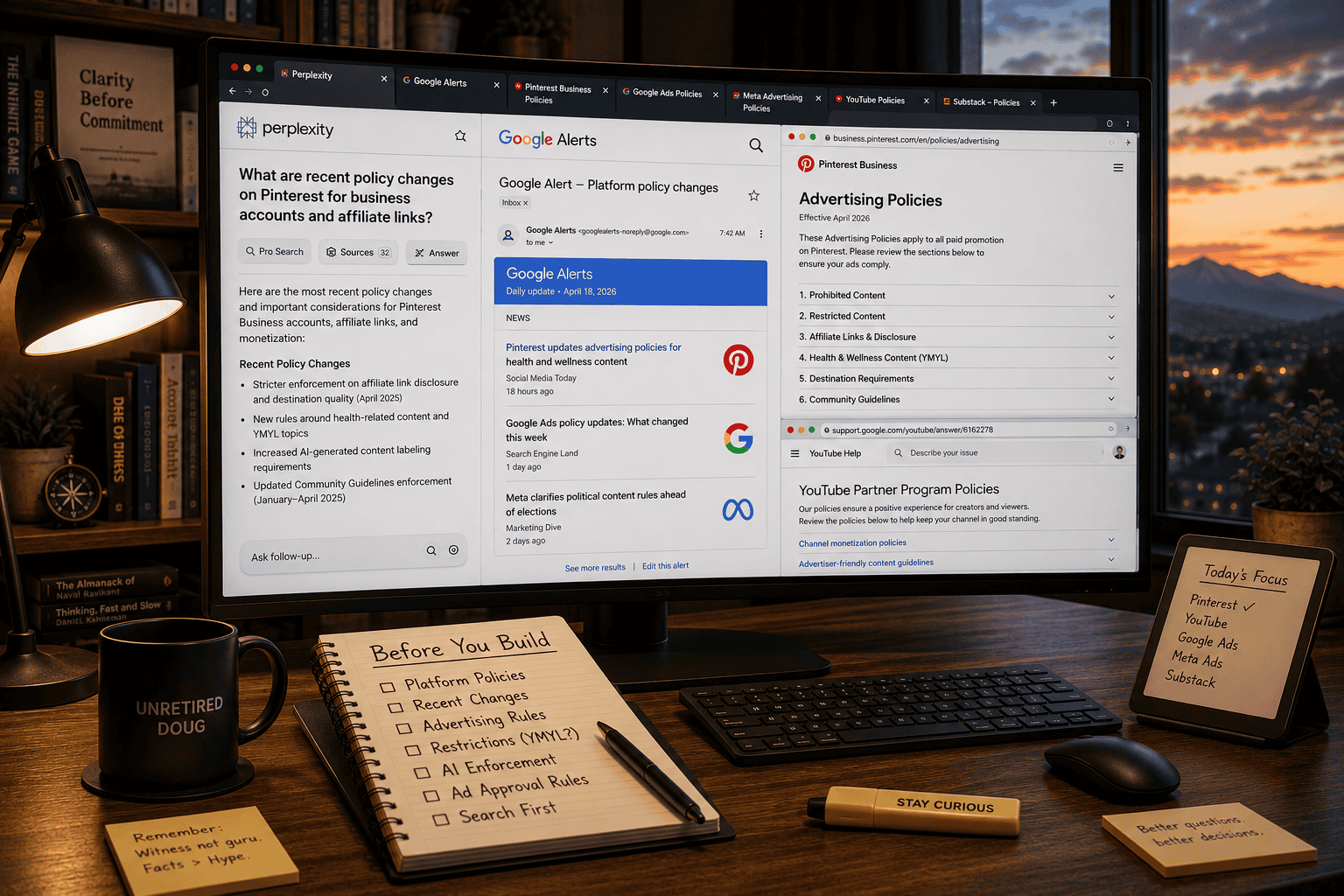
I asked Perplexity what tools exist for exactly this, since it tends to be strong at fast, cited answers to “what’s actually happening right now” questions. Here’s a rundown of what came back.
Perplexity itself turned out to be the actual fit for the moment I was in: not “watch this page forever” but “tell me what’s true about this right now, with sources I can check myself.” (See below for the prompts I’ll run each time.)
fineprint.to is a free Chrome extension that reads terms of service and privacy policies as you browse and flags what matters: arbitration clauses, data sharing, AI training rights. It’s good for “what am I agreeing to” when signing up for a vendor, ad network, or affiliate program. Not a policy-change tracker. It has free plan, a $3.99/month plan, and $9.99/month plan at the time of this writing (July 2026).
Google Alerts turned out to be the other genuinely useful, genuinely free piece. Setting up alerts for the exact policy pages that matter, using a site-scoped search like site:business.pinterest.com policy, surfaces real changes faster than a generic news alert, which mostly catches third-party commentary about a change rather than the platform’s own announcement. Good starting targets: “Pinterest advertising policy,” “Google Ads policy update,” “Meta advertising policies,” and anything affiliate-network-specific (e.g., ClickBank or ShareASale).
The process I’m actually going to run
Before committing time to a new niche, platform, or content format, I want to be asking, specifically:
What does this platform currently consider low-value or policy-violating, in this content type, this month, not whenever I last checked? Does this content category (health, finance, anything YMYL-adjacent) carry restrictions that follow it across platforms, not just on the platform I’m publishing to? Is there a specific known tripping point, like the Made-For-Kids classification on YouTube or ad-review restrictions on Pinterest, that a course or guide would have to mention if it were thorough?
I’ll use a search tool built for current information to get the lay of the land fast, then verify any cautionary notes against the platform’s actual policy page. For the handful of pages I want live tracking on, Google Alerts with site-scoped queries is free and good enough (I’m leaving out a couple enterprise-level tools that’d be more than I need and are well beyond most solopreneurs’ likely budgets).
None of this takes long. A search before I commit, an alert on the pages that matter, a quick gut-check against what a course or guide fails to say. Cheap insurance against building something I have to unwind later.
The prompts I’ll actually run
I’m running these in Perplexity specifically because it’s built to ground every answer in live web sources with citations by default, which matters when the whole point is “what does this page say today.” Claude and ChatGPT can both search the web now too, and either would work fine with these same prompts if that’s what’s already open. But checking current, sourced information is Perplexity’s actual job, not a bolt-on feature, so it’s my default for this one. One honest caveat worth knowing: even Perplexity’s citations aren’t infallible, so anything that’s actually going to change a decision still gets a click-through to the source page before I act on it.
Prompt 1 — landscape check, run for any new niche or platform
I’m considering creating [CONTENT TYPE/NICHE] content for [PLATFORM]. What does [PLATFORM]’s current content and advertising policy say about this category, as of today? Specifically: what would get this content demonetized, restricted, or removed; what’s changed in [PLATFORM]’s enforcement of this category in the last 3–6 months; and is there a known, well-documented reason creators in this niche get flagged that isn’t obvious from the policy page itself? Cite your sources.
Prompt 2 — cross-platform check, run when content touches health, finance, or other YMYL-adjacent categories
[CONTENT TYPE/NICHE] content falls into the YMYL (your money or your life) category. Which platforms currently apply extra restrictions to YMYL content for advertising, organic reach, or monetization, specifically Pinterest, Google Ads, Meta/Facebook, and [PLATFORM]? What specifically triggers a shadow ban, ad denial, or reduced distribution for this category on each? Cite your sources and note anything that’s changed recently.
Prompt 3 — course or guide honesty check, run before buying a PLR or done-for-you product
I’m evaluating a course or guide about [TOPIC/METHOD] for [PLATFORM]. Based on [PLATFORM]’s current policies, what known risks, restrictions, or trip points should a thorough, honest course on this topic mention? Does the material I’ve been shown appear to address these, or does it skip past them? (Paste in the actual sales page or table of contents if you have it.)