
Yes, but watch for these traps.
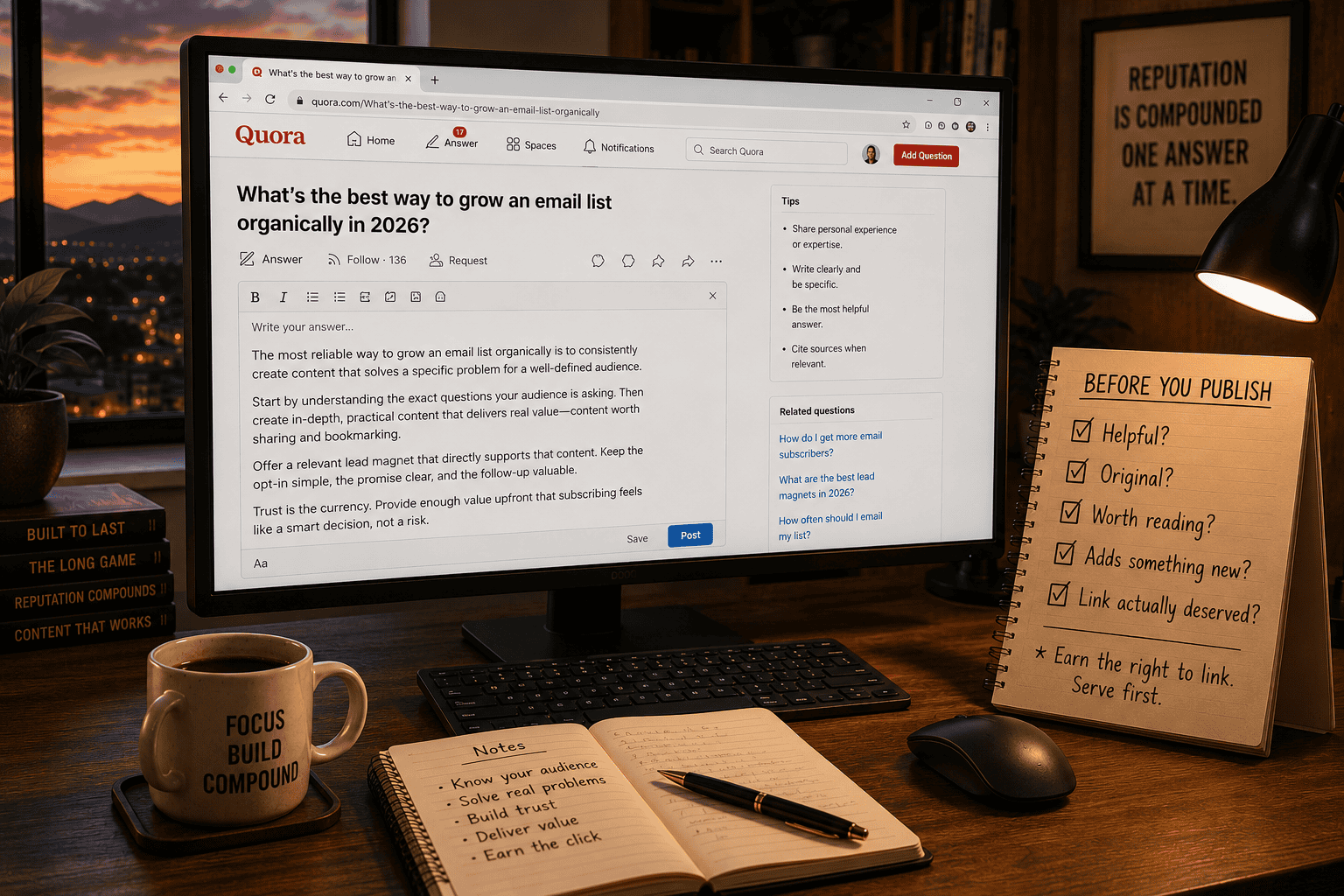
Quora is worth your time. I want to say that up front, because most of what follows is going to sound like a case against it, and it isn’t. Quora sends real traffic to people who earn it. Answers get cited by Google, sometimes by AI tools, sometimes republished elsewhere. People arrive there already asking the exact question you know how to answer. That’s rare on the internet.
It makes such good sense that it’s easy to start thinking of it as a free traffic faucet you turn on with a click. Use AI to generate answers quickly, post ’em quickly, watch the views roll in. I get why that’s appealing. I also think it could burn anyone who tries it, so here are some gotchas to keep in mind if you want to go that route (not recommended).
Trap 1: The zero-history trap
A brand-new account with no answer history, dropping a link into a discussion, doesn’t read as an expert to Quora — it reads as spam, because that’s structurally what spam looks like. It doesn’t matter how good the underlying offer is. Quora’s own platform policy defines spam largely by pattern, not intent: content whose apparent purpose is directing traffic to an outside commercial site while giving the community little of value in return. A fresh account posting bulk, link-forward content matches that pattern almost exactly, regardless of what’s actually being sold.
The fix isn’t complicated, but it isn’t instant either: answer real questions, without a link, until the account has a track record. Only then does a link read as a contribution instead of a redirect.
Trap 2: The “rapid volume” trap
Volume and visibility aren’t the same thing on Quora. The platform’s own ranking signals lean on upvotes, demonstrated expertise, and answer quality — not raw output. A batch of answers obviously made with AI and with no human judgement is the easiest pattern in the world for spam detection to catch. It’s like waving a flag, because it’s optimized for speed instead of for reading like something a specific person actually wrote in response to a specific question.
Quality guides on Quora marketing consistently land on the same principle, and it’s not rapid-fire high-quantity posting: a handful of genuinely strong answers a week beats dozens of thin ones, every time.
Trap 3: The “views = money” trap
You can get thousands of free views. But here’s the thing: views aren’t clicks. Clicks aren’t conversions. A view is someone’s eyes passing over a headline for half a second before they scroll on. If a pitch leads with view counts instead of click-through or conversion numbers, that’s usually because the view count is the only number that looks good.
Trap 4: The “no experience needed” trap
This is the one that actually matters most. Authority on Quora isn’t granted at signup — it’s built, answer by answer, over time, the same way it’s built anywhere else people are trusting you with a decision. A tool can format an answer for you. It can’t manufacture the track record that makes a stranger trust what you posted. That part still has to be earned, and it takes months, not minutes.
Trap 5: The policy-loophole trap
Quora isn’t secretly banning self-promotion — its policy actually moved the other direction years ago, away from a blanket ban and toward “self-promotion is fine if it earns its place.” That’s good news if you’re doing this for real. It’s bad news if the plan depends on gaming the system, because gaming the system shows a pattern, because the platform is specifically built to notice exactly that pattern.
So what actually works
Nothing exotic. Pick questions in a topic you either know about or you’re willing to learn as you go. Sure, get AI help to develop an answer, then ask questions and make that answer better. Inject “Youness” into it. Answer a question like you’re talking to one specific person, not broadcasting to a crowd. Skip the link for a while. Let a few answers earn upvotes and see real engagement before you ever point anyone anywhere. Expect three to six months before it feels like it’s compounding, because that’s roughly what it takes to build the kind of account history that makes a link look like a contribution instead of a redirect.
Platform strategies can take time to kick in. Quora’s a slow-burn traffic play. Do it right, and you’ll be doing the only version of this that’s still standing in six months.
Individual results depend on effort, consistency, and how well you actually know the topic you’re answering in. This isn’t a get-rich-quick platform — it’s a place where showing up honestly, repeatedly, eventually adds up.
I’ll keep exploring and reporting on commonly recommended traffic sources here on the blog.
Browse the full series →