
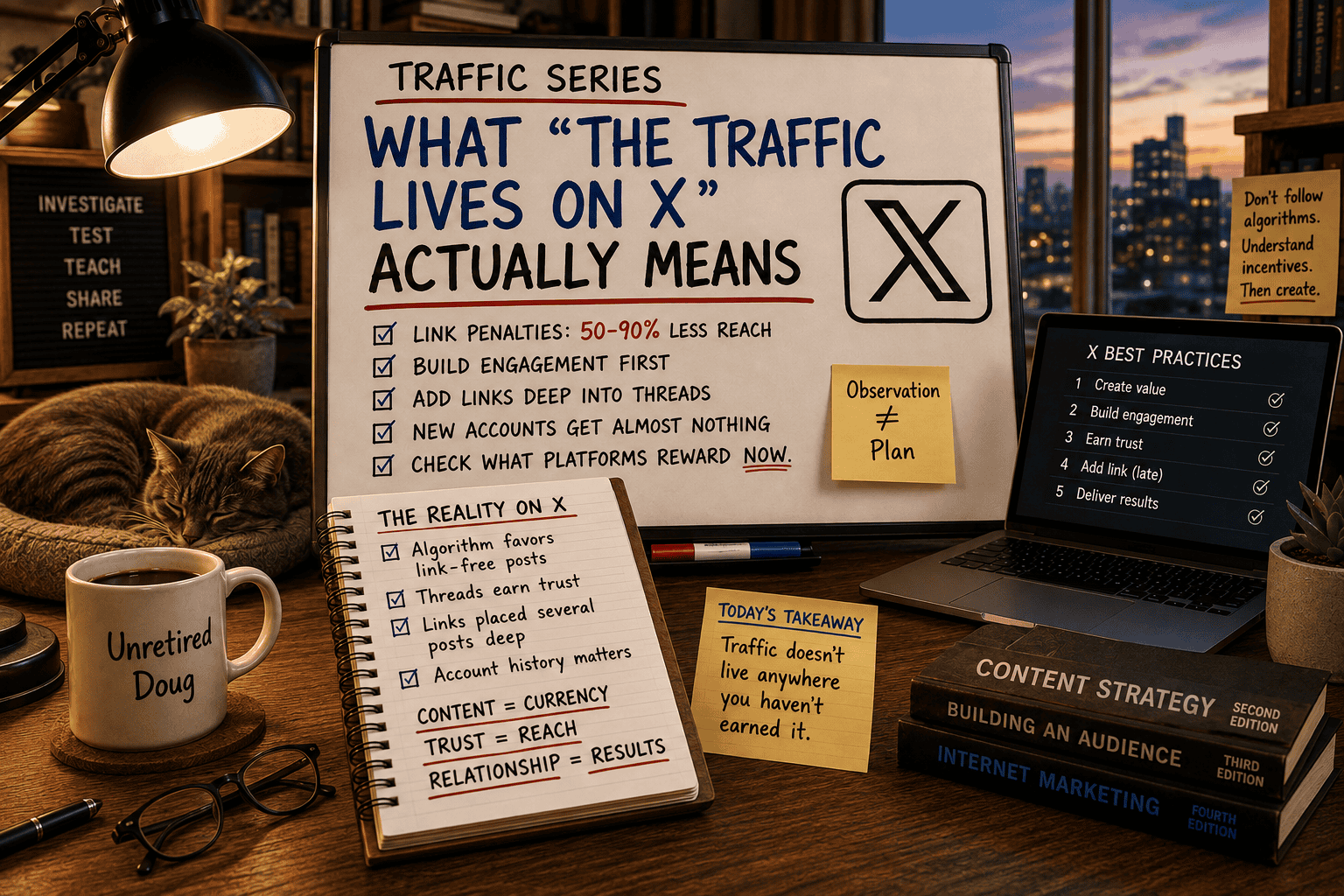
A traffic-source list in a done-for-you bundle tells you where an audience already exists. It doesn’t tell you what it currently costs to reach that audience, and on X specifically, that cost has gone up.
- X currently reduces the reach of any post carrying an outbound link, with reductions commonly cited in the 50 to 90 percent range, according to platform statements and marketer reporting through mid-2026.
- Getting a link read on X now means building an engaged account first and placing the link several posts into a thread, well after a link-free hook has already earned distribution.
- A brand-new account with no posting history gets almost nothing from being told the traffic “lives” on a platform it hasn’t built any presence on yet.
- The same caution applies to any traffic-source list in a DFY bundle. It’s worth checking what a platform rewards right now, not what it rewarded when the bundle’s sales copy was written.
I recently got an offer for a bundle of done-for-you consumer reports, 400 of them, spread across 8 niches, plus done-for-you splash pages for displaying whichever slice of the report library I chose to distribute. For the moment, I want to set aside the effort involved in building a credible presence in any particular one of those niches. What actually caught my attention was one of the recommended distribution channels: X.
I get done-for-you offers fairly often (alongside offers for rapid AI-powered content creation tools, which land us at the same starting point for this traffic discussion). This particular bundle wasn’t quite typical of what usually lands in front of me, but the traffic-source claim attached to it was familiar enough that it’s worth pulling apart on its own. I think it pays to do a little digging into what’s really required for success before treating a bullet point like a plan. This is part of a running series here on Unretired Doug where I look at the traffic sources internet marketers, including me, are routinely told to rely on, and check what actually holds up once you get past the sales page. X appears pretty commonly on such lists.
So I went looking into what’s actually true about X right now, rather than take the bullet point at face value. Here’s what that research turned up. Worth saying plainly up front: I’m not currently active on X myself, so none of what follows comes from my own posting history there. It comes from the platform’s own public statements and from current marketer reporting on how the algorithm actually behaves, which is a different kind of evidence than a personal case study, and worth reading as such.
The Traffic Sources Slide
It’s a familiar pattern once you’ve seen a few of these bundles. Each niche gets a short list of platforms where that audience supposedly hangs out. Home improvement content goes to Pinterest and YouTube. Gaming content goes to Reddit and Twitch. Dating and relationships content goes to Instagram and TikTok. Somewhere in most of these lists, X shows up too, usually attached to “threads” as the format.
As a description of where an interested audience exists, none of this is wrong. Those audiences really are on those platforms. The problem is that the slide reads as a plan rather than an observation, and the two aren’t the same thing. Knowing where fish live isn’t the same as knowing how to catch one, and a vendor writing sales copy has every incentive to leave that distinction blurry. “Traffic lives on X” fits on one line of a features list. “X will take months of consistent posting before a link earns any reach” does not sell nearly as well, even though it’s the more useful sentence.
What “The Traffic Lives on X” Leaves Out
X’s current ranking approach is built around keeping people on the platform. Posts with outbound links get meaningfully less distribution than posts without them, and that penalty has held steady through 2026 even after the platform’s own product team signaled it might ease up. For anyone hoping to post a report link and get clicks, that’s the wrong direction entirely.
The workaround that’s emerged among people who actually run affiliate content on X isn’t really a shortcut. It’s a discipline. Write several posts of real, specific, link-free value first, earn the algorithm’s trust in that thread, then place the link a few posts deep, after a reader has already decided the thread is worth their time. That’s a genuinely different skill than pasting a caption from a swipe file, and it doesn’t work at all without an account that already has some following and engagement history behind it.
The content is done for you. The audience isn’t, and on X in particular, the audience is the part that takes the longest to build.
What This Looks Like Week to Week
If you actually tried to run the “post it on X” line from one of these bundles starting from a cold account, the first few weeks would look like posting into a void. No link-free hook has an existing audience to reach yet, so early posts get modest, organic-only reach regardless of quality. There’s no shortcut around that startup period, and it isn’t measured in days.
Once an account has some real following and a habit of posting, the cadence that seems to work is something like one or two well-built threads a week, each one built around a specific, numbers-driven hook rather than a generic recommendation. That’s a sustained content-creation project in its own right. It has almost nothing in common with copying a report title into a caption box, which is what the bundle’s traffic toolkit actually hands you.
Compare that to something like a blog post or an email sequence. Write it once, and it keeps working in the background, ranking, getting shared, sitting in an archive a reader can find months later. X doesn’t offer that. Old posts don’t keep earning; the platform rewards what’s fresh and what’s currently being engaged with, so the work doesn’t compound the way an owned asset does. It has to be repeated.
Who This Actually Fits
None of this makes X a bad platform. It makes it a platform that fits a particular kind of operator and a particular kind of workload. If you genuinely enjoy the conversational, back-and-forth rhythm of the place, and you’re willing to treat it as its own ongoing project rather than a distribution channel for content built somewhere else, it can work. People do build real audiences and real affiliate income there.
It fits poorly with the premise most DFY bundles are actually selling, which is closer to “install this, post the provided captions, and start earning.” That premise assumes traffic is a switch you flip once the content exists. On X specifically, traffic is closer to a second business you’d be starting from zero, on top of whatever the bundle itself already asked of you.
What the Click Actually Lands On
There’s a second piece to this, separate from the niche-credibility question I set aside earlier. Suppose someone does the hard part right. They build a real X presence, earn a following, write a genuinely useful thread, and place a link a reader has earned the right to see. Where does that click actually go?
In the bundle that prompted this piece, the answer is a splash page: a single link showing a grid of report covers pulled from the same shared library everyone running that bundle has access to, spanning whichever niches the account owner chose to enable. A reader who followed a specific thread, on a specific claim, arrives instead at a general storefront of unrelated prefab downloads.
That’s a mismatch, and it costs more on X than it would almost anywhere else. Getting a link seen on X, as the earlier sections here lay out, requires real trust built over a real thread. Spending that trust on a destination that reads as “assortment of downloadable content someone else wrote” rather than “more from the person whose thread I just read” wastes the one thing X made expensive to earn.
I’ll call this destination fit: how well what a visitor lands on continues the specific promise that got them to click, given the level of trust that particular traffic source required to earn. It’s a different question from niche credibility, and it applies to any traffic source, not just X. A cold Pinterest pin tolerates a fairly generic landing page. A thread that took weeks of account-building to earn a read does not.
I’m currently building a tool for marketers that scores destination fit against dozens of common traffic sources. More on that soon.
Where AI-Written Text Isn’t the Sensitive Point
I’ve written elsewhere on this blog about Quora, a platform where AI-generated content is under active, automated scrutiny. Quora now runs submissions through Pangram, a dedicated AI-text classifier, and has used it to identify and remove more than a million AI-generated posts. If you’re weighing where AI-assisted writing carries risk, that’s worth knowing. It’s equally worth knowing where it currently doesn’t.
X is one of the places it doesn’t, at least for text. The platform does not prohibit AI-generated posts, and it carries no rule requiring you to disclose that a post was written with AI help. Its enforcement attention goes to behavior, not authorship: volume that reads as spam, fake personas, coordinated inauthentic networks. A well-crafted, AI-assisted thread that reads like a real person wrote it doesn’t trip any of that.
The one caveat is media, not writing. X has built labeling around AI-generated images and video, an opt-in “Made with AI” toggle backed by metadata detection that’s easy to strip in practice, plus a separate NLP classifier still specific to adult content. None of that reaches ordinary AI-assisted post text, and there’s no equivalent of Pangram scanning threads for writing style.
That’s the state of things now, not a permanent guarantee. Regulatory pressure elsewhere and X’s own early experiments with pre-share AI alerts suggest this could tighten. But for anyone weighing X against a platform like Quora as a place to build a presence, the current asymmetry is real, and it currently favors X.
A Simple Way to Check Any Traffic Claim
Before buying into a bundle’s traffic-source list, or before committing real time to one of the platforms it names, it’s worth a short check. Search for how that platform’s organic reach actually works right now, specifically for posts carrying outbound links, and read something written in the last few months rather than an older evergreen guide. Mechanics like this shift, and a traffic-source slide written a year or two ago may already be describing a platform that’s moved on.
If what you find describes a startup period measured in weeks or months before a channel becomes minimally productive, and the bundle presents that channel as instant distribution, that gap is the thing to notice. It doesn’t mean skip the channel. It means go in with a realistic understanding instead of an expectation that a caption and a click-through link are enough.
The broader habit underneath all of this is one I keep coming back to on this site: build the things you own first, and treat any platform you don’t own as its own project with its own learning curve, not a free extension of infrastructure you already built. Dig your well before you’re thirsty. A traffic-source list doesn’t dig it for you.
The Short Version
Let’s sum it up:
- A DFY bundle’s traffic-source list describes where an audience exists, not what it currently takes to reach that audience.
- On X specifically, outbound links get significantly reduced reach, and getting past that penalty requires an existing engaged following plus a deliberate posting cadence, not a copied caption.
- A new account gets little practical benefit from being told the traffic “lives” somewhere it hasn’t built any presence on yet.
- Building real reach on X is a sustained, repeatable project of its own, closer to starting a second channel than flipping on distribution for content built elsewhere.
- The same check applies to any traffic-source claim: verify current platform mechanics before treating a bullet point as a plan.
- Even a well-earned click needs somewhere worth landing. A generic prefab-content storefront wastes trust that a platform like X made expensive to earn in the first place.
- AI-assisted writing currently carries real scrutiny on some platforms, like Quora’s Pangram deployment, but not on X, where AI-generated text is neither prohibited nor required to be disclosed.
Quick Answers
Does this mean X is a bad choice for affiliate marketers?
No. It means treating it as a channel you build deliberately, on its own timeline, rather than a distribution add-on for content produced somewhere else.
Is this problem unique to X?
No. Every platform has its own current reach mechanics, and “traffic lives here” claims that skip over what it actually takes to reach that traffic show up across platforms and niches, not just on X.
How do I find out what a platform actually rewards right now?
Look for recent reporting and the platform’s own statements about organic reach, ideally from the last few months, rather than an older guide that may describe mechanics that have since changed.
What should I do instead of taking a bundle’s traffic list at face value?
Treat it as a starting hypothesis. Verify current mechanics for any platform you’re considering, and be honest with yourself about whether you’re willing to do the ongoing, non-passive work that platform actually requires.
I’ll keep working through commonly recommended traffic sources here on the blog.
Browse the full series →