
Most beginners treat this as a question about income streams. Which one pays faster? Which one is more passive? Which one is easier to start?
Those are reasonable questions. They’re just not the most important ones.
Affiliate marketing and self-publishing are genuinely different operational lives. Not different flavors of the same thing — different rhythms, different skill sets, different psychological demands. One tends to keep you busy maintaining motion. The other tends to keep you busy building something. Both require real work. Both can fail. And in the current environment, where AI tools have lowered the production barrier for both models simultaneously, the distinction between them matters more than ever — because the internet is being flooded with people who are doing the production without doing the thinking.
That’s the part worth understanding before you choose.
What Affiliate Marketing Actually Is (and Isn’t)
The pitch is straightforward: recommend products, earn commissions, collect revenue. That’s mechanically accurate.
The operational reality is something else.
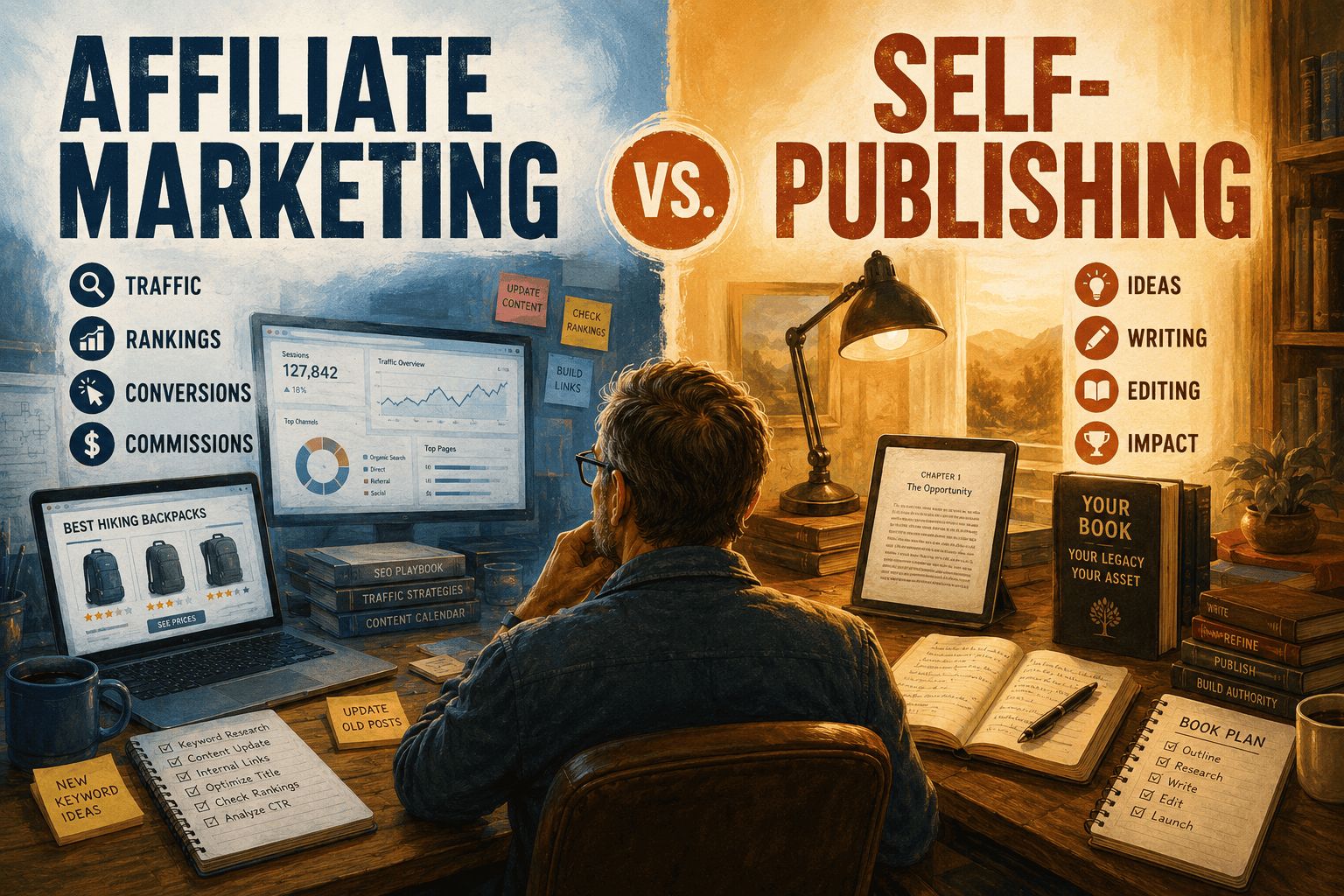
Affiliate marketing is primarily a traffic acquisition business. The product commissions are the reward. The actual work — the thing you spend most of your time doing — is building and maintaining an audience. And that work tends to look like: studying search behavior, producing content, refining headlines, checking rankings, troubleshooting visibility problems, updating old articles, and watching your traffic sources for signs of trouble.
If that sounds like something you’d enjoy, affiliate marketing might genuinely suit you. Some people find this deeply satisfying — there’s a real craft to understanding how audiences find things, what makes them click, and what makes them trust a recommendation enough to act on it. The testing cycle is relatively fast, the feedback loops are shorter than in publishing, and there’s no shortage of problems to solve.
But there’s a fragility question worth taking seriously.
Most affiliate businesses are built on traffic they don’t own — search rankings, platform algorithms, third-party programs with their own terms of service. When Google’s March 2024 core update rolled out, roughly half of the niche and affiliate sites studied lost more than 90% of their traffic in the following months. That wasn’t an outlier event. It was a reminder of something that had always been true: if your business depends on someone else’s algorithm, you’re always one policy change away from a difficult conversation with yourself.
That doesn’t mean affiliate marketing is a bad model. It means the resilience of the model depends heavily on what you build around it — an email list, a real audience relationship, content that earns trust rather than just ranking for keywords. The affiliates who survived the 2024 updates mostly had those things. The ones who didn’t, largely, were building on sand.
Convenience and fragility often live closer together than they appear from the outside.
What Self-Publishing Actually Is (and Isn’t)
Self-publishing looks slower, and often it is. There’s a longer upfront investment — researching, outlining, writing, editing, formatting, positioning. A serious nonfiction book typically requires sustained focus over weeks or months, not a weekend.
That said, things have changed. AI tools have meaningfully compressed parts of the production timeline. Research assistance, structural outlining, revision support, and formatting tools now allow a capable operator to produce useful material considerably faster than was realistic five years ago. The production ceiling has genuinely dropped.
The catch — and this is worth sitting with — is that lower barriers cut both ways. When publishing gets easier, the mere fact of having published becomes less valuable. Amazon’s KDP platform now processes over 2.6 million new titles per year. The question is no longer whether you can produce a book. The question is whether you can produce something people will recommend, return to, and trust.
That’s a harder problem than it sounds, and it’s one that AI tools don’t solve. They can help with structure and polish. They don’t supply a distinct perspective, earned authority, or the kind of useful interpretation that makes a book worth recommending six months after it came out.
Operationally, self-publishing tends to suit people who prefer project-based work over perpetual content cycles. There’s a different rhythm: long creative periods, concentrated revision phases, a launch window, and then a quieter maintenance period. Books can continue generating royalties long after the creation period ends — not automatically, and not without positioning and discoverability work, but the asset doesn’t expire the same way a search ranking can.
The ownership question is also different. A book is intellectual property you control. An affiliate business is typically a set of arrangements — with traffic sources, with affiliate programs, with platforms — that you don’t. Both models can generate real income. Only one of them leaves you with something that can’t be deindexed.
The Day-to-Day Reality of Each
This is the section most comparison articles skip, which is a shame, because it may matter more than any stat about commission rates or royalty percentages.
Every business model, over time, becomes a lifestyle pattern. Understanding what that pattern actually feels like — not in the success-story version, but in the ordinary week version — is worth more than most frameworks.
Affiliate marketing tends to look like this week after week: creating and updating content, tracking rankings and traffic trends, analyzing why something isn’t converting, adjusting headlines and structures, monitoring what competitors are doing, troubleshooting visibility problems when they appear. It’s ongoing. It doesn’t finish. There are natural rhythms — some weeks are heavier than others — but the motion never fully stops.
Some people find this energizing. If you’re someone who enjoys systems, iteration, and audience behavior, the affiliate marketing workflow can genuinely become absorbing. The feedback loops are real and relatively fast. There’s always something to test or improve.
Others find it quietly exhausting. Not because the model fails, but because the recurring operational environment grates. Six months in, they realize they don’t actually enjoy spending their weeks this way. That realization is worth trying to arrive at before the six months, not after.
Self-publishing tends to look like this: extended periods of concentrated creative work, followed by revision phases that require a different kind of attention, followed by launch preparation and positioning work, followed by quieter maintenance periods where you’re monitoring sales and reviews rather than producing at full pace. The stress concentrates differently — it’s heavier during creation and launch, lighter during maintenance.
Some people find this rhythm far preferable. The deep-work nature of it suits certain temperaments very well. Others struggle with the delayed feedback, the long stretches of uncertainty during production, and the discipline required to finish something rather than publish incrementally.
Neither model is objectively better. They create different daily lives. The question is which daily life you’d rather be living a year from now.
The Mistake Most Beginners Make
Most beginners don’t actually choose a business model. They choose emotional relief from uncertainty.
That’s understandable. The marketing around both models is relentless — automation, AI-powered publishing, done-for-you systems, passive income, push-button simplicity. Some of those tools are genuinely useful. But when every layer of your business depends on someone else’s system doing the difficult thinking, you tend to build something that looks like a business from the outside but lacks the resilience to survive contact with reality.
This is especially relevant now. The web is filling with competent but interchangeable content — structurally coherent, readable, rankable for a while, but not particularly useful and not particularly trusted. Search engines are getting better at detecting this. Readers are getting better at detecting it too. The result is that quality thresholds are rising precisely as production costs are falling, which is not the dynamic most beginners are expecting.
The long-term opportunity may not belong to the people producing the most content. It may belong to the people producing the most useful content — which is a capability problem, not a volume problem.
Acceleration is not the same thing as capability. That distinction is worth making early.
Why Combining Both Can Make Sense
Many operators eventually discover that these models reinforce each other more naturally than they compete.
A book establishes a kind of authority that content alone rarely achieves. It signals sustained commitment to a subject. It can differentiate a site from the hundreds of generic affiliate pages in its niche. It creates something to recommend — a reason for readers to trust your other recommendations.
A content platform, meanwhile, creates ongoing discoverability. Search traffic and email lists build the audience that makes a book launch viable. The recommendation infrastructure you build for affiliate content translates naturally to book promotion.
The combination also creates something valuable on a different dimension: it’s harder to replicate. A niche site can be copied in weeks. A niche site run by someone with a recognized name, a book, an email list, and a track record of useful recommendations is a much harder thing to build around. That’s the kind of infrastructure that tends to hold up when algorithms shift.
This is the approach that looks most resilient over a three-to-five year horizon for most people who are serious about building something durable, rather than just capturing a moment.
Where This Leaves You
The practical question isn’t which model sounds better. It’s which operational life you’d actually sustain.
Lean toward affiliate marketing if: you enjoy the traffic and audience-building side of things, you’re comfortable with ongoing content production, you prefer faster feedback loops over long creation cycles, and you’re prepared to diversify your traffic sources rather than depending on any single platform.
Lean toward self-publishing if: you prefer project-based deep work, you want to build intellectual property you own outright, you’d rather concentrate your effort in defined creation periods than maintain perpetual content motion, and you’re patient enough to build discoverability over time.
Consider both if: you’re building for the long term and want the kind of infrastructure that creates multiple discovery paths, genuine authority, and resilience that doesn’t depend entirely on any single algorithm or platform.
In any case, the useful question isn’t which model makes money faster. It’s what kind of work you’re willing to keep doing when it’s harder than expected — which it usually is.
A Few Questions Worth Thinking Through
How long does it realistically take to earn meaningful income from either model?
Affiliate marketing can generate some income relatively quickly, but building consistent earnings usually takes six months to two years of serious work. Self-publishing timelines vary widely — some authors earn steadily from a first book, many require a catalog of several titles before income becomes meaningful. Neither model pays out on the timeline most beginners hope for.
Does AI make self-publishing easier?
Technically, yes — research, outlining, editing, and formatting are all faster now than they were five years ago. But faster production also means more competition and higher reader expectations for genuine value. AI compresses the timeline; it doesn’t solve the positioning problem or provide the perspective that makes a book worth recommending.
Is affiliate marketing more exposed to platform risk than self-publishing?
Generally, yes, though both models carry platform dependency to some degree. Affiliate programs change commission rates — Amazon has cut its rates multiple times. Google algorithm updates have wiped out significant traffic for thousands of affiliate sites. Self-published authors depend on Amazon KDP for most of their sales distribution. Diversification helps in both cases.
Can you do both at once when you’re just starting out?
Probably not well. Both models require genuine attention to build properly, and splitting focus too early usually means doing both models inadequately. It makes more sense to develop real capability in one, then layer in the other once the foundation is stable.